Overview
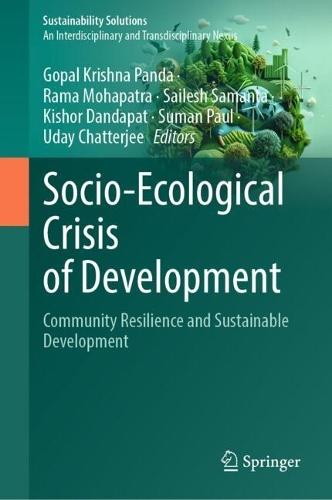
The book presents the shifting environmental trends worldwide in the name of development and offers a harmonious adjustment between development and the natural environment, addressing the intricate complexities in a comprehensive and sustainable manner. In recent times, humanity finds itself in a race against time to tackle the severe environmental crisis we face. Climate change, which is largely attributed to human activity, poses a significant challenge to social, political, and economic systems worldwide. As governments and scientists in the field acknowledge, it is the most pressing environmental threat of the 21st century. The earth's average temperature has risen by approximately 0.60C over the past century due to human activity, and greenhouse gas emissions are likely to cause a temperature increase of between 1.4 and 5.80C this century, depending on the efforts made to address climate change. Environmental problems manifest in various ways in both developed and developing countries, with some issues affecting regions globally while each country also grapples with unique developmental and environmental challenges. Furthermore, regional and local concerns demand immediate attention. The transfer of technology from developed countries to Third World countries has raised environmental concerns, as inadequate management has led to environmental degradation. Although human ingenuity and scientific progress have contributed to advancements in agriculture, irrigation, mining, industries, transportation, forestry, and land management, these pursuits have often disrupted the natural environment. As awareness of the adverse effects of developmental activities grows, people are actively seeking ways to mitigate these effects by adopting methods and technologies that promote sustainable development.
Full Product Details
Author: Gopal Krishna Panda ,
Rama Mohapatra ,
Sailesh Samanta ,
Kishor Dandapat
Publisher: Springer Nature Switzerland AG
Imprint: Springer Nature Switzerland AG
ISBN: 9783032221704
ISBN 10: 3032221706
Pages: 457
Publication Date: 22 May 2026
Audience:
Professional and scholarly
,
College/higher education
,
Professional & Vocational
,
Postgraduate, Research & Scholarly
Format: Hardback
Publisher's Status: Forthcoming
Availability: Not yet available

This item is yet to be released. You can pre-order this item and we will dispatch it to you upon its release.
Author Information
Prof. Gopal Krishna Panda is a physical geographer, presently working as Emeritus Professor in the Post Graduate Dept. of Geography, School of Tribal Resource management at KISS (Kalinga Institute of Social Science) Deemed University, Bhubaneswar and former Prof and Head of the Dept. of Geography of Utkal University, Bhubaneswar. He has been awarded the Emeritus Fellowship of UGC in the year 2016 and honoured with the Senior Fellowship of ICSSR, New Delhi in 2019. During his tenure of service in the Dept. of Geography at Utkal University, he has served in different capacities as Professor and Head, Chairman of the Post Graduate Council, Member of the Syndicate, Senate and Chief Executive of the Population Research Centre of Utkal University. Prof. Rama Mohapatra is an expert in applications of GISc (Geographic Information Science), remote sensing technologies, econometrics, and machine learning to model geographical data. Overall, he has more than 25 years of teaching and research experience in the field of GISc. This is his 14th year at Minnesota State University, Mankato. His primary role at Minnesota State University involves teaching numerous GISc classes, serving as thesis adviser, guiding students on their internships, and supervising graduate and undergraduate student research projects. Dr. Sailesh Samanta is working as an Associate Professor and Section Head of the GIS section under the School of Surveying and Land Studies at The Papua New Guinea University of Technology, Papua New Guinea. He is also coordinating the undergraduate distance program in Geomatics at this university. His maiden PhD was on Climatological modeling of Temperature and Rainfall through GIS Techniques. Dr. Kishor Dandapat is a teaching faculty of the Department of Geography at Seva Bharati Mahavidyalaya, Jhargram, under Vidyasagar University, Midnapore, West Bengal. He had a master’s degree in Geography from Pt. Ravi Shankar Shukla University, Raipur and a Ph.D. from Utkal University, Bhubaneswar. His area of interest is in Geography, mostly focuses on human ecology, environmental issues, natural hazards and disaster management, and fluvial geomorphology. Dr. Dandapat published a book from international publishers 'Flood Hazards Management: A Community Approach'. Notion Press, Chennai, India’. Prof Suman Paul was born in Kolkata, West Bengal, India on July 31st, 1978. He received his B. Sc. and M. Sc. degrees from University of Calcutta, Calcutta, India in 2000 and 2002 respectively. He was associated as an Assistant Professor at Post Graduate Department of Geography with more than 9 years of experience at Krishnagar Govt. College and Acharya B. N. Seal Govt. College. Presently he is the HOD and Professor of Geography Dept., Sidho-Kanho-Birsha University, Purulia, West Bengal, India. He achieved National Scholarship and stood 1st position (1st Class FIRST) at Under Graduate level from Calcutta University. His areas of specialization are urban geography, environmental hazards & disaster analysis, GIS and remote sensing. Dr. Uday Chatterjee is an Assistant Professor at the Department of Geography, Bhatter College, Dantan (Autonomous), Paschim Medinipur, West Bengal, India and Applied Geographer with a Doctoral Degree in Applied Geography at Ravenshaw University, Cuttack, Odisha, India. His areas of research interest cover Urban Planning, Social and Human geography, Applied Geomorphology, Hazards & Disasters, Environmental Issues. Currently, Dr. Uday Chatterjee has completed the Special Issue (S.I) of Urbanism, Smart Cities and Modelling, Geojournal, Springer as a Lead Editor.