Overview
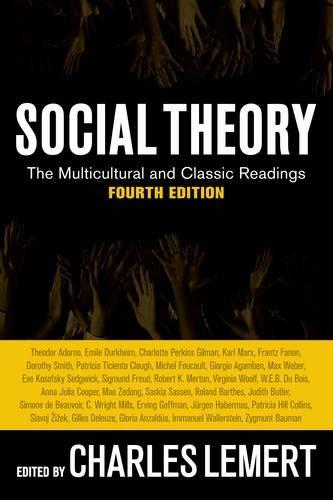
This bestselling reader takes us beyond classic social theory by encompassing a truly inspiring range of readings that have significantly contributed to our current understanding of social theory. This first truly multicultural anthology collects important, readable texts representative of the full range of social theory from the nineteenth century to the present. Now that social theory is practiced in many disciplines, it is necessary to reflect on the variety of theories being read today and the earlier sources that are customarily neglected. If today we read Donna Haraway, Henry Louis Gates, and Michel Foucault, we should also read and understand Charlotte Perkins Gilman and W.E.B. Du Bois, alongside Weber, Simmel, William James, and others from the end of the nineteenth century. This book, therefore, sets a wider gauge for the understanding of the history of social thought than could have been possible before. It brings together theories in unexpected and exciting ways: those of Parsons and Dorothy Smith, Merton and Lacan, Wallerstein and Frantz Fanon, James Coleman and Molefi Asante. Extensive introductory essays by the editor situate the readings in their historical place and time, identifying the currents of social change that shaped fundamental questions of modern and postmodern life. This fourth edition has been thoroughly revised and updated to include cutting-edge documents on teletechnologies, masculinities, rhizomes, bare life, and more.
Full Product Details
Author: Charles Lemert
Publisher: Taylor & Francis Inc
Imprint: Westview Press Inc
Edition: 4th New edition
Dimensions:
Width: 15.20cm
, Height: 3.80cm
, Length: 22.90cm
Weight: 0.816kg
ISBN: 9780813343921
ISBN 10: 0813343925
Pages: 712
Publication Date: 01 July 2009
Audience:
College/higher education
,
Undergraduate
,
Postgraduate, Research & Scholarly
Format: Paperback
Publisher's Status: Out of Print
Availability: In Print 
Limited stock is available. It will be ordered for you and shipped pending supplier's limited stock.
Table of Contents
"* Social Theory: Its Uses and Pleasures Modernity's Classical Age, 1848-1919 * Estranged Labour; Camera Obscura, Karl Marx * Class Struggle, K. Marx and Friedrich Engels * The Eighteenth Brumaire of Louis Bonaparte; On Imperialism in India; The Values of Commodities; The Fetishism of Commodities; Labour-Power and Capital, K. Marx * The Patriarchal Family, F. Engels * Anomie and the Modern Division of Labor; Sociology and Social Facts; Suicide and Modernity, Emile Durkheim * Primitive Classifications and Social Knowledge, E. Durkheim and Marcel Mauss * The Cultural Logic of Collective Representations, E. Durkheim * The Spirit of Capitalism and the Iron Cage; The Bureaucratic Machine; What Is Politics?; The Types of Legitimate Domination; Class, Status, Party, Max Weber * The Psychical Apparatus and the Theory of Instincts; Dream-Work and Interpretation; Oedipus, the Child; Remembering, Repeating, and Working-Through; The Return of the Repressed in Social Life; Civilization and the Individual, Sigmund Freud * Arbitrary Social Values and the Linguistic Sign, Ferdinand de Saussure * The Self and Its Selves, William James * Double-Consciousness and the Veil; The Spirit of Modern Europe, W.E.B. Du Bois * The Yellow Wallpaper; Women and Economics, Charlotte Perkins Gilman * The Colored Woman's Office, Anna Julia Cooper * The Stranger, Georg Simmel * The Looking-Glass Self, Charles Horton Cooley Social Theories And World Conflict, 1919-1945, * The Psychology of Modern Society; The New Liberalism, John Maynard Keynes * The Irrational Chasm Between Subject and Object, Georg Lukcs * Notes on Science and the Crisis, Max Horkheimer * The Unit Act of Action Systems, Talcott Parsons * What Is to Be Done?, V. I. Lenin * The Sociology of Knowledge and Ideology, Karl Mannheim * Psychoanalysis and Sociology, Erich Fromm * The Self, the I, and the Me, George Herbert Mead * Social Structure and Anomie, Robert K. Merton * Moral Man and Immoral Society, Reinhold Niebuhr * The Negro Problem as a Moral Issue, Gunnar Myrdal * Disorganization of the Polish Immigrant, William I. Thomas and Florian Znaniecki * Personality and Status Within the Gang, Frederic M. Thrasher * Art, War, and Fascism, Walter Benjamin * A Room of One's Own, Virginia Woolf * Intellectuals and Hegemony (1929-1936), Antonio Gramsci * Nonviolent Force: A Spiritual Dilemma, Mohandas Karamchand Gandhi * Identity, Struggle, Contradiction, Mao Tse-tung * The Japanese and the Americans, Ruth Benedict The Golden Moment, 1945-1963, * On the United States and Containment of the Soviets, George Kennan * The End of Ideology in the West, Daniel Bell * Modernization: Stages of Growth, W. W. Rostow * Action Systems and Social Systems; Sex Roles in the American Kinship System, Talcott Parsons * Manifest and Latent Functions, R. K. Merton * The Structural Study of Myth, Claude Lvi-Strauss * Semiological Prospects, Roland Barthes * Why Theory?, Louis Althusser * Character and Society: The Other-directed Personality, David Riesman * Youth and American Identity, Erik H. Erikson * On Face-Work, Erving Goffman * The Eccentric Self and the Discourse of the Other, Jacques Lacan * Woman as Other, Simone de Beauvoir * Between Colonizer and Colonized, Aim Csaire * The Power of Nonviolent Action, Martin Luther King Jr * The Sociological Imagination, C. Wright Mills * Participatory Democracy (from The Port Huron Statement), Students for a Democratic Society * The Problem That Has No Name, Betty Friedan * Decolonializing, National Culture, and the Negro Intellectual, Frantz Fanon Will The Center Hold? 1963-1979, * Change and the Planning System, John Kenneth Galbraith * Emancipatory Knowledge; Social Analysis and Communicative Competence, Jurgen Habermas * Society as a Human Product, Peter Berger and Thomas Luckmann * Knowing a Society from Within: A Woman's Standpoint, Dorothy Smith * The Modern World-System, Immanuel Wallerstein * The State as a Janus-faced Structure, Theda Skocpol * The Moynihan Report: Rethinking Family, Christopher Lasch * Gender Personality and the Reproduction of Mothering, Nancy Chodorow * The Decentering Event in Social Thought, Jacques Derrida * Discourse on the West, Michel Foucault * Black Power and Stokely, C.L.R. James * Toward a Reflexive Sociology, Alvin W. Gouldner * Repressive Desublimation, Herbert Marcuse * Reflexive Properties of Practical Sociology, Harold Garfinkel * Structures, Habitus, * Practices, Pierre Bourdieu * The Master's Tools Will Never Dismantle the Master's House, Audre Lorde After Modernity, Since 1979, * Whither Postmodernism?, Andreas Huyssen * The Postmodern Condition, Jean-Franois Lyotard * Private Irony and Liberal Hope, Richard Rorty * Power as Knowledge, M. Foucault * Simulacra and Simulations: Disneyland, Jean Baudrillard * Post-Modernity or Radicalized Modernity?, Anthony Giddens * Cultural Studies and the New Left, Stuart Hall * Radical Democracy: Alternative for a New Left, Ernesto LaClau and Chantal Mouffe * Foucault on Power: A Theory for Women?, Nancy Hartsock * The Afrocentric Idea, Molefi Kete Asante * Postpositivist Case for the Classics, Jeffrey Alexander * The New Social Structure and the New Social Science, James S. Coleman * E Pluribus Unum?, Arthur M. Schlesinger Jr * The New Cultural Politics of Difference, Cornel West * ""Race"" as a Trope of the World, Henry Louis Gates Jr * The Cyborg Manifesto and Fractured Identities, Donna Haraway * Infinite Layers/Third World?, Trinh T. Minh-ha * Can the Subaltern Speak?, Gayatri Chakravorty Spivak * Black Feminist Thought in the Matrix of Domination, Patricia Hill Collins * The New Mestiza, Gloria Anzalda * Sexual Identification Is a Strange Thing, Jeffrey Weeks * Imitation and Gender Insubordination, Judith Butler * Who Is Your Mother? Red Roots of White Feminism, Paula Gunn Allen * The End of the Modern Era, Vaclav Havel * Rethinking the Globalizing World, Charles Lemert * Future Social Science and the Invisible Elbow, Charles Tilly * The Information Age, Bill Gates * The Global Network, Manuel Castells * The City in a Globalizing World, David Harvey * The Global, the Local, and the Return of Ethnicity, Stuart Hall * The Post-Work Manifesto, Stanley Aronowitz, Dawn Esposito, William DiFazio, and Margaret Yard * What To Do When Work Disappears, William Julius Wilson * Cultural Criticism and Telecommunications, Patricia Clough * The Post-Modern Family, Judith Stacey * Working Women in the Time Bind, Arlie Hochschild * The Productivity of the Closet, Stephen Seidman * The Courage to Stand Alone, Wei Jingsheng * Reach Toward the Ineffable, Toni Morrison"
Reviews
Charles Lemert captures the surfacing of multiple theoretical voices in the postmodern era. No theory course should be without Social Theory . <br> --Steve Seidman, State University of New York at Albany
Charles Lemert captures the surfacing of multiple theoretical voices in the postmodern era. No theory course should be without Social Theory . --Steve Seidman, State University of New York at Albany
""Lemert provides an illuminating introduction to the collection and introductions to each section that provide an overview of the socio-historical context and delineation of key thinkers and texts in each period. Combining important classical and contemporary material, Lemert's collection enables the student and reader to trace out the origins of the modern world to our present global and conflicted condition."" --Douglas Kellner, University of California, Los Angeles ""This collections presents a provocative wide-angle view of the history of social theory, including very recent work which interestingly engages with a future only dimly coming into focus. Well-chosen selections from the new social movements as well as the classics and recent mainstream make this a fine introduction for courses in the social sciences. The collection also offers students and scholars in other fields a valuable overview of the ideas and assumptions that have shaped thought in the humanities, jurisprudence, and public policy more generally."" --Sandra Harding, UCLA, Co-Editor of Signs: Journal of Women in Culture and Society ""Lemert gives shape to a sociological imagination for the twenty-first century. This is necessary reading for us all."" --Patricia Clough, Queens College and CUNY Graduate Center """"Social Theory"" is an essential guide through the complex contours of multicultural ideology and theory from the nineteenth century to the present. Lemert brings together a surprising range of multicultural voices and perspectives into a powerful and provocative introductory text. Social Theory clearly illustrates how critical ideas have the power to transform societies."" --Manning Marable, Columbia University ""A rich, highly textured, historically sweeping, and strikingly inclusive collection that aims to reconstruct, perhaps for the first time, the actual dialogue of contemporary social thought."" --Jeffrey Alexander, Yale University ""Charles Lemert captures the surfacing of multiple theoretical voices in the postmodern era. No theory course should be without ""Social Theory""."" --Steve Seidman, State University of New York at Albany ""Lemert gives shape to a sociological imagination for the twenty-first century. This is necessary reading for us all."" --Patricia Clough, Queens College and CUNY Graduate Center ""This collections presents a provocative wide-angle view of the history of social theory, including very recent work which interestingly engages with a future only dimly coming into focus. Well-chosen selections from the new social movements as well as the classics and recent mainstream make this a fine introduction for courses in the social sciences. The collection also offers students and scholars in other fields a valuable overview of the ideas and assumptions that have shaped thought in the humanities, jurisprudence, and public policy more generally."" --Sandra Harding, UCLA, Co-Editor of ""Signs: Journal of Women in Culture and Society"" ""With an equally sure grasp of the classics of the past and the probable classics of the future, Charles Lemert has assembled a remarkable array of stimulating readings in social theory. The result is a well-stocked tool kit for the canon wars of the twenty-first century."" --Martin Jay, University of California, Berkeley
Author Information
Charles Lemert is professor of sociology at Wesleyan University and the author of numerous classic books including Sociology After the Crisis and Social Things.
Tab Content 6
Author Website:
Countries Available
All regions
|