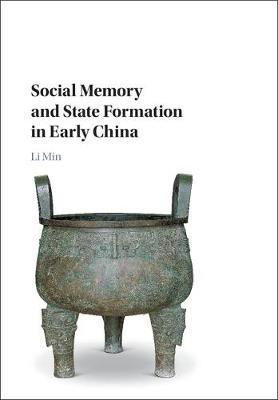
Full Product Details
Author: Min Li (University of California, Los Angeles)
Publisher: Cambridge University Press
Imprint: Cambridge University Press
Dimensions:
Width: 18.50cm
, Height: 3.30cm
, Length: 26.20cm
Weight: 1.400kg
ISBN: 9781107141452
ISBN 10: 1107141451
Pages: 588
Publication Date: 24 May 2018
Audience:
Professional and scholarly
,
Professional & Vocational
Format: Hardback
Publisher's Status: Active
Availability: Manufactured on demand

We will order this item for you from a manufactured on demand supplier.
Reviews
Advance praise: 'This book opens a new window to the study of ancient Chinese history. The topic of this book is unique. It does not follow any traditional interpretations in Chinese archaeology, but a combination of processual and post-processual archaeological approaches with new integration of ancient textual records. It addresses a set of questions relating to the origins of Chinese civilization and the rise of dynastic states. These questions have been the central concerns in scholarly discourse, and long been intensively debated. This book takes a new angle to tackle some of the issues, using the latest archaeological findings, anthropological theories, traditional textural information, and analogy with other civilizations in other parts of the world.' Liu Li, Stanford University Advance praise: 'In part, the argument boils down to what the nature of the 'Xia' dynasty that sites at the fount of the 'Three Dynasties' that define the origins of Chinese civilization, and how the received historical narrative about the Xia developed. He presented this narrative as a palimpsest that involved the accretion of influences from different eras and places. In contrast to arguments that attribute most of the significant components of the Xia narrative to the late first millennium, he argues that certain aspects of the notion of an origin must have a considerably earlier provenance, in particular connecting to two different aspects of the late third and early second millennium BC, both of which can be explored archaeologically.' Rowan Flad, Harvard University Advance praise: 'This book provides a long-awaited archaeological perspective on the genealogy of knowledge in spatial, temporal, technological, and formal representations involved in the Wen Ding narrative as a historical palimpsest. It is an especially challenging one that few scholars would take on. The approach is uniquely creative resulting in intriguing interpretations about historical and archaeological data from the late Neolithic to the Zhou periods. It is a cutting edge and, in many ways, bold and innovative study that will quickly take its place as a seminal contribution, not only for the history, archaeology, and anthropology of China, but much more broadly in both the social sciences and in the humanities.' John Papadopoulos, University of California, Los Angeles Advance praise: 'Taking as his leitmotif the cultural evolution of the tripod from humble cooking vessel to preeminent symbol of kingship, Professor Li skillfully extracts from a vast accumulation of archaeological data the material evidence required to magisterially narrate the emergence of China's early civilizations. Professor Li elevated the level of discourse significantly by taking a sophisticated social archaeological approach to the question of the 'Xia'. Professor Li convincingly shows how, far from being a late fiction, the 'Xia' corresponded to a culturally constructed constellation of political concepts, institutions, and 'social memories of different episodes of state building from the Longshan and Erlitou periods'. It was this composite of elements, notionally the 'Xia', which constituted the conceptual framework that co-evolved with the archaic kingship during the Zhou Dynasty. This is a perspective that could only emerge from a thorough mastery of the social, resource, and landscape archaeology of the period, informed by a sound theoretical approach to the material.' David W. Pankenier, Lehigh University, Pennsylvania Advance praise: 'Professor Li's monograph is a direct and canny intervention in the central debate in the archaeology of pre-imperial China, that is, the debate over the relationship between canonical literary-historical accounts of early polities and archaeological evidence for the extent and nature of these polities. The brilliance of Professor Li's approach is that it situates the emergence of accounts of the past (including those literary-historical accounts) in a richly detailed presentation of cultural exchange, urban development and decline, and population movement in the millennia before the emergence of writing ... the book will be greeted as a major achievement, both for its confident control of the sources and for its rigorous theoretical approach to the problem of cultural memory-formation.' David Schaberg, University of California, Los Angeles
Author Information
Li Min, an archaeologist of early China, is Associate Professor of East Asian Archaeology at the University of California, Los Angeles.