|
|
|||
|
||||
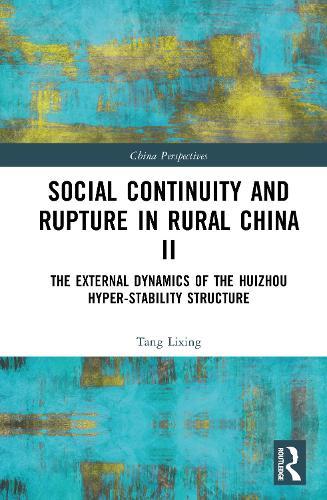
OverviewAs the second volume of a two-volume set that examines the distinctive social structure and governance of Huizhou, China, this book focuses on the external factors that influence and renew social functioning. From the sixteenth century to the first half of the twentieth century, Huizhou, a historic region in what is now Anhui Province in China, was characterized by longterm social stability and prosperity. Even during times of war and unrest, Huizhou was able to quickly restore order. This two-volume study explores the reasons for this stability and its relevance and implications for contemporary society. In this second volume, the author examines a group of ‘outsiders’ to Huizhou society, who conducted business outside the region while maintaining their hometown and linking their social networks from both urban and rural Huizhou. The book discusses how local tradition and rural governance were sustained through wars and social unrest. It also illustrates how a new, modernized order was re-established after the devastation of war and communist reform in the twentieth century. The title will appeal to scholars and students of Chinese history, the social and economic history of modern China, and readers interested in China’s transition to modernity. Full Product DetailsAuthor: Tang Lixing (Professor, College of Humanities and Communications, Shanghai Normal University, China)Publisher: Taylor & Francis Ltd Imprint: Routledge Weight: 0.720kg ISBN: 9781032950150ISBN 10: 1032950153 Pages: 294 Publication Date: 21 March 2025 Audience: Professional and scholarly , College/higher education , Professional & Vocational , Postgraduate, Research & Scholarly Format: Hardback Publisher's Status: Active Availability: In Print This item will be ordered in for you from one of our suppliers. Upon receipt, we will promptly dispatch it out to you. For in store availability, please contact us. Table of Contents1. The External Dynamics of Village Autonomy 2. The Memory and Reconstruction of Clans after the Collapse of the Internal Cycle 3. The Struggles of Village Autonomy after the Collapse of the External Cycle 4. The Breaking of the Internal and External Cycles and the Demise of Village Autonomy 5. ConclusionReviewsAuthor InformationTang Lixing is a distinguished professor at China Academy of Art and a professor of history at Shanghai Normal University, China. He is a pioneering scholar of Anhui Studies in China. His research expertise includes late imperial and modern Chinese history, Chinese social history, and cultural history. His recent publications with Routledge also include Merchants and Society in Modern China: Rise of Merchant Groups (2018). Tab Content 6Author Website:Countries AvailableAll regions |
||||