|
Overview
Full Product Details
Author: Will Barratt , Will Barrett
Publisher: Taylor & Francis Inc
Imprint: Stylus Publishing
Weight: 0.630kg
ISBN: 9781579225711
ISBN 10: 1579225713
Pages: 254
Publication Date: 23 February 2011
Audience:
College/higher education
,
Tertiary & Higher Education
Format: Hardback
Publisher's Status: Active
Availability: In Print 
This item will be ordered in for you from one of our suppliers. Upon receipt, we will promptly dispatch it out to you. For in store availability, please contact us.
Table of Contents
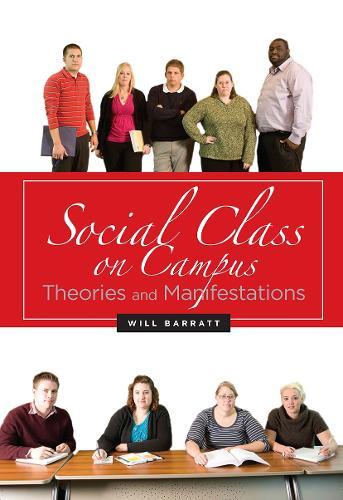
Acknowledgements About the author Part I. UNDERSTANDING SOCIAL CLASS 1. A Starting Point Class is more than money; Class is personal; Class is an intercultural experience; Class is individual perception; Class as a tool; A word about precision Class as identity; Class as income and wealth; Class as capital; Class as education; Class as prestige; Class as occupation; Class as culture; Class as a system; Class as privilege and oppression; Class as role; Social Class on Campus; Campus majority social class; Class Is More than Money; A Tale of Five Students. Whitney Page, Louise, Misty, Ursula, And Eleanor; Class bubbles; The cast of characters. Whitney Page; The cast of characters - Louise; The cast of characters - Misty; The cast of characters - Ursula; The cast of characters - Eleanor; What will likely happen to these women?; Money, culture, and social class of origin; Social class contrast and fit on campus; Social Class Experience; Reflection Questions; Discussion Questions 2. Your Experience and Social Class The Privilege Meme; Where You Start Matters; Starting with boundaries; Starting with individuals; Starting with groups; Starting with politics; Starting somewhere; Where I Start; Historical views of class; Plato and class; Christianity and class; China and class; Hindu class; Native Americans and class4; Mark and Engels on class; Class and Anti-Class; Key Words and Secret Language; In conclusion; Experience; Write a personal classnography; Reflection questions; Discussion questions 3. Class Myths “Class doesn’t exist in the USA.”; “We are all middle class anyway.”; “The working class is disappearing.”; “Once you get a degree you are no longer working class.”; “Education is the key to upward mobility.”; “College is open to anyone who wants to work hard.” ; “You can’t separate class from ethnicity” ; “All white people are the same.” ; “People talk about class because they don’t want to confront ethnicity and gender”; “Everyone knows about class”; “The world is a meritocracy”; Myth and reality; Experience; Reflection Questions; Discussion Questions 4. The Social Class Identity Social Class Identity. Development; Social Class Identity. Maturity; Social Class Identity. Transition; Our Three Social Class Identities; Social Class Contrast; Social Class Transition; Managing multiple social class identities; Alternation; Integration; Assimilation; Accommodation; Support for Social Class Transition; Class Passing; Class as Role; Summary; Experience; Reflection Questions; Discussion Questions 5. The Majority Class Student Experience of Class on Campus Choosing how we name classes; Misty Goes to College; So What?; Ursula Goes to College; So What?; Eleanor’s Story; So What?; Marking class on campus; The reproduction of class; College as a confirmation experience. The world of accommodation; Campus Class Markers. Fashion; Campus Class Markers. Language; Campus Class Markers. Social Interaction; Campus Class Markers. Organizational Structure; Campus Class Markers. Leadership; Campus Class Markers. Learning Experiences; Campus Class Markers. The Physical Campus; Class Passing; The monoculture campus; The dangers of being the majority; Experience; Reflection Questions; Discussion Questions 6. The Minority Class Student Experience of Class on Campus The lower class experience on campus; College as a conversion experience. The world of assimilation; Whitney Page’s Story; So What; Louise’s Story; So What; Deficit model of class. Rising up the under class; Class and minority status as stress; College as an evangelical experience; Summary; Experience; Reflection Questions; Discussion Questions 7. The Campus Ecology of Class The Campus Social Class Human Aggregate; Gender and ethnicity; The average; The Campus Social Class Physical Environment; The meaning of objects; The Campus Social Class Organizational Environment; The Campus Social Class Constructed Environment; Summary; Experience; Reflection Questions; Discussion Questions Part II. MANIFESTATIONS OF SOCIAL CLASS 8. Class as Income and Wealth A case study; Classic views of class groups based on income; Naming income classes; Income as more than income; So what?; Class as wealth; Us and Them. The Middle Income Class and the Other Income Classes; The media fiction wealthy; So what?; Experience; Reflection Question; Discussion Question 9. Class as Capital Bourdieu on Capital; Embodied cultural capital; Objectified cultural capital; Institutionalized cultural capital; Bourdieu on Social Capital; Other kinds of capital; Academic Capital; Leadership Capital; Spiritual, Moral, Values, and Ethical Capital; Language Capital; So What - Implications for Campus; Summary; Experience; Reflection Questions; Discussion Questions 10. Class as Education Social Class and the Campus; The Individual Effects of Education; Summary; Experience; Reflection Questions; Discussion Questions 11. Class as Prestige A Prestige Experience; Your prestige class; Cost and prestige; Ranking and Prestige; Keeping up with the “others”; Prestige and class; Prestige and College; Competition; Prestige in Perspective; Experience; Reflection Questions; Discussion Questions 12. Class as Occupation Income and Occupational Prestige; Occupational Prestige and Social Dominance; Occupations and class summary; Experience; Reflection Questions; Discussion Questions 13. Class as Culture Subcultures and Education; Etiquette; Class, culture, and language; Class, culture, and food; Class, culture, and fashion; Cultures in Competition; Student Cultures, Student Typologies; Faculty Cultures, Faculty Typologies; The Reproduction of Culture; Class, Culture, Privilege, and Oppression; Summary; Experience; Reflection Questions; Discussion Questions 14. Class, Ethnicity, and Gender. More complexity Class and gender; Class and ethnicity; Class, gender, and ethnicity; Experience; Reflection Questions; Discussion Questions 15. Stories Zach’s Story; Khou’s Story; Christina’s Story; Ken’s Story; Abe’s Story; Discussion Questions 16. What Can Anyone Do? Things you can do about class; Things you can encourage others on your campus do about class References Index
Reviews
Barratt's research is unique, providing his audience with an opportunity to obtain a broader sense of how social class influences their personal lives. --Indiana State University Newsroom (04/01/2011) Offers a pedagogical perspective on how class mediates social relations in higher education. --The Chronicle of Higher Education (03/25/2011) Author Will Barratt successfully breaks class down in a way that allows the reader to observe it through a variety of lenses (education, capital, prestige, etc.) and helps us to understand it in terms beyond just level of income... the information is also organized in a way that allows the reader to single out specific chapters. Questions designed for discussion and reflection are also placed at the close of each chapter. These features make it useful as both a college text and as a challenge to professionals to think more critically. This design gives it a multi-functionality that many texts do not have. -- (08/01/2011)
Author Will Barratt successfully breaks class down in a way that allows the reader to observe it through a variety of lenses (education, capital, prestige, etc.) and helps us to understand it in terms beyond just level of income... the information is also organized in a way that allows the reader to single out specific chapters. Questions designed for discussion and reflection are also placed at the close of each chapter. These features make it useful as both a college text and as a challenge to professionals to think more critically. This design gives it a multi-functionality that many texts do not have.-- NACADA Journal (National Academic Advising Association) (8/1/2011 12:00:00 AM) Barratt's research is unique, providing his audience with an opportunity to obtain a broader sense of how social class influences their personal lives.-- Indiana State University Newsroom (4/1/2011 12:00:00 AM) Offers a pedagogical perspective on how class mediates social relations in higher education.-- The Chronicle of Higher Education (3/25/2011 12:00:00 AM)
Author Information
Will Barratt has taught in the Departments of Counseling and Educational Leadership at Indiana State University over the past 20 years. He was the Holmstedt Distinguished Professor in the Bayh College of Education in 2006-2007 and was given the Caleb Mills Distinguished Teaching Award in 2008. During 1998-1999 he was Associate Dean of the College of Graduate and Professional Studies before returning to the classroom. He received degrees from Beloit College, Miami University, and The University of Iowa. He lived in Budapest in 1987-1988 and in Beijing in 1995-1996.
Tab Content 6
Author Website:
Countries Available
All regions
|