Overview
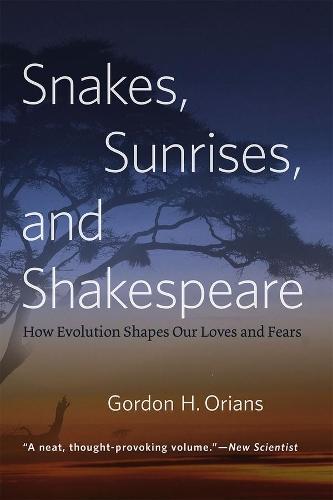
Our breath catches and we jump in fear at the sight of a snake. We pause and marvel at the sublime beauty of a sunrise. These reactions are no accident; in fact, many of our human responses to nature are steeped in our deep evolutionary past-we fear snakes because of the danger of venom or constriction, and we welcome the assurances of the sunrise as the predatory dangers of the dark night disappear. Many of our aesthetic preferences-from the kinds of gardens we build to the foods we enjoy and the entertainment we seek-are the lingering result of natural selection. In this ambitious and unusual work, evolutionary biologist Gordon H. Orians explores the role of evolution in human responses to the environment, beginning with why we have emotions and ending with evolutionary approaches to aesthetics. Orians reveals how our emotional lives today are shaped by decisions our ancestors made centuries ago on African savannas as they selected places to live, sought food and safety, and socialized in small hunter-gatherer groups. During this time our likes and dislikes became wired in our brains, as the appropriate responses to the environment meant the difference between survival or death. His rich analysis explains why we mimic the tropical savannas of our ancestors in our parks and gardens, why we are simultaneously attracted to danger and approach it cautiously, and how paying close attention to nature's sounds has resulted in us being an unusually musical species. We also learn why we have developed discriminating palates for wine, and why we have strong reactions to some odors, and why we enjoy classifying almost everything. By applying biological perspectives ranging from Darwin to current neuroscience to analyses of our aesthetic preferences for landscapes, sounds, smells, plants, and animals, Snakes, Sunrises, and Shakespeare transforms how we view our experience of the natural world and how we relate to each other.
Full Product Details
Author: Gordon H. Orians
Publisher: The University of Chicago Press
Imprint: University of Chicago Press
Dimensions:
Width: 1.60cm
, Height: 0.10cm
, Length: 2.30cm
Weight: 0.340kg
ISBN: 9780226271828
ISBN 10: 022627182
Pages: 232
Publication Date: 27 April 2015
Audience:
General/trade
,
General
Format: Paperback
Publisher's Status: Active
Availability: Manufactured on demand

We will order this item for you from a manufactured on demand supplier.
Reviews
""No scholar better understands the intimate linkage between evolutionary biology and the human condition, and none has expressed it in a more interesting and well-illustrated manner than Orians."" (E. O. Wilson, Harvard University) ""A neat, thought-provoking volume."" (New Scientist) ""Orians argues that our emotional responses to aesthetics in nature are hardwired and an evolutionary legacy of our animal origins. Here, he explores the relationship between our 'ghosts of environments past' and our view of the world."" (Times Higher Education)
No scholar better understands the intimate linkage between evolutionary biology and the human condition, and none has expressed it in a more interesting and well-illustrated manner than Orians. (E. O. Wilson, Harvard University) A neat, thought-provoking volume. (New Scientist) Orians argues that our emotional responses to aesthetics in nature are hardwired and an evolutionary legacy of our animal origins. Here, he explores the relationship between our 'ghosts of environments past' and our view of the world. (Times Higher Education)
One of the most interesting and surprising ideas I have ever come across is that what biologists call 'habitat selection' is the same as what artists and landscape architects call 'environmental aesthetics.' The human eye for beauty is not an inexplicable preference for arbitrary shapes and colors but may be explained as an instinct for choosing surroundings that are safe, healthful, and informative. The eminent zoologist Gordon Orians, who originated this powerful idea, now treats us to a cornucopia of hypotheses on why certain things please the eye, ear, and tongue and others terrify, repel, or disgust them. This is a lovely contribution to our understanding of aesthetics and should keep scientists, artists, and humanities scholars debating its ideas for years to come. --Steven Pinker, author of The Better Angels of Our Nature
Author Information
Gordon H. Orians lives in Seattle, where he is professor emeritus of biology at the University of Washington. He is the author or editor of several books, including, most recently, Red-Winged Blackbirds: Decision-Making and Reproductive Success and Life: The Science of Biology.