Overview
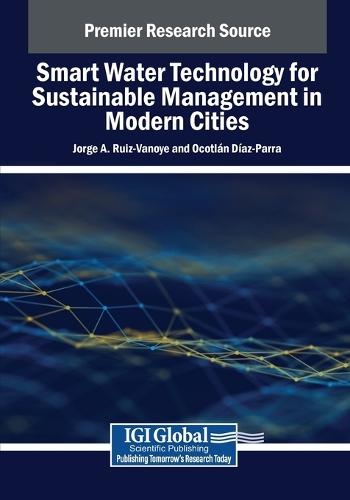
With growing populations and the pressures of climate change, cities face significant challenges in maintaining sustainable water systems. Smart water technologies, including sensors, data analytics, and automated systems, enable real-time monitoring and efficient management of water resources, reducing waste and improving infrastructure. These innovations help improve water quality and availability while supporting efforts to minimize environmental impact and improve urban sustainability. As cities expand, the adoption of smart water technology is crucial for a reliable, sustainable, and equitable water supply. Smart Water Technology for Sustainable Management in Modern Cities examines the convergence of artificial intelligence (AI) and smart water technologies in the context of smart cities. It explores how AI is transforming water management to address challenges such as efficiency, sustainability, climate change resilience and optimizing water use in urban environments. This book covers topics such as wastewater treatment, precision agriculture, and smart cities, and is a useful resource for environmental scientists, urban developers, engineers, computer scientists, academicians, and researchers.
Full Product Details
Author: Jorge A. Ruiz-Vanoye ,
Ocotlán Díaz-Parra
Publisher: IGI Global
Imprint: Engineering Science Reference
ISBN: 9798369380758
Pages: 456
Publication Date: 18 February 2025
Audience:
College/higher education
,
Professional and scholarly
,
Tertiary & Higher Education
,
Professional & Vocational
Format: Paperback
Publisher's Status: Active
Availability: In Print

This item will be ordered in for you from one of our suppliers. Upon receipt, we will promptly dispatch it out to you. For in store availability, please contact us.
Author Information
Jorge Ruiz-Vanoye is a Professor and Researcher at Universidad Politécnica de Pachuca (UPP), a National Researcher under the CONAHCYT program, and an Adjunct Researcher at the National Laboratory of Autonomous Vehicles and Exoskeletons (LANAVEX). Additionally, he holds the title of Lecturer-level Researcher for the Agency for the Quality of the University System of Catalonia (Generalitat de Catalunya). His research interests include Smart Cities, Smart Water, Smart Education, Smart Government, Smart Healthcare, Smart Farming, Smart Energy, Smart Sports, Smart Food, Smart Tourism, Algorithmic Finance, Algorithmic Portfolio Management, Applications and Theory of Algorithms, Bio-inspired Algorithms, Combinatorial Optimization Problems, Compilers, Computational Intelligence, Computational Complexity Theory, Computational Financial Intelligence, Complexity of Algorithms, Complexity of Instances, Computational Statistics, Computer Networks, Computer Science Security, Cybercrimes, Data Mining, Education, Evolutionary Computation, Heuristic Optimization Techniques in Bioinformatics, Hybrid Evolutionary Algorithms, Hybrid Optimization Algorithms, Machine Learning, Meta-heuristics, Operations Research, Operations Management, Parallel & Distributed Computing, Production Planning and Logistics Optimization, Project Scheduling Problems, Software Engineering, and Transgenic Algorithms. Octlan Diaz-Parra is a Professor and Researcher at Universidad Politécnica de Pachuca (UPP), a National Researcher under the CONAHCYT program, and an Adjunct Researcher at the National Laboratory of Autonomous Vehicles and Exoskeletons (LANAVEX). His research interests include Smart Cities, Smart Water, Smart Education, Smart Government, Smart Healthcare, Smart Farming, Smart Energy, Smart Sports, Smart Food, Smart Tourism, Algorithmic Finance, Algorithmic Portfolio Management, Applications and Theory of Algorithms, Bio-inspired Algorithms, Combinatorial Optimization Problems, Compilers, Computational Intelligence, Computational Complexity Theory, Computational Financial Intelligence, Complexity of Algorithms, Complexity of Instances, Computational Statistics, Computer Networks, Computer Science Security, Cybercrimes, Data Mining, Education, Evolutionary Computation, Heuristic Optimization Techniques in Bioinformatics, Hybrid Evolutionary Algorithms, Hybrid Optimization Algorithms, Machine Learning, Meta-heuristics, Operations Research, Operations Management, Parallel & Distributed Computing, Production Planning and Logistics Optimization, Project Scheduling Problems, Software Engineering, and Transgenic Algorithms.