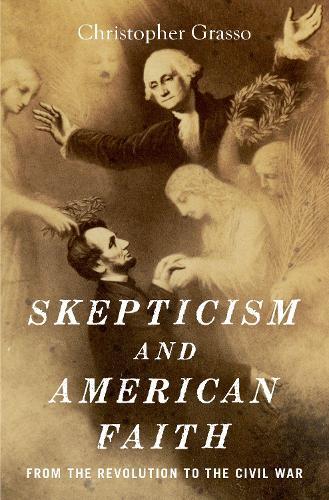
Full Product Details
Author: Christopher Grasso (Professor of History, Professor of History, College of William and Mary)
Publisher: Oxford University Press Inc
Imprint: Oxford University Press Inc
Dimensions:
Width: 23.90cm
, Height: 4.10cm
, Length: 16.00cm
Weight: 1.043kg
ISBN: 9780190494377
ISBN 10: 0190494379
Pages: 664
Publication Date: 19 July 2018
Audience:
General/trade
,
General
Format: Hardback
Publisher's Status: Active
Availability: To order

Stock availability from the supplier is unknown. We will order it for you and ship this item to you once it is received by us.
Reviews
Christopher Grasso has pursued what other historians have considered by-ways in order to show that deism, skepticism, and religious doubt were anything but marginal in the formative decades of the United States. Deep research, intelligent organization, and persuasive argumentation make this book one of the very best in the recent outpouring of outstanding studies explaining 'religious America' between the founding and the Civil War. --Mark A. Noll, author of America's God: From Jonathan Edwards to Abraham Lincoln Questioning the overworked distinction between the religious and the secular, Grasso explores the dense entanglements of skepticism and faith that shaped so much of American religious and political life. Even as evangelicalism waxed strong in the new nation, freethinking suspicions could not be banished and kept eating away (often from within) at the particularities of the Christian gospel. The very subtlety of Grasso's story raises considerable doubt about any trust we yet place in such grand narrative devices as secularization and Christianization. --Leigh Eric Schmidt, Washington University in St. Louis Americans have often assumed that the United States was founded on faith. But in this landmark history, Christopher Grasso argues that doubt was far more prevalent than many observers have cared to admit. Drawing on a vast array of sources, Grasso reveals that a lively dialogue between faith and skepticism characterized the entire period from the Revolution to the Civil War not only at the public level but also in the personal lives of individuals both famous and obscure. Anyone who has ever wondered about the status of (ir)religion in American society will need to wrestle with this remarkable book. --Peter J. Thuesen, author of Predestination: The American Career of a Contentious Doctrine A magisterial study of the entangled threads of faith and skepticism that have run so prominently through America's history. In Grasso's deft reading, faith and disbelief in nineteenth-century America were not opposite poles of experience but a spiritual and psychological continuum along which many people traveled. The cast of characters is epic and in tracking the personal journeys of men and women into and out of faith, Grasso recreates a vibrant world of skeptics, scoffers, and the simply indifferent who for too long have lived in the scholarly shadow of their more famous evangelical counterparts. --Susan Juster, author of Sacred Violence in Early America
Christopher Grasso has pursued what other historians have considered by-ways in order to show that deism, skepticism, and religious doubt were anything but marginal in the formative decades of the United States. Deep research, intelligent organization, and persuasive argumentation make this book one of the very best in the recent outpouring of outstanding studies explaining 'religious America' between the founding and the Civil War. --Mark A. Noll, author of America's God: From Jonathan Edwards to Abraham Lincoln Questioning the overworked distinction between the religious and the secular, Grasso explores the dense entanglements of skepticism and faith that shaped so much of American religious and political life. Even as evangelicalism waxed strong in the new nation, freethinking suspicions could not be banished and kept eating away (often from within) at the particularities of the Christian gospel. The very subtlety of Grasso's story raises considerable doubt about any trust we yet place in such grand narrative devices as secularization and Christianization. --Leigh Eric Schmidt, Washington University in St. Louis Americans have often assumed that the United States was founded on faith. But in this landmark history, Christopher Grasso argues that doubt was far more prevalent than many observers have cared to admit. Drawing on a vast array of sources, Grasso reveals that a lively dialogue between faith and skepticism characterized the entire period from the Revolution to the Civil War not only at the public level but also in the personal lives of individuals both famous and obscure. Anyone who has ever wondered about the status of (ir)religion in American society will need to wrestle with this remarkable book. --Peter J. Thuesen, author of Predestination: The American Career of a Contentious Doctrine A magisterial study of the entangled threads of faith and skepticism that have run so prominently through America's history. In Grasso's deft reading, faith and disbelief in nineteenth-century America were not opposite poles of experience but a spiritual and psychological continuum along which many people traveled. The cast of characters is epic and in tracking the personal journeys of men and women into and out of faith, Grasso recreates a vibrant world of skeptics, scoffers, and the simply indifferent who for too long have lived in the scholarly shadow of their more famous evangelical counterparts. --Susan Juster, author of Sacred Violence in Early America
In Skepticism and American Faith: From the Revolution to the Civil War, historian Christopher Grasso contends that a persistent dialogue between skepticism and Christianity indelibly shaped the antebellum United States. With an eye for colorful characters-mechanics, preachers, housewives, reformers, slaveholders, soldiers, and many more-Grasso makes his case in admirable if sometimes excruciating detail. Readers will learn of Methodist preachers whose private doubts mushroomed into publicly scandalous unbelief, of self-proclaimed infidels lurching into Christian faith, of competing churches that painted each other as engines of infidelity, of pro-slavery clergymen who linked infidelity and abolitionism to form the dominant (white) Christianity of the South, and of abolitionist preachers who shaped US nationalism by warning against the national sins of slavery and unbelief. * Reading Religion *
Christopher Grasso has pursued what other historians have considered by-ways in order to show that deism, skepticism, and religious doubt were anything but marginal in the formative decades of the United States. Deep research, intelligent organization, and persuasive argumentation make this book one of the very best in the recent outpouring of outstanding studies explaining 'religious America' between the founding and the Civil War. --Mark A. Noll, author of America's God: From Jonathan Edwards to Abraham Lincoln Questioning the overworked distinction between the religious and the secular, Grasso explores the dense entanglements of skepticism and faith that shaped so much of American religious and political life. Even as evangelicalism waxed strong in the new nation, freethinking suspicions could not be banished and kept eating away (often from within) at the particularities of the Christian gospel. The very subtlety of Grasso's story raises considerable doubt about any trust we yet place in such grand narrative devices as secularization and Christianization. --Leigh Eric Schmidt, Washington University in St. Louis Americans have often assumed that the United States was founded on faith. But in this landmark history, Christopher Grasso argues that doubt was far more prevalent than many observers have cared to admit. Drawing on a vast array of sources, Grasso reveals that a lively dialogue between faith and skepticism characterized the entire period from the Revolution to the Civil War not only at the public level but also in the personal lives of individuals both famous and obscure. Anyone who has ever wondered about the status of (ir)religion in American society will need to wrestle with this remarkable book. --Peter J. Thuesen, author of Predestination: The American Career of a Contentious Doctrine A magisterial study of the entangled threads of faith and skepticism that have run so prominently through America's history. In Grasso's deft reading, faith and disbelief in nineteenth-century America were not opposite poles of experience but a spiritual and psychological continuum along which many people traveled. The cast of characters is epic and in tracking the personal journeys of men and women into and out of faith, Grasso recreates a vibrant world of skeptics, scoffers, and the simply indifferent who for too long have lived in the scholarly shadow of their more famous evangelical counterparts. --Susan Juster, author of Sacred Violence in Early America Revealing...Grasso's book demonstrates the centrality of skepticism in understanding how the American inclination to faith has been 'forged in the foundry of culture.' --Publishers Weekly
Author Information
Christopher Grasso is professor of history at the College of William and Mary and was the editor of the William and Mary Quarterly. He is the author of A Speaking Aristocracy: Transforming Public Discourse in Eighteenth-Century Connecticut and the editor of Bloody Engagements: John R. Kelso's Civil War.