Overview
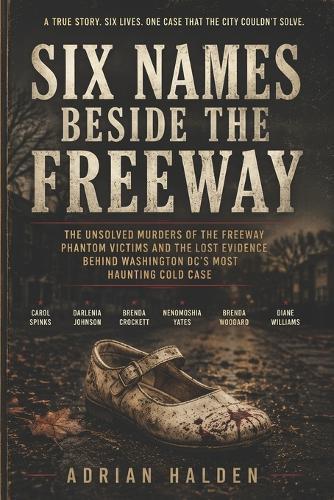
A victim-centered true crime investigation into one of Washington DC's most haunting unsolved cases. Six Names Beside the Freeway examines the Freeway Phantom murders with discipline, restraint, and a clear refusal to let the killer's nickname eclipse the lives at the center of the case. Between 1971 and 1972, Carol Denise Spinks, Darlenia Denise Johnson, Brenda Faye Crockett, Nenomoshia Yates, Brenda Denise Woodard, and Diane Denise Williams were abducted and killed in and around Washington, D.C. Their names became linked to a roadside pattern, an expanding serial murder investigation, and a Washington DC cold case that remains unresolved. This unsolved true crime book follows the case from the first disappearance through the later inquiries that tried to rescue truth from damaged records, fragile forensic evidence, conflicting suspect theories, and lost evidence. Rather than forcing a tidy answer, it studies what the public record can support: ordinary routines interrupted, bodies found near major roads, recurring investigative markers, a troubling handwritten note, calls made before one victim was found, and the painful limits of evidence that could connect the crimes more clearly than it could identify the killer. The book also places the Freeway Phantom murders inside the city that shaped them. Washington in the early 1970s was a majority-Black city under strain, marked by uneven trust in institutions, jurisdictional complexity, and questions families continued to ask: Would these girls have received a different urgency if they had been white, wealthier, or from different neighborhoods? How did race, policing, public fear, and media language influence what was remembered-and what was allowed to fade? As a 1970s serial murder case, this is not only a story about violence. It is a study of a cold case investigation that never became a trial, a true crime investigative history shaped by incomplete files, forensic limitations, and theories that could not become proof. The manuscript examines the Green Vega theory, Robert Askins, the unidentified local offender theory, and the wider suspect trap without converting suspicion into certainty. It asks what evidence can prove, what it cannot, and what justice loses when records disappear. The moral center is not the phantom. It is the six names. This is victim-centered true crime for readers who want careful analysis instead of sensational certainty. It honors the known facts, identifies uncertainty where the record is thin, and follows the deeper questions left behind by an abduction murder investigation that crossed roads, neighborhoods, and jurisdictions. The case did not end with an arrest, a verdict, or a name. Enter the record, follow the evidence, and remember the six names.
Full Product Details
Author: Adrian Halden
Publisher: Independently Published
Imprint: Independently Published
Dimensions:
Width: 15.20cm
, Height: 1.50cm
, Length: 22.90cm
Weight: 0.381kg
ISBN: 9798198411012
Pages: 282
Publication Date: 24 May 2026
Audience:
General/trade
,
General
Format: Paperback
Publisher's Status: Active
Availability: Available To Order

We have confirmation that this item is in stock with the supplier. It will be ordered in for you and dispatched immediately.