Overview
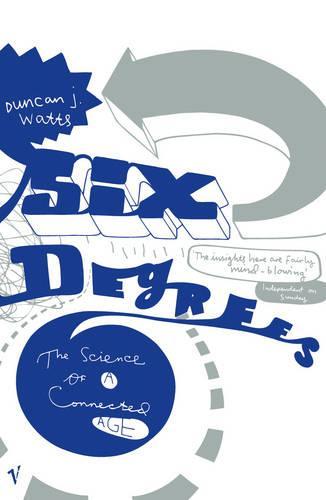
A truly eye-opening and comprehensive study of the power and influence of networks; a thrilling tale of interconnectedness. 'Six degrees of separation' is a cliche, as is 'it's a small world', both cliches of the language and cliches of everyday experience. But it's also an intriguing idea with a long history and some surprising implications. We all live in tightly bonded social networks, yet linked to vast numbers of people more closely than we sometimes think. Scientists have begun to apply insights from the theoretical study of networks to understand forms as superficially different as social networks and electrical networks, computer networks and economic networks, and to show how common principles underlie them all. Duncan J. Watts explores the science of networks and its implications, ranging from the Dutch tulipmania of the seventeenth century, the success of Harry Potter, the impact of September 11th on Manhattan, to the structure of the world wide web.
Full Product Details
Author: Duncan Watts
Publisher: Vintage Publishing
Imprint: Vintage
Edition: New edition
Dimensions:
Width: 12.90cm
, Height: 2.30cm
, Length: 19.80cm
Weight: 0.255kg
ISBN: 9780099444961
ISBN 10: 0099444968
Pages: 368
Publication Date: 06 May 2004
Recommended Age: From 0 years
Audience:
Professional and scholarly
,
College/higher education
,
General/trade
,
Professional & Vocational
,
Tertiary & Higher Education
Format: Paperback
Publisher's Status: Active
Availability: Manufactured on demand

We will order this item for you from a manufactured on demand supplier.
Reviews
Six degrees of separation' is a cliche, as is 'it's a small world', both cliches of the language and cliches of everyday experience. But it's also an intriguing idea with a long history and some surprising implications. We all live in tightly bonded social networks, yet linked to vast numbers of people more closely than we sometimes think. Scientists have begun to apply insights from the theoretical study of networks to understand forms as superficially different as social networks and electrical networks, computer networks and economic networks, and to show how common principles underlie them all. Duncan J. Watts explores the science of networks and its implications, ranging from the Dutch tulipmania of the seventeenth century, the success of Harry Potter, the impact of September 11th on Manhattan, to the structure of the world wide web.
""The insights here are fairly mind-blowing"" Independent ""Accessible and engaging"" Nature ""A fascinating read"" Good Book Guide ""Watts looks at the new science of connectivity studies in a new and informative way...he takes us on a fascinating tour of a newly emerging subject"" Focus ""Watt's theory is exciting for various reasons, but particularly because it brings together ideas from mathematics, physics and the social science. Oh, and popular culture, of course"" Independent on Sunday
The insights here are fairly mind-blowing Independent Accessible and engaging Nature A fascinating read Good Book Guide Watts looks at the new science of connectivity studies in a new and informative way...he takes us on a fascinating tour of a newly emerging subject Focus Watt's theory is exciting for various reasons, but particularly because it brings together ideas from mathematics, physics and the social science. Oh, and popular culture, of course Independent on Sunday
Author Information
An Australian, born in Canada, Duncan Watts currently teaches Sociology at Columbia University in New York. He is the author of Small Worlds- The Dynamics of Networks Between Order and Randomness (Princeton University Press; 1999).