Overview
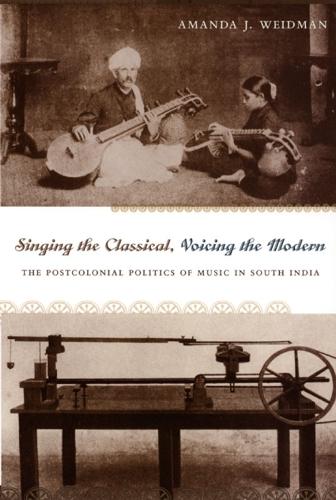
While Karnatic music, a form of Indian music based on the melodic and rhythmic principles of raga and tala, is known today as South India's classical music, its status as ""classical"" is an early twentieth-century construct, one that emerged in the crucible of colonial modernity, nationalist ideology, and South Indian regional politics. As Amanda Weidman demonstrates, in order for Karnatic music to be considered classical, it needed to be modeled on Western classical music, with its system of notation, composers, compositions, conservatories, and concerts, but also to remain distinctively Indian. Weidman argues that these contradictory desires led to the emergence of a particular ""politics of voice,"" in which the voice came to stand for authenticity and Indianness.Combining ethnographic observation derived from her experience as a student and performer of South Indian music and close readings of archival materials, Weidman traces the emergence of this politics of voice through compelling analyses of the relationship between vocal sound and instrumental imitation, conventions of performance and staging, the status of women as performers, debates about language and music, and the relationship between oral tradition and technologies of printing and sound reproduction. In this sustained exploration of the way ""voice"" is elaborated as a trope of modern subjectivity, national identity, and cultural authenticity, Weidman provides a model for thinking about the voice in anthropological and historical terms. At the same time, she makes a crucial contribution to the study of modernity, showing that modernity is characterized as much by particular ideas about orality, aurality, and the voice as it is by regimes of visuality.
Full Product Details
Author: Amanda J. Weidman
Publisher: Duke University Press
Imprint: Duke University Press
Dimensions:
Width: 15.20cm
, Height: 2.20cm
, Length: 23.50cm
Weight: 0.490kg
ISBN: 9780822336204
ISBN 10: 0822336200
Pages: 368
Publication Date: 18 July 2006
Audience:
Professional and scholarly
,
Professional & Vocational
Format: Paperback
Publisher's Status: Active
Availability: In Print

This item will be ordered in for you from one of our suppliers. Upon receipt, we will promptly dispatch it out to you. For in store availability, please contact us.
Reviews
"""Singing the Classical, Voicing the Modern is a brilliant critique of the emergence of Karnatic music as a 'classical' art during the nineteenth and early twentieth centuries. Situating her account within modernist and colonialist discourses of the authentic subject, Amanda J. Weidman explores a broad range of sources, from little-known early-twentieth-century Indian texts (in Tamil, Sanskrit, and Telugu) to contemporary studies in anthropology and musicology to feminist and media theory.""--Katherine Bergeron, author of Decadent Enchantments: The Revival of Gregorian Chant at Solesmes ""Amanda J. Weidman brilliantly turns the tables on ideologies of voice in challenging us to envision music as constituting technologies for producing voices. Ethnomusicology, anthropology, postcolonial studies, and critical histories of technology all take a step forward as a genealogy of Indian 'classical' music engenders new insights into colonialism, nationalism, gender, traditionality, and modernity.""--Charles L. Briggs, Professor of Anthropology, University of California, Berkeley"
Singing the Classical, Voicing the Modern is a brilliant critique of the emergence of Karnatic music as a 'classical' art during the nineteenth and early twentieth centuries. Situating her account within modernist and colonialist discourses of the authentic subject, Amanda J. Weidman explores a broad range of sources, from little-known early-twentieth-century Indian texts (in Tamil, Sanskrit, and Telugu) to contemporary studies in anthropology and musicology to feminist and media theory. --Katherine Bergeron, author of Decadent Enchantments: The Revival of Gregorian Chant at Solesmes Amanda J. Weidman brilliantly turns the tables on ideologies of voice in challenging us to envision music as constituting technologies for producing voices. Ethnomusicology, anthropology, postcolonial studies, and critical histories of technology all take a step forward as a genealogy of Indian 'classical' music engenders new insights into colonialism, nationalism, gender, traditionality, and modernity. --Charles L. Briggs, Professor of Anthropology, University of California, Berkeley
Singing the Classical, Voicing the Modern ranks as one of the most important contributions to South Asian music studies in recent years. -- Rolf Groesbeck, Ethnomusicology Brilliant and essential are two words that are best avoided in any review, and though I made every effort to resist, I cannot properly conclude without invoking them. I have hardly scratched the surface of this well-supported, provocative, multifaceted text. Weidman's book deserves multiple close readings and further discussion by anyone interested in the processes and politics involved in the cultural construction of aesthetics. Those who have specific interest in Indian Classical music, Karnatic music, or the postcolonial negotiation will be well rewarded by this brilliant and essential read. -- Joshua S. Levin, American Anthropologist In this fascinating study Amanda J. Weidman brings postcolonial theory to bear upon music, a field of endeavour largely neglected by postcolonial scholarship in general... [T]his book is well-written and cogently argued, and it should be suitable for use in graduate classrooms. It should also be of particular interest to anyone interested in postcolonial theory, modernity, performance and Indian music more generally. -- Joshua Tucker, Social Anthropology This work will be indispensable to anyone interested in South Indian musical culture and wishing to go beyond encyclopedia articles. -- B. Nettl, Choice Through analysis of music theory treatises, advertisements and other media, and drawing from contemporary feminist theory, linguistic anthropology, and musicology, Weidman pieces together an erudite study of the political and historical roots of one of India's cherished musical traditions. Her theoretical framework deserves special attention; it engages productively with historical detail in order to conceptualize the role of music in producing modes of South Indian subjectivity and modernity... What makes this book exemplary is Weidman's painstaking historiography, her postcolonial stance, and her commitment to putting Karnatic music in its social context. -- Chloe Coventry, Pacific Review of Ethnomusicology Weidman should be commended for her thoroughly interdisciplinary effort in undertaking such a complex and problematic task, for understanding the importance of performance and history, and for taking account of modern technology in writing that history. The book opens the way for area specialists, anthropologists, and music scholars alike to produce work that takes seriously the place of music in debates about modernity, especially in colonial contexts. -- Sindhumathi Revuluri, Journal of Asian Studies Weidman's is one of the best books I've read about a contemporary musical tradition. -- Ian Bedford, The Australian Journal of Anthropology Weidman's narrative traverses the various modes of ethnography beginning from her own experience as a student of Carnatic classical music, ... These various strands are sutured into a perceptive narrative which has the multiple facets of being partly a social history of Carnatic music, partly a theoretical exposition of the politics of voice as well as an eminently readable account of the interaction of cultural and aesthetic forms with larger political structures... [W]e must make mention, enviously, of Weidman's writing which is crisp and simple and yet capable of carrying complex ideas within a sparse and measured prose. -- Ashwin Kumar, Economic and Political Weekly Singing the Classical, Voicing the Modern is a brilliant critique of the emergence of Karnatic music as a 'classical' art during the nineteenth and early twentieth centuries. Situating her account within modernist and colonialist discourses of the authentic subject, Amanda J. Weidman explores a broad range of sources, from little-known early-twentieth-century Indian texts (in Tamil, Sanskrit, and Telugu) to contemporary studies in anthropology and musicology to feminist and media theory. -- Katherine Bergeron, author of Decadent Enchantments: The Revival of Gregorian Chant at Solesmes Amanda J. Weidman brilliantly turns the tables on ideologies of voice in challenging us to envision music as constituting technologies for producing voices. Ethnomusicology, anthropology, postcolonial studies, and critical histories of technology all take a step forward as a genealogy of Indian 'classical' music engenders new insights into colonialism, nationalism, gender, traditionality, and modernity. -- Charles L. Briggs, Professor of Anthropology, University of California, Berkeley
Author Information
Amanda J. Weidman is Assistant Professor of Anthropology at Bryn Mawr College.