Overview
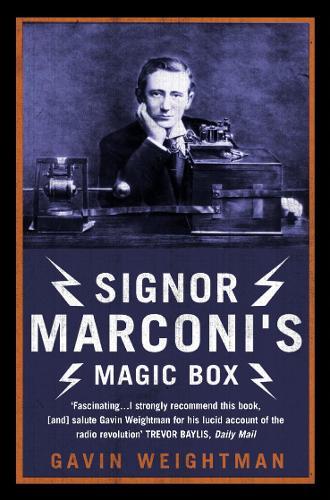
The intriguing story of how wireless was invented by Guglielmo Marconi – and how it amused Queen Victoria, saved the lives of the Titanic survivors, tracked down criminals and began the radio revolution. Wireless was the most fabulous invention of the 19th century: the public thought it was magic, the popular newspapers regarded it as miraculous, and the leading scientists of the day (in Europe and America) could not understand how it worked. In 1897, when the first wireless station was established by Marconi in a few rooms of the Royal Needles Hotel on the Isle of Wight, nobody knew how far these invisible waves could travel through the ‘ether’, carrying Morse Coded messages decipherable at a receiving station. (The definitive answer was not discovered till the 1920s, by which time radio had become a sophisticated industry filling the airwaves with a cacaphony of sounds – most of it American.) Marconi himself was the son of an Italian father and an Irish mother (from the Jameson whiskey family); he grew up in Italy and was fluent in Italian and English, but it was in England that his invention first caught on. Marconi was in his early twenties at the time (he died in 1937). With the ‘new telegraphy’ came the real prospect of replacing the network of telegraphic cables that criss-crossed land and sea at colossal expense. Initially it was the great ships that benefited from the new invention – including the Titanic, whose survivors owed their lives to the wireless.
Full Product Details
Author: Gavin Weightman
Publisher: HarperCollins Publishers
Imprint: HarperCollins
Dimensions:
Width: 12.90cm
, Height: 2.20cm
, Length: 19.80cm
Weight: 0.258kg
ISBN: 9780007130061
ISBN 10: 0007130066
Pages: 336
Publication Date: 15 March 2004
Audience:
General/trade
,
General
Format: Paperback
Publisher's Status: Active
Availability: Manufactured on demand

We will order this item for you from a manufactured on demand supplier.
Reviews
'Gavin Weightman brings alive the excitement and uncertainty of the early wireless experiments. His book cannot fail to spark the imagination of anyone wishing to comprehend the magnitude of the revolution brought about by wireless. It is an excellent read' New Scientist 'A fascinating story set in a fascinating period' Sunday Tribune (Dublin) 'Gavin Weightman's impeccably researched book is far more than a fact-led shunt through the Marconi story. His prose shimmers with the kind of romance that, in the mobile phone age, is quite difficult to grasp. But what a lovely story! An unassuming young chap confronts and defies the finest scientific minds in the world. It is pleasing to report that the cinematic aspect of this tale comes gloriously alive within Weightman's evocative, vividly detailed writing. Utterly captivating and, even for techno-dunces like myself, wholly illuminating' Manchester Evening News 'Fascinating!I strongly recommend this book, [and] salute Gavin Weightman for his lucid account of the radio revolution' Trevor Baylis, Daily Mail
`Gavin Weightman brings alive the excitement and uncertainty of the early wireless experiments. His book cannot fail to spark the imagination of anyone wishing to comprehend the magnitude of the revolution brought about by wireless. It is an excellent read' New Scientist'A fascinating story set in a fascinating period' Sunday Tribune (Dublin)'Gavin Weightman's impeccably researched book is far more than a fact-led shunt through the Marconi story. His prose shimmers with the kind of romance that, in the mobile phone age, is quite difficult to grasp. But what a lovely story! An unassuming young chap confronts and defies the finest scientific minds in the world. It is pleasing to report that the cinematic aspect of this tale comes gloriously alive within Weightman's evocative, vividly detailed writing. Utterly captivating and, even for techno-dunces like myself, wholly illuminating' Manchester Evening News'Fascinating...I strongly recommend this book, [and] salute Gavin Weightman for his lucid account of the radio revolution' Trevor Baylis, Daily Mail
A middling account of Guglielmo Marconi's development of the wireless telegraph -the radio. Whether that invention is the most fabulous of the 19th century is most arguable, of course, and radio would not come into its own until well into the 20th. Still, British journalist Weightman (The Frozen Water Trade, 2003) offers a bright portrait of Marconi, who, with the patronage of English scientists (the Italian government having had no interest in his work), demonstrated in 1896 that somehow, through processes he didn't quite understand at the time, electrical impulses could be captured in his magic boxes and made to sound tones. Marconi's London audience perceived the event, Weightman writes, as something akin to magic: It was like some fantastic act at a music hall. In fact, those present might easily have dismissed the demonstration as the work of a magician and his assistant, for the young man had a suspiciously exotic Italian name, although he looked and talked like a smart Londoner about town. Only later did Marconi realize that these signals could be charged with meaning, by which time he was in competition with several other inventors to establish standards and networks for the wireless telegraph and reap the rewards. Those inventors, among them Robert Marriott and Reginald Fessenden, were performing wonders in the early 1900s, establishing radio links between distant points, and the Marconi Company had its work cut out for it just keeping up with these rivals. Still, Weightman notes, when the Titanic sank in 1912 it sent out not the SOS of those competitors, but the Marconi system's CQD - seek you, distress. And, for all his struggles, Marconi died wealthy and world-renowned-though, sadly, an apologist and de facto ambassador for the Mussolini regime. Pleasant reading for students of technological history, but radio buffs may be disappointed with Weightman's light treatment of technical matters. (Kirkus Reviews)
The 1890s and early 1900s were a remarkable decade for inventions that changed the world, including Rontgen's X-Rays and Tesla's experiments with electricity. Another was the wireless - the 'new telegraphy' invented by Guglielmo Marconi, who turned a boyhood fascination with electricity into an entirely new form of communication. Thomas Edison said of Marconi, 'He delivers more than he promises.' Marconi was an amateur, an eccentric iconoclast, and he had little idea how his electronic signals actually worked, but work they did, even worrying genteel society who thought that ladies' modesty and privacy would be offended by these invisible rays that went through walls! Marconi made his discovery in Italy, but took it to London where his invention stood a greater chance of being taken up. Until then telegraphic cables were the only way of sending messages, apart from semaphore and carrier pigeon. His noisy spark transmitter sent a wireless signal which could be picked up by anyone who had a receiver. Importantly, wireless allowed communication from ship to shore, and ship to ship. The messages were received as Morse code printout and deciphered into longhand - even Queen Victoria had a wireless link with her son. Marconi quickly became famous but he had to prove he could compete with the cable telegraph and send messages over hundreds of miles. The book gives a fascinating description of the age: Marconi's 'invisible forces' encouraged spiritualism and belief in communications from the dead; Dr Crippen was caught by the use of Marconi's invention as the murderer sailed to the US with his lover; and the rescue of some of the Titanic passengers was a sensational success for Marconi's wireless. In his personal life, however, Marconi was unable to relax because of the threat of his competitors, and his marriage eventually collapsed under the strain. Eventually the spark transmitters were replaced by high-speed alternators which could transmit speech, but Marconi had blazed the trail of communications technology. Detailed, factual and readable, this is a fascinating study of Marconi's life and career. (Kirkus UK)
Author Information
Gavin Weightman is an experienced television documentary-maker (producer/director/writer), journalist and author of many books such as The Making of Modern London: 1815–1914, The Making of Modern London: 1914–1939, London River, Picture Post Britain and Rescue: A History of the British Emergency Services (Boxtree).