Overview
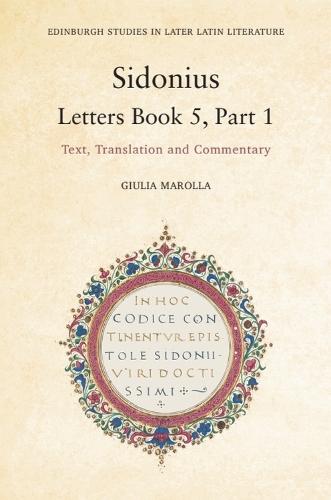
Studies the first half of Sidonius' fifth book of letters from a philological, literary and historical perspective Sidonius stands at a crossroads between the last days of the Roman Empire in the Auvergne and Provence and the emergence of Burgundians and Visigoths as territorial powers. An aristocrat, politician, author and bishop, he was involved in and bore witness to this takeover. His literary prose is characterised by a floweriness which at times makes his letters ambiguous and ostentatiously obscure. This volume provides readers with a tool to understand this convoluted prose, enabling them to see the troubled political waters of the fifth century through the eyes of Sidonius. The book contains a new critical edition of the firstten letters of Book 5 of Sidonius' Epistulae, together with an accessible English translation and a philological and historical commentary. It provides a general introduction to the book as a whole and a detailed exploration of the letters that covers literary themes, models, prosopography, dating problems and prose rhythm. Taking an interdisciplinary approach, it addresses historical questions relevant to the specific letters and to Sidonius' position at the centre of the Romano-Gallic aristocracy. Key features: Provides the first commentary on Book 5 of Apollinaris' Letters. Includes a newly edited Latin text and a new English translation. Contributes to an overall understanding of Sidonius' literary output as a whole. Offers a comprehensive and innovative study of key historical data, especially prosopography and dating of the letters. Keywords: Sidonius Apollinaris; Late Antiquity; Latin Literature; Gaul; History of the Later Roman Empire; Latin Linguistics. Subject: Classics & Ancient History
Full Product Details
Author: Giulia Marolla (<i>cultrice della materia</i> in Latin Literature, Late Latin Literature and History of the Latin Language, University of Bari 'Aldo Moro')
Publisher: Edinburgh University Press
Imprint: Edinburgh University Press
ISBN: 9781399510783
ISBN 10: 1399510789
Pages: 384
Publication Date: 28 February 2025
Audience:
Professional and scholarly
,
Professional & Vocational
Format: Paperback
Publisher's Status: Active
Availability: Manufactured on demand

We will order this item for you from a manufactured on demand supplier.
Reviews
Il libro della Marolla va salutato come un notevole contributo ai progressi della ricerca su Sidonio, sia per la ricchezza della trattazione e la novità di molti suoi approcci, sia per il rigore metodologico con cui le singole note affrontano il vario e complesso ventaglio delle contingenti questioni, sia, infine, per una nitida chiarezza espositiva che mai si perde in inutili lungaggini, rendendo la lettura di queste pagine critiche perfino, a volte, avvincente. (Marolla's book is to be hailed as a remarkable contribution to research on Sidonius - for the richness of the dissertation and the novelty of many of its approaches, for the methodological rigour with which the individual notes address the various and complex range of contingent questions and, lastly, for the clarity of its exposition, which never loses itself in unnecessary lengthiness, making the reading of these pages of criticism even, at times, absorbing.) --Alessandro Fo, University of Siena ""Futuro Classico"" In the first commentary ever published on Book 5 of the letters of Sidonius, Giulia Marolla combines philological, literary and historical expertise to offer a profound new insight into the coherent artistic unit created from the largely secular matters that preoccupy the bishop in Book 5. Fresh discoveries abound in this tour de force. --Roy Gibson, Durham University This new edition and exhaustive commentary on the first part of Sidonius' fifth book of letters examines it from philological, literary and historical perspectives, highlighting a variety of themes, intermingled literary models and unconventional lexical choices. This book offers rich pictures of Sidonius' family, friends, relationships, social interactions with literary milieu and political connections. --Isabella Gualandri, University of Milan
"Il libro della Marolla va salutato come un notevole contributo ai progressi della ricerca su Sidonio, sia per la ricchezza della trattazione e la novit� di molti suoi approcci, sia per il rigore metodologico con cui le singole note affrontano il vario e complesso ventaglio delle contingenti questioni, sia, infine, per una nitida chiarezza espositiva che mai si perde in inutili lungaggini, rendendo la lettura di queste pagine critiche perfino, a volte, avvincente. (Marolla's book is to be hailed as a remarkable contribution to research on Sidonius - for the richness of the dissertation and the novelty of many of its approaches, for the methodological rigour with which the individual notes address the various and complex range of contingent questions and, lastly, for the clarity of its exposition, which never loses itself in unnecessary lengthiness, making the reading of these pages of criticism even, at times, absorbing.) --Alessandro Fo, University of Siena ""Futuro Classico"" In the first commentary ever published on Book 5 of the letters of Sidonius, Giulia Marolla combines philological, literary and historical expertise to offer a profound new insight into the coherent artistic unit created from the largely secular matters that preoccupy the bishop in Book 5. Fresh discoveries abound in this tour de force. --Roy Gibson, Durham University This new edition and exhaustive commentary on the first part of Sidonius' fifth book of letters examines it from philological, literary and historical perspectives, highlighting a variety of themes, intermingled literary models and unconventional lexical choices. This book offers rich pictures of Sidonius' family, friends, relationships, social interactions with literary milieu and political connections. --Isabella Gualandri, University of Milan"
For me, one of the most crucial insights Marolla's study provides concerns the epistolographical tradition in which Sidonius stands. [...] Marolla's book is a first important step towards closing this gap in the research on late Latin epistolography. However, in order to assess whether the numerous insightful parallels she identifies in Symmachus's and Sidonius's language, thoughts, and argumentations are immediate influences or whether both authors merely share in the same common epistolary conventions of Late Antiquity, further studies are necessary. No future study can neglect Marolla's book. The sequel she announces on page 2, a follow-up commentary on the second half of book 5, is eagerly awaited.--Andreas Abele, University of Tübingen ""Journal of Late Antiquity"" Giulia Marolla hat mit ihrer Arbeit einen bedeutenden Beitrag zur Sidoniusforschung geleistet. Besonders der Kommentar besticht durch eine exzellente Recherche sowie eine übersichtliche Gestaltung. (Giulia Marolla has made an important contribution to the research of Sidonius with her work [...] The commentary in particular is impressive due to excellent research and a clear design.)--Veronika Egetenmeyr, Koblenz ""Historische Zeitschrift"" Il libro della Marolla va salutato come un notevole contributo ai progressi della ricerca su Sidonio, sia per la ricchezza della trattazione e la novità di molti suoi approcci, sia per il rigore metodologico con cui le singole note affrontano il vario e complesso ventaglio delle contingenti questioni, sia, infine, per una nitida chiarezza espositiva che mai si perde in inutili lungaggini, rendendo la lettura di queste pagine critiche perfino, a volte, avvincente. (Marolla's book is to be hailed as a remarkable contribution to research on Sidonius - for the richness of the dissertation and the novelty of many of its approaches, for the methodological rigour with which the individual notes address the various and complex range of contingent questions and, lastly, for the clarity of its exposition, which never loses itself in unnecessary lengthiness, making the reading of these pages of criticism even, at times, absorbing.) --Alessandro Fo, University of Siena ""Futuro Classico"" In the first commentary ever published on Book 5 of the letters of Sidonius, Giulia Marolla combines philological, literary and historical expertise to offer a profound new insight into the coherent artistic unit created from the largely secular matters that preoccupy the bishop in Book 5. Fresh discoveries abound in this tour de force. --Roy Gibson, Durham University This new edition and exhaustive commentary on the first part of Sidonius' fifth book of letters examines it from philological, literary and historical perspectives, highlighting a variety of themes, intermingled literary models and unconventional lexical choices. This book offers rich pictures of Sidonius' family, friends, relationships, social interactions with literary milieu and political connections. --Isabella Gualandri, University of Milan
For me, one of the most crucial insights Marolla’s study provides concerns the epistolographical tradition in which Sidonius stands. [...] Marolla’s book is a first important step towards closing this gap in the research on late Latin epistolography. However, in order to assess whether the numerous insightful parallels she identifies in Symmachus’s and Sidonius’s language, thoughts, and argumentations are immediate influences or whether both authors merely share in the same common epistolary conventions of Late Antiquity, further studies are necessary. No future study can neglect Marolla’s book. The sequel she announces on page 2, a follow-up commentary on the second half of book 5, is eagerly awaited. -- Andreas Abele, University of Tübingen * Journal of Late Antiquity * Il libro della Marolla va salutato come un notevole contributo ai progressi della ricerca su Sidonio, sia per la ricchezza della trattazione e la novità di molti suoi approcci, sia per il rigore metodologico con cui le singole note affrontano il vario e complesso ventaglio delle contingenti questioni, sia, infine, per una nitida chiarezza espositiva che mai si perde in inutili lungaggini, rendendo la lettura di queste pagine critiche perfino, a volte, avvincente. (Marolla’s book is to be hailed as a remarkable contribution to research on Sidonius – for the richness of the dissertation and the novelty of many of its approaches, for the methodological rigour with which the individual notes address the various and complex range of contingent questions and, lastly, for the clarity of its exposition, which never loses itself in unnecessary lengthiness, making the reading of these pages of criticism even, at times, absorbing.) -- Alessandro Fo, University of Siena * Futuro Classico * Giulia Marolla hat mit ihrer Arbeit <...> einen bedeutenden Beitrag zur Sidoniusforschung geleistet. Besonders der Kommentar besticht durch eine exzellente Recherche sowie eine übersichtliche Gestaltung. (Giulia Marolla has made an important contribution to the research of Sidonius with her work [...] The commentary in particular is impressive due to excellent research and a clear design.) -- Veronika Egetenmeyr, Koblenz * Historische Zeitschrift * This new edition and exhaustive commentary on the first part of Sidonius' fifth book of letters examines it from philological, literary and historical perspectives, highlighting a variety of themes, intermingled literary models and unconventional lexical choices. This book offers rich pictures of Sidonius' family, friends, relationships, social interactions with literary milieu and political connections. -- Isabella Gualandri, University of Milan In the first commentary ever published on Book 5 of the letters of Sidonius, Giulia Marolla combines philological, literary and historical expertise to offer a profound new insight into the coherent artistic unit created from the largely secular matters that preoccupy the bishop in Book 5. Fresh discoveries abound in this tour de force. -- Roy Gibson, Durham University
Author Information
Giulia Marolla received her PhD from the University of the Republic of San Marino, Scuola Superiore di Studi Storici in 2021 and her dissertation was awarded a badge of honour by the Associazione Internazionale di Studi Tardoantichi. She is continuing her research on Sidonius’ letters at the University of Bari ‘Aldo Moro’.