Overview
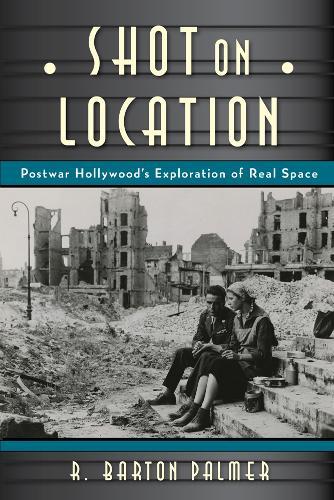
In the early days of filmmaking, before many of Hollywood’s elaborate sets and soundstages had been built, it was common for movies to be shot on location. Decades later, Hollywood filmmakers rediscovered the practice of using real locations and documentary footage in their narrative features. Why did this happen? What caused this sudden change? Renowned film scholar R. Barton Palmer answers this question in Shot on Location by exploring the historical, ideological, economic, and technological developments that led Hollywood to head back outside in order to capture footage of real places. His groundbreaking research reveals that wartime newsreels had a massive influence on postwar Hollywood film, although there are key distinctions to be made between these movies and their closest contemporaries, Italian neorealist films. Considering how these practices were used in everything from war movies like Twelve O’Clock High to westerns like The Searchers, Palmer explores how the blurring of the formal boundaries between cinematic journalism and fiction lent a “reality effect” to otherwise implausible stories. Shot on Location describes how the period’s greatest directors, from Alfred Hitchcock to Billy Wilder, increasingly moved beyond the confines of the studio. At the same time, the book acknowledges the collaborative nature of moviemaking, identifying key roles that screenwriters, art designers, location scouts, and editors played in incorporating actual geographical locales and social milieus within a fictional framework. Palmer thus offers a fascinating behind-the-scenes look at how Hollywood transformed the way we view real spaces.
Full Product Details
Author: R. Barton Palmer
Publisher: Rutgers University Press
Imprint: Rutgers University Press
Dimensions:
Width: 15.60cm
, Height: 1.50cm
, Length: 23.50cm
Weight: 0.494kg
ISBN: 9780813564081
ISBN 10: 0813564085
Pages: 277
Publication Date: 18 February 2016
Audience:
College/higher education
,
Undergraduate
,
Postgraduate, Research & Scholarly
Format: Paperback
Publisher's Status: Active
Availability: In Print

This item will be ordered in for you from one of our suppliers. Upon receipt, we will promptly dispatch it out to you. For in store availability, please contact us.
Reviews
A well-documented, clearly written study that enhances understanding of an important trend that still resonates today... Recommended. --Choice A tremendously important advance in our understanding of landscape, cityscape, and place in postwar American cinema, among the most innovative current work in film and media studies, American studies, English literature, and cultural geography. --Mark Shiel author of Hollywood Cinema and the Real Los Angeles Like the tenacious investigators of the post-war semi-documentaries he analyzes (among many other genres and films), Palmer delivers a probing, conceptually sophisticated, multi-faceted, sensitively written account of Hollywood's return to location shooting. A major achievement that overturns the historical consensus. --Matthew Bernstein author of Walter Wanger, Hollywood Independent Shot on Location provides clear evidence that Hollywood's approach to location shooting was in many ways influenced by Europe both in the philosophy of the filmmakers and in the strategies through which the footage was used to add a sense of authenticity....Shot on Location is a worthy contribution to film history, as it furthers the connections between disparate but exciting facets of film history. --The Velvet Light Trap
A tremendously important advance in our understanding of landscape, cityscape, and place in postwar American cinema, among the most innovative current work in film and media studies, American studies, English literature, and cultural geography. --Mark Shiel author of Hollywood Cinema and the Real Los Angeles (03/30/2015)
A tremendously important advance in our understanding of landscape, cityscape, and place in postwar American cinema, among the most innovative current work in film and media studies, American studies, English literature, and cultural geography. --Mark Shiel author of Hollywood Cinema and the Real Los Angeles A tremendously important advance in our understanding of landscape, cityscape, and place in postwar American cinema, among the most innovative current work in film and media studies, American studies, English literature, and cultural geography. --Mark Shiel author of Hollywood Cinema and the Real Los Angeles Like the tenacious investigators of the post-war semi-documentaries he analyzes (among many other genres and films), Palmer delivers a probing, conceptually sophisticated, multi-faceted, sensitively written account of Hollywood's return to location shooting. A major achievement that overturns the historical consensus. --Matthew Bernstein author of Walter Wanger, Hollywood Independent
Author Information
R. BARTON PALMER is the Calhoun Lemon Professor of Literature and the director of film studies at Clemson University in Clemson, South Carolina. He is the author or editor of more than thirty-five books, including Larger than Life: Movie Stars of the 1950s (with Murray Pomerance), “A Little Solitaire”: John Frankenheimer and American Film (with Murray Pomerance), and Thinking in the Dark: Cinema, Theory, Practice with Murray Pomerance (all by Rutgers University Press).