Overview
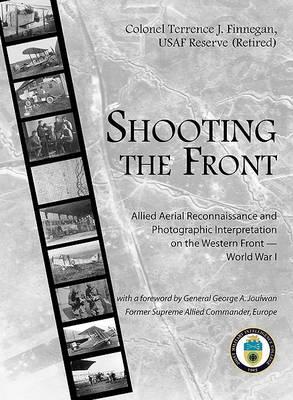
What is remarkable about photography's role in the war is photography was already a well established fixture of the modern 19th century society. The aura of aviation's beginnings reflected countless attempts to consolidate known technologies into a reliable and workable framework. It was the aeroplan that became the driving force of aeiral observation in the Great War. It's ability to command the high ground and provide a concise view of the battle area, both tactically and strategically, would enamor both combatants and the public at large to new methods of warfare. Aerial observation quickly became an important resource as the forces maneuvered in the drive towards Paris. This comprehensive resource will interest military history and aviation enthusiasts, as well as persons in the intelligence field and the coordinating illustrations, that include aircraft, cameras, people, aerial photos, and maps varying in scales, enhance the readers' experience
Full Product Details
Author: Col Terrence J Finnegan ,
National Intelligence University ,
Gen George A Joulwan
Publisher: Defense Intelligence Agency
Imprint: Defense Intelligence Agency
Dimensions:
Width: 21.60cm
, Height: 2.50cm
, Length: 27.90cm
ISBN: 9781932946048
ISBN 10: 1932946047
Pages: 523
Publication Date: 29 January 2007
Audience:
Young adult
,
Teenage / Young adult
Format: Paperback
Publisher's Status: Active
Availability: Out of stock

The supplier is temporarily out of stock of this item. It will be ordered for you on backorder and shipped when it becomes available.
Reviews
45-0839 D600 MARC Science & Technology \ History of Science & Technology Finnegan, Terrence J. Shooting the front: allied aerial reconnaissance and photographic interpretation on the western front - World War I. National Defense Intelligence College, 200 MacDill Blvd Washington, DC 20340-5100, 2006. 508p bibl index afp; ISBN 9781932946062, $63.00. Reviewed in 2007oct CHOICE. <br> WW I marked the beginning of modern warfare that incorporated key technologies, including aerial photography and interpretation, that have been refined over time and continue to be important today. Finnegan (retired, USAF) has written a fascinating, well-researched book focusing on those technologies and their impact during the Great War. As he states, much has been written on the exciting topic of aerial combat during WW I, but little has been written on less glamorous aerial reconnaissance. To his credit, he succeeds in bringing the subject to life, at least in part, through the incorporation of numerous graphics. These include aerial photographs and the resulting maps; photographs of European and American innovators, i! ncluding famous fine art and commercial photographer Edward Steichen; and images of the cameras, camera operators, and aircraft involved in aerial reconnaissance. A particularly interesting chapter, Camouflage and Deception, documents how participants were forced into a game of hide-and-seek, altering the physical landscape to hide strategic intentions. As observational methods improved, the French saw camouflage as an essential art form and incorporated cubist techniques, established by Picasso, to conceal details on the field. Aerial photographers, in response, developed newphotographic plates and color filters to discriminate between real and artificial foliage, for example. A significant work. Summing Up: Recommended. All levels. -- C. Baker, Baylor University This information is from Choice Reviews Online, an ALA/ACRL publication, available by subscription at http: //www.cro2.org/ <br>
Reprinted with permission from CHOICE, copyright by the American Library Association 45-0839 D600 MARC Science & Technology \ History of Science & Technology Finnegan, Terrence J. Shooting the front: allied aerial reconnaissance and photographic interpretation on the western front - World War I. National Defense Intelligence College, 200 MacDill Blvd Washington, DC 20340-5100, 2006. 508p bibl index afp; ISBN 9781932946062, $63.00. Reviewed in 2007oct CHOICE. WW I marked the beginning of modern warfare that incorporated key technologies, including aerial photography and interpretation, that have been refined over time and continue to be important today. Finnegan (retired, USAF) has written a fascinating, well-researched book focusing on those technologies and their impact during the Great War. As he states, much has been written on the exciting topic of aerial combat during WW I, but little has been written on less glamorous aerial reconnaissance. To his credit, he succeeds in bringing the subject to life, at least in part, through the incorporation of numerous graphics. These include aerial photographs and the resulting maps; photographs of European and American innovators, i! ncluding famous fine art and commercial photographer Edward Steichen; and images of the cameras, camera operators, and aircraft involved in aerial reconnaissance. A particularly interesting chapter, Camouflage and Deception, documents how participants were forced into a game of hide-and-seek, altering the physical landscape to hide strategic intentions. As observational methods improved, the French saw camouflage as an essential art form and incorporated cubist techniques, established by Picasso, to conceal details on the field. Aerial photographers, in response, developed new photographic plates and color filters to discriminate between real and artificial foliage, for example. A significant work. Summing Up: Recommended. All levels. -- C. Baker, Baylor University This in
Author Information
Colonel Terrence J. Finnegan is a recently retired USAF Reservist whose last assignment was at Bolling Air Force Base, Washington, and D.C. serving the Joint Military Intelligence College. His parallel careers in the Air Force and the Department of Defense as a civil servant covered assignments around the globe, to include the National Security Agency, European Command, NATO, Pacific Command, and Central Command during Operation Desert Storm. As a retired civil servant, his career included the Defense Intelligence Agency, NORAD, Space Command, and recently Northern Command. Colonel Finnegan's career primarily centered on intelligence and policy issues supporting NATO and NORAD Alliances. His work also covered new frontiers in intelligence such as Information Operations. He is presently a defense contractor supporting the National Guard.