Overview
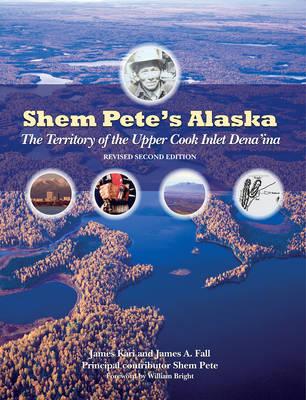
Shem Pete (1896–1989), a colorful and brilliant raconteur from Susitna Station, Alaska, left a rich legacy of knowledge about the Upper Cook Inlet Dena’ina world. Shem was one of the most versatile storytellers and historians in twentieth century Alaska, and his lifetime travel map of approximately 13,500 square miles is one of the largest ever documented with this degree of detail anywhere in the world. The first two editions of Shem Pete’s Alaska contributed much to Dena’ina cultural identity and public appreciation of the Dena’ina place names network in Upper Cook Inlet. This new edition adds nearly thirty new place names to its already extensive source material from Shem Pete and more than fifty other contributors, along with many revisions and new annotations. The authors provide synopses of Dena’ina language and culture and summaries of Dena’ina geographic knowledge, and they also discuss their methodology for place name research. Exhaustively refined over more than three decades, Shem Pete’s Alaska will remain the essential reference work on the landscape of the Dena’ina people of Upper Cook Inlet. As a book of ethnogeography, Native language materials, and linguistic scholarship, the extent of its range and influence is unlikely to be surpassed.
Full Product Details
Author: James Kari ,
James A. Fall ,
Shem Pete ,
William Bright
Publisher: University of Alaska Press
Imprint: University of Alaska Press
Edition: Second Edition, Revised
Dimensions:
Width: 21.60cm
, Height: 3.00cm
, Length: 27.90cm
Weight: 1.219kg
ISBN: 9781602233065
ISBN 10: 1602233063
Pages: 432
Publication Date: 15 July 2016
Audience:
Professional and scholarly
,
Professional & Vocational
Format: Paperback
Publisher's Status: Active
Availability: Available To Order

We have confirmation that this item is in stock with the supplier. It will be ordered in for you and dispatched immediately.
Reviews
"""Should be regarded as necessary reading for researchers and graduate students who plan to work with or alongside indigenous people. The book is easy to read, ethically sound, and leaves the reader with a greater sense of the extraordinary knowledge and wisdom held by indigenous people in this part of the world.""-- ""Alaska Journal of Anthropology"""
Should be regarded as necessary reading for researchers and graduate students who plan to work with or alongside indigenous people. The book is easy to read, ethically sound, and leaves the reader with a greater sense of the extraordinary knowledge and wisdom held by indigenous people in this part of the world. -- Alaska Journal of Anthropology
Should be regarded as necessary reading for researchers and graduate students who plan to work with or alongside indigenous people. The book is easy to read, ethically sound, and leaves the reader with a greater sense of the extraordinary knowledge and wisdom held by indigenous people in this part of the world. --Alaska Journal of Anthropology
Author Information
James Kari is professor emeritus of linguistics with the Alaska Native Language Center, University of Alaska Fairbanks, and the author or editor of numerous publications on Athabascan languages and peoples. James Fall is statewide program manager for the Division of Subsistence, Alaska Department of Fish and Game.