Awards
- Winner of Shortlisted for the Royal Historical Society's Whitfield Prize in British History Winner of the Arthur Miller Institute First Book Prize.
- Winner of Winner of the Arthur Miller Institute First Book Prize.
Overview
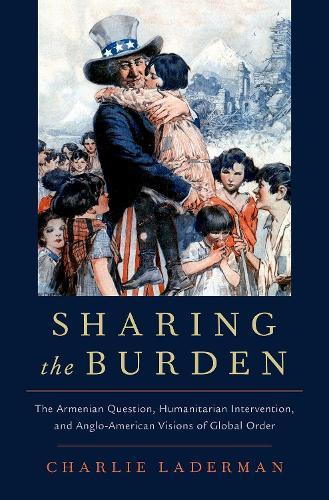
The destruction of the Armenian community in the Ottoman Empire was an unprecedented tragedy. Even amidst the horrors of the First World War, Theodore Roosevelt insisted that it was the greatest crime of the conflict. The wartime mass killing of approximately one million Armenian Christians was the culmination of a series of massacres that Winston Churchill would later recall had roused publics on both sides of the Atlantic and inspired fervent appeals to save the Armenians. Sharing the Burden explains how the Armenian struggle for survival became so entangled with the debate over the international role of the United States as it rose to world power status in the early twentieth century. In doing so, Charlie Laderman provides a fresh perspective on the role of humanitarian intervention in US foreign policy, Anglo-American relations, and the emergence of a new world order after World War I. The United States' responsibility to protect the Armenians was a central preoccupation of Presidents Theodore Roosevelt and Woodrow Wilson. Both American and British leaders proposed an Anglo-American alliance to take joint responsibilities for the Middle East and envisioned a US intervention to secure an independent Armenia as key to the new League of Nations. The Armenian question illustrates how policymakers, missionaries, and the public grappled for the first time with atrocities on this scale. It also reveals the values that animated American society during this pivotal period in the nation's foreign relations. Deepening understanding of the Anglo-American special relationship and its role in reforming global order, Sharing the Burden illuminates the possibilities, limitations, and continued dilemmas of humanitarian intervention in international politics.
Full Product Details
Author: Charlie Laderman (Lecturer in International History, Lecturer in International History, King's College London)
Publisher: Oxford University Press Inc
Imprint: Oxford University Press Inc
Dimensions:
Width: 16.20cm
, Height: 2.40cm
, Length: 24.40cm
Weight: 0.586kg
ISBN: 9780190618605
ISBN 10: 0190618604
Pages: 336
Publication Date: 05 November 2019
Audience:
General/trade
,
General
Format: Hardback
Publisher's Status: Active
Availability: Not yet available

This item is yet to be released. You can pre-order this item and we will dispatch it to you upon its release.
Reviews
Charlie Laderman does an outstanding job showing how humanitarian and religious outrage at the Armenian massacres set the stage for American intervention in the Cuban war for independence from Spain and presaged America shaping the international order in the twentieth century. Sharing the Burden is an essential read for understanding the importance of shared values in American and British foreign policy. * Kori Schake, author of Safe Passage: The Transition from British to American Hegemony * Anyone interested in US foreign relations during the Gilded Age and Progressive Era should read this important book. Focusing on the international politics of humanitarian intervention in the Ottoman Empire to aid the Armenians, Laderman provides new insights into the promise and failure of the League of Nations and its mandate system to create a new world order after World War I. * Lloyd E. Ambrosius, University of Nebraska-Lincoln * A compelling and beautifully-written history of the centrality of the Armenian question in trans-Atlantic politics before and after the Great War. No other book gives humanitarianism in foreign policy making its due in this period using extensive archival research placed in the context of global history. * Kathleen Dalton, author of Theodore Roosevelt: A Strenuous Life * In the early twentieth century, Theodore Roosevelt and Woodrow Wilson believed it their duty as statesmen to prevent further killings of Armenian Christians, eventually reckoned at 1.5 million. Sharing the Burden is an invaluable account of reactions by missionaries, as well as the US and British governments, to genocide. * Wm. Roger Louis, University of Texas at Austin * When - if ever - should liberal democratic States intervene abroad to stop atrocities and abuses of basic human rights, even when they have the power to do so? The problem of humanitarian intervention is no recent one, as Charlie Laderman shows in his incisive and empathetic study of the widely-covered Turkish atrocities against the Armenians. Again and again, leading US statesmen and opinion-makers considered the tempting possibility of 'sharing the burden,' of joint Anglo-American actions to rescue the desperate Armenians. Yet it was not to be. This is superb political and diplomatic history, with a sobering message for policy-makers and pundits today. * Paul Kennedy, author of The Rise and Fall of the Great Powers * Laderman's persuasive and readable history has implications for the present day. The congressional resolutions last fall were, largely, a rebuke of Turkey for its current invasion of northern SyriaCongressional resolutions are very welcome, but history suggests that these Christians should not expect much more from America. Just as in the last century, despite the best intentions, America's commitment to Christians in the Middle East today is limited: well wishes, exhortations for equality and tolerance, some humanitarian assistance-though nothing like the massive humanitarian campaign that took place in the last century and saved so many lives....The sad lesson of Laderman's book is this: if Christians in Syria expect the American government to do more to help them, they will find themselves on their own * Mark L. Movsesian, Law and Liberty blog * By analysing a series of episodes many today have forgotten about, Laderman...reminds us that the dilemmas of humanitarian intervention that have bedevilled policymakers in recent decades are, in fact, not new problems at all....He persuasively argues that the 'Armenian question' is intimately tied up with the rise of the United States as a world power....The next time American leaders consider such an intervention, they would be wise to read Laderman's impressive book. * Grant Golub, LSE Review of Books * A fascinating and thoroughly assured work of international political history....With immense skill, Laderman weaves together numerous strands, including transatlantic relations, the politics of intervention, the role of missionaries, the rise of the US as a global power, various international and historical contexts, and World War I. Sharing the Burden is highly topical and immensely stimulating. * from the shortlist citation for the Whitfield Prize of the Royal Historical Society * A thoroughly researched and highly compelling account of how the Armenian question acted as a catalyst for an emerging American-British geopolitical alliance and the United States' rise as a predominant actor in the international arena....[A] truly visionary presentation of the Armenian question as a precursor for the future dilemmas of humanitarian intervention in general and of American global leadership in particular....The book will remain an essential read for current and future American policymakers as they reflect on their personal leadership's potential and limitations, the factors driving their nation's willingness to engage the world, and the risks that come with 'sharing the burden' of international leadership and humanitarian intervention. * Tobias Cremer, Providence Magazine *
Charlie Laderman does an outstanding job showing how humanitarian and religious outrage at the Armenian massacres set the stage for American intervention in the Cuban war for independence from Spain and presaged America shaping the international order in the twentieth century. Sharing the Burden is an essential read for understanding the importance of shared values in American and British foreign policy. * Kori Schake, author of Safe Passage: The Transition from British to American Hegemony * Anyone interested in US foreign relations during the Gilded Age and Progressive Era should read this important book. Focusing on the international politics of humanitarian intervention in the Ottoman Empire to aid the Armenians, Laderman provides new insights into the promise and failure of the League of Nations and its mandate system to create a new world order after World War I. * Lloyd E. Ambrosius, University of Nebraska-Lincoln * A compelling and beautifully-written history of the centrality of the Armenian question in trans-Atlantic politics before and after the Great War. No other book gives humanitarianism in foreign policy making its due in this period using extensive archival research placed in the context of global history. * Kathleen Dalton, author of Theodore Roosevelt: A Strenuous Life * In the early twentieth century, Theodore Roosevelt and Woodrow Wilson believed it their duty as statesmen to prevent further killings of Armenian Christians, eventually reckoned at 1.5 million. Sharing the Burden is an invaluable account of reactions by missionaries, as well as the US and British governments, to genocide. * Wm. Roger Louis, University of Texas at Austin * When - if ever - should liberal democratic States intervene abroad to stop atrocities and abuses of basic human rights, even when they have the power to do so? The problem of humanitarian intervention is no recent one, as Charlie Laderman shows in his incisive and empathetic study of the widely-covered Turkish atrocities against the Armenians. Again and again, leading US statesmen and opinion-makers considered the tempting possibility of 'sharing the burden,' of joint Anglo-American actions to rescue the desperate Armenians. Yet it was not to be. This is superb political and diplomatic history, with a sobering message for policy-makers and pundits today. * Paul Kennedy, author of The Rise and Fall of the Great Powers *
Charlie Laderman does an outstanding job showing how humanitarian and religious outrage at the Armenian massacres set the stage for American intervention in the Cuban war for independence from Spain and presaged America shaping the international order in the twentieth century. Sharing the Burden is an essential read for understanding the importance of shared values in American and British foreign policy. * Kori Schake, author of Safe Passage: The Transition from British to American Hegemony, N/A * Anyone interested in US foreign relations during the Gilded Age and Progressive Era should read this important book. Focusing on the international politics of humanitarian intervention in the Ottoman Empire to aid the Armenians, Laderman provides new insights into the promise and failure of the League of Nations and its mandate system to create a new world order after World War I. * Lloyd E. Ambrosius, University of Nebraska-Lincoln, N/A * A compelling and beautifully-written history of the centrality of the Armenian question in trans-Atlantic politics before and after the Great War. No other book gives humanitarianism in foreign policy making its due in this period using extensive archival research placed in the context of global history. * Kathleen Dalton, author of Theodore Roosevelt: A Strenuous Life, N/A * In the early twentieth century, Theodore Roosevelt and Woodrow Wilson believed it their duty as statesmen to prevent further killings of Armenian Christians, eventually reckoned at 1.5 million. Sharing the Burden is an invaluable account of reactions by missionaries, as well as the US and British governments, to genocide. * Wm. Roger Louis, University of Texas at Austin, N/A * When - if ever - should liberal democratic States intervene abroad to stop atrocities and abuses of basic human rights, even when they have the power to do so? The problem of humanitarian intervention is no recent one, as Charlie Laderman shows in his incisive and empathetic study of the widely-covered Turkish atrocities against the Armenians. Again and again, leading US statesmen and opinion-makers considered the tempting possibility of 'sharing the burden,' of joint Anglo-American actions to rescue the desperate Armenians. Yet it was not to be. This is superb political and diplomatic history, with a sobering message for policy-makers and pundits today. * Paul Kennedy, author of The Rise and Fall of the Great Powers, N/A *
Author Information
Charlie Laderman is a Lecturer in International History in the Department of War Studies at King's College London.