Overview
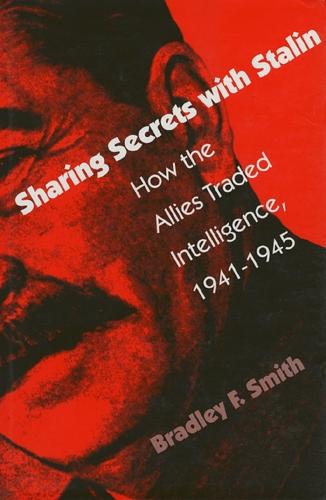
Author Bradley Smith reveals the surprisingly rich exchange of wartime intelligence between the Anglo-American allies and the Soviet Union, as well as the procedures and politics that made such an exchange possible. Between the late 1930s and 1945, allied intelligence organisations expanded at an enormous rate in order to acquire the secret information their governments needed to win the war. But, as Smith demonstrates, the demand for intelligence far outpaced the ability of any one ally to produce it. For that reason, Washington, London and Moscow were compelled to share some of their most sensitive secrets. Historians have long known about the close Anglo-American intelligence collaboration, but until now the Soviet connection has been largely unexplored. Smith contends that Cold War animosities helped keep this story from a public that might have found it hard to believe that such cooperation was ever possible. In fact, official denials - from such illustrious Cold Warriors as Supreme Court Justice Lewis Powell and the CIA's Sherman Kent - continued well into the late 1980s. Smith argues that, contrary to the official story, Soviet-American intelligence exchanges were both extensive and successful. He shows that East and West were not as hostile to each other during the war or as determined to march right off into the Cold War as many have suggested. Among other things, he provides convincing evidence that the US Army gave the Soviets its highest-grade ULTRA intelligence in August 1945 to speed up the Soviet advances in the Far East. Based on interviews and research in Anglo-American archives and despite limited access to tenaciously guarded Soviet documents, Smith's book persuasively demonstrates how reluctant and suspicious allies, driven by the harsh realities of total war, finally set aside their ideological differences to work closely with people they neither trusted not particularly liked.
Full Product Details
Author: Bradley F. Smith
Publisher: University Press of Kansas
Imprint: University Press of Kansas
Dimensions:
Width: 16.10cm
, Height: 2.90cm
, Length: 23.70cm
Weight: 0.333kg
ISBN: 9780700608003
ISBN 10: 0700608001
Pages: 336
Publication Date: 31 October 1996
Audience:
College/higher education
,
Professional and scholarly
,
Undergraduate
,
Postgraduate, Research & Scholarly
Format: Hardback
Publisher's Status: Active
Availability: In Print

This item will be ordered in for you from one of our suppliers. Upon receipt, we will promptly dispatch it out to you. For in store availability, please contact us.
Reviews
As engaging as it is astonishing, this book provides extremely important revelations and striking pen-portraits etched in acid of the main actors. Certainly the sources are fabulous. --<b>John Erickson</b>, author of <i>The Road to Stalingrad</i> This richly detailed book is a major revelation, an inquiry into one of the darkest corners of Russian-Allied relations during World War II. --<b>John Prados</b>, author of <i>Combined Fleet Decoded</i> Credibility, utility, and readability propel this book into the first ranks of its genre. There, it measures up well with the pre-eminent works by Hinsley, Deutsch, and Drea. This work is particularly timely and useful, appearing when current U.S.-Russian cooperative efforts are plagued by the misunderstandings of the past and when the Russian archives are slowly creaking open. --<b>David M. Glantz</b>, coauthor of <i>When Titans Clashed: How the Red Army Stopped Hitler</i> The most complete and detailed picture of such exchanges of intelligence that we are likely to see for some time. --<b>Warren F. Kimball</b>, author of <i>The Juggler: Franklin Roosevelt as Wartime Statesman</i> Smith has done an extraordinary job in uncovering a story that forces us to rethink the achievements and the failures of one of history--s more improbable alliances. --<b>Wesley K. Wark</b>, author of <i>The Ultimate Enemy: British Intelligence and Nazi Germany, 1933-1939</i> A major contribution to the literature of World War II by a scholar of considerable intellectual integrity. --<b>Carl Boyd</b>, author of <i>Hitler's Japanese Confidant: General Oshima Hiroshi and MAGIC Intelligence, 1941-1945</i>
-As engaging as it is astonishing, this book provides extremely important revelations and striking pen-portraits etched in acid of the main actors. Certainly the sources are fabulous.---John Erickson, author of The Road to Stalingrad -This richly detailed book is a major revelation, an inquiry into one of the darkest corners of Russian-Allied relations during World War II.---John Prados, author of Combined Fleet Decoded -Credibility, utility, and readability propel this book into the first ranks of its genre. There, it measures up well with the pre-eminent works by Hinsley, Deutsch, and Drea. This work is particularly timely and useful, appearing when current U.S.-Russian cooperative efforts are plagued by the misunderstandings of the past and when the Russian archives are slowly creaking open.---David M. Glantz, coauthor of When Titans Clashed: How the Red Army Stopped Hitler -The most complete and detailed picture of such exchanges of intelligence that we are likely to see for some time.---Warren F. Kimball, author of The Juggler: Franklin Roosevelt as Wartime Statesman -Smith has done an extraordinary job in uncovering a story that forces us to rethink the achievements and the failures of one of history--s more improbable alliances.---Wesley K. Wark, author of The Ultimate Enemy: British Intelligence and Nazi Germany, 1933-1939 -A major contribution to the literature of World War II by a scholar of considerable intellectual integrity.---Carl Boyd, author of Hitler's Japanese Confidant: General Oshima Hiroshi and MAGIC Intelligence, 1941-1945
World War II historian Smith (The Ultra-Magic Deals, 1992, etc.) persuasively argues (contrary to the consensus that Stalin and his Western allies were standoffish partners) that sharing of wartime intelligence between the Anglo-Americans and Soviets was extensive and that it continued until the very last days of the war. When Hitler launched Operation Barbarossa against the Soviet Union in June 1941, the outlook for Russo-British cooperation seemed inauspicious. After all, Britain had directed an international military campaign against the nascent Soviet regime in the years following the Russian Revolution. The US was so anti-Soviet that it did not recognize the USSR until 1935. Meanwhile Stalin, himself xenophobic, dismissed British warnings of an imminent Nazi invasion as part of a Western plot against Russia. However, Smith shows that despite a mutual abiding mistrust, the ideological adversaries were compelled to share secrets by the exigencies of war and a demand for anti-Nazi intelligence that outstripped the lone resources of the USSR or England. Even before US entry into the war Harry Hopkins, FDR's personal envoy, helped cement a working relationship among the Allies with intelligence sharing and equipment grants. Despite frequent personality clashes with the more secretive Soviets and conflicts over the appropriateness of sharing sensitive data, the Anglo-Americans shared secrets ranging from estimates of German and Japanese war strategy and materiel to intercepts from America's MAGIC program, which read Japanese codes. While the US was warier of Soviet intentions than Britain in the early stages of the partnership, Smith contends, by war's end the US had become an enthusiastic sharer of intelligence and, hoping to involve the Soviet Union in war against Japan, was giving high-level secret information to the Soviets as late as August 1945. Although compelled by lack of access to Soviet files to base his account almost solely on Anglo-American sources, Smith gives a richly detailed and well-researched contribution to the literature on WW II intelligence. (Kirkus Reviews)