Overview
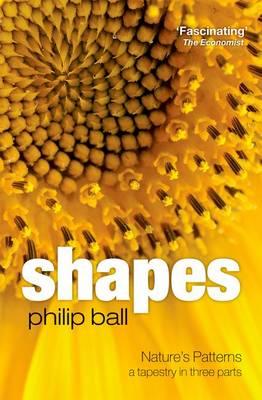
Patterns are everywhere in nature - in the ranks of clouds in the sky, the stripes of an angelfish, the arrangement of petals in flowers. Where does this order and regularity come from? It creates itself. The patterns we see come from self-organization. Whether living or non-living, scientists have found that there is a pattern-forming tendency inherent in the basic structure and processes of nature, so that from a few simple themes, and the repetition of simple rules, endless beautiful variations can arise. Part of a trilogy of books exploring the science of patterns in nature, acclaimed science writer Philip Ball here looks at how shapes form. From soap bubbles to honeycombs, delicate shell patterns, and even the developing body parts of a complex animal like ourselves, he uncovers patterns in growth and form in all corners of the natural world, explains how these patterns are self-made, and why similar shapes and structures may be found in very different settings, orchestrated by nothing more than simple physical forces. This book will make you look at the world with fresh eyes, seeing order and form even in the places you'd least expect.
Full Product Details
Author: Philip Ball (Freelance writer and consultant editor for Nature)
Publisher: Oxford University Press
Imprint: Oxford University Press
Dimensions:
Width: 13.80cm
, Height: 2.10cm
, Length: 19.50cm
Weight: 0.368kg
ISBN: 9780199604869
ISBN 10: 019960486
Pages: 336
Publication Date: 26 May 2011
Audience:
General/trade
,
General
Format: Paperback
Publisher's Status: Out of Print
Availability: In Print

Limited stock is available. It will be ordered for you and shipped pending supplier's limited stock.
Reviews
Fascinating detail. * The Economist * Ball has opened a welcome window on a little-understood but thought-provoking aspect of the making of the natural world. * Alan Cane, Financial Times * Philip Ball gives us some very interesting food for thought. * Mark Ronan, Standpoint * Review from previous edition Wideranging, intelligent and non-dogmatic trilogy of books. * Martin Kemp, Times Literary Supplement *
Review from previous edition Wideranging, intelligent and non-dogmatic trilogy of books. Martin Kemp, Times Literary Supplement Philip Ball gives us some very interesting food for thought. Mark Ronan, Standpoint Ball has opened a welcome window on a little-understood but thought-provoking aspect of the making of the natural world. Alan Cane, Financial Times Fascinating detail. The Economist
Author Information
Philip Ball is a freelance writer and a consultant editor for Nature, where he previously worked as an editor for physical sciences. He is a regular commentator in the scientific and popular media on science and its interactions with art, history and culture. His ten books on scientific subjects include The Self-Made Tapestry: Pattern Formation in Nature, H2O: A Biography of Water, The Devil's Doctor: Paracelsus and the World of Renaissance Magic and Science, and Critical Mass: How One Thing Leads To Another, which won the 2005 Aventis Prize for Science Books. He was awarded the 2006 James T. Grady - James H. Stack award by the American Chemical Society for interpreting chemistry for the public. Philip studied chemistry at Oxford and holds a doctorate in physics from the University of Bristol. His latest book The Music Instinct published in February 2010.