Overview
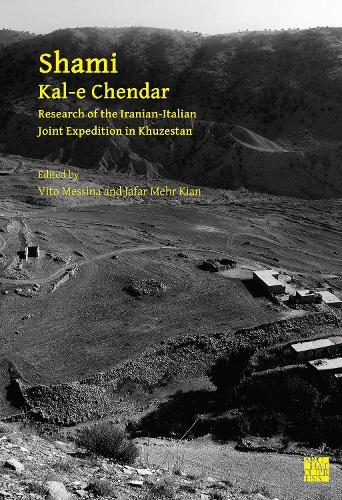
This report publishes the results of the research conducted between 2012 and 2018 by the Iranian- Italian Joint Expedition in Khuzestan at Kal-e Chendar, in the valley of Shami, about 30 km north of present-day Izeh. The project aimed to shed new light on one of the most intriguing religious complexes of Hellenistic and Parthian Iran, located in highland Khuzestan, the heart of ancient Elymais. Identified thanks to the accidental discovery of statues (some fragmentary) in 1935, the site of Kal-e Chendar was briefly investigated by Sir Marc Aurel Stein, one of the most famous explorers of Inner Asia, and Bahman Karimi, Inspector of the Iranian Antiquities Service, early in 1936. It was subsequently to fall into oblivion for many decades despite the importance of the discoveries they made. Based on an interdisciplinary approach, the research project aimed to acquire new information on the materiality of the site and to systematically study its archaeological context, putting forward new interpretations of the function, chronology and meaning of the complex. Based on previous investigations and the results of this new research, it is clear that an important religious complex existed at Kal-e Chendar in the Hellenistic and Parthian periods, from about the 3rd century BCE to the 2nd century CE. The complex was multifunctional. Its religious dimension, although of paramount importance, was not the only characteristic of the site: monumental terraces, built to support sacred buildings now lost, alternate with a wide cemetery, implying that religious and funerary functions were here strictly interrelated. The complex also probably had social meaning.
Full Product Details
Author: Professor Vito Messina (Full Professor of Archaeology of Asia, University of Torino (UniTo)) ,
Jafar Mehr Kian (Senior Researcher, RICHT-ICAR - University of Teheran)
Publisher: Archaeopress
Imprint: Archaeopress Archaeology
Weight: 1.827kg
ISBN: 9781803279558
ISBN 10: 1803279559
Pages: 428
Publication Date: 12 June 2025
Audience:
Professional and scholarly
,
Professional & Vocational
Format: Paperback
Publisher's Status: Active
Availability: Manufactured on demand

We will order this item for you from a manufactured on demand supplier.
Author Information
Vito Messina is Full Professor of the Archaeology of Asia (University of Torino). He is the co-director of, and took part in, archaeological campaigns in Iran, Iraq and Turkmenistan. He is the PI of several projects in collaboration with international institutions and is the Director of the School of Archaeology of the University of Torino. Jafar Mehr Kian is the director of several archaeological expeditions and rescue excavations in Iran, and author of many articles regarding ancient Elymais and ancient rock carvings. He is the president of the Ayapir NGO, which conducts research in highland Khuzestan.