Overview
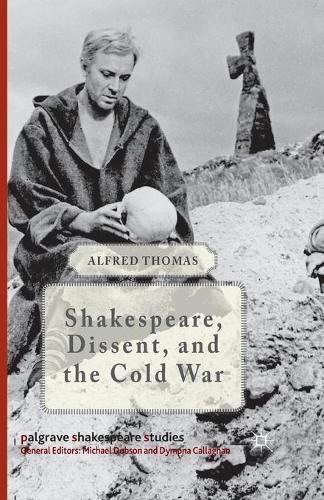
Shakespeare, Dissent and the Cold War is the first book to read Shakespeare's drama through the lens of Cold War politics. The book uses the Cold War experience of dissenting artists in theatre and film to highlight the coded religio-political subtexts in Hamlet, King Lear, Macbeth and The Winter's Tale.
Full Product Details
Author: Alfred Thomas
Publisher: Palgrave Macmillan
Imprint: Palgrave Macmillan
Edition: 1st ed. 2014
Weight: 0.355kg
ISBN: 9781349494156
ISBN 10: 1349494151
Pages: 265
Publication Date: 01 January 2014
Audience:
Professional and scholarly
,
Professional & Vocational
Format: Paperback
Publisher's Status: Active
Availability: Manufactured on demand

We will order this item for you from a manufactured on demand supplier.
Reviews
"""Thomas has written a lively, intelligent, and interesting study of the politics of Shakespearean drama and its relationship to the literature and theater of Cold-War (and post-Cold-War) Europe. He examines Shakespeare's deliberate employment of religio-political codes that call attention to the persecution of English Catholics, the repressive practices of the English government and the socially disruptive effects of religious antagonisms. In analyzing Russian film versions of Hamlet and King Lear as indirect criticisms of the Soviet system, the Czech-English playwright Tom Stoppard's Cahoot's Macbeth in the context of post-1968 Czech political resistance, and Ingeborg Bachmann's poem 'Bohemia Lies on the Sea,' Thomas highlights the political potential of Shakespearean drama that can be translated into powerful political protest and analysis in changed (modern) circumstances."" - Arthur Marotti, Wayne State University, USA"
Thomas has written a lively, intelligent, and interesting study of the politics of Shakespearean drama and its relationship to the literature and theater of Cold-War (and post-Cold-War) Europe. He examines Shakespeare's deliberate employment of religio-political codes that call attention to the persecution of English Catholics, the repressive practices of the English government and the socially disruptive effects of religious antagonisms. In analyzing Russian film versions of Hamlet and King Lear as indirect criticisms of the Soviet system, the Czech-English playwright Tom Stoppard's Cahoot's Macbeth in the context of post-1968 Czech political resistance, and Ingeborg Bachmann's poem 'Bohemia Lies on the Sea,' Thomas highlights the political potential of Shakespearean drama that can be translated into powerful political protest and analysis in changed (modern) circumstances. - Arthur Marotti, Wayne State University, USA
Author Information
Alfred Thomas is Professor of English at the University of Illinois at Chicago, having previously taught at Rutgers, Harvard and Berkeley, USA. He is the author of seven books, including A Blessed Shore: England and Bohemia from Chaucer to Shakespeare (2007) and Prague Palimpsest: Writing, Memory, and the City (2010).