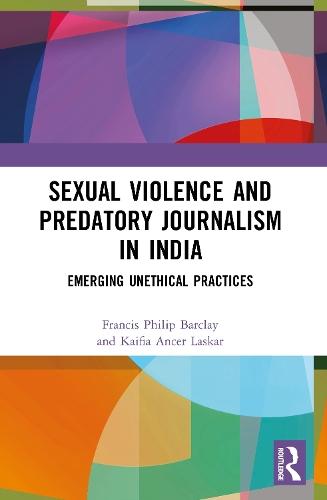
Full Product Details
Author: Francis Philip Barclay (Central University of Tamil Nadu, India) ,
Kaifia Ancer Laskar (Aliah University, India)
Publisher: Taylor & Francis Ltd
Imprint: Routledge
ISBN: 9781032741918
ISBN 10: 1032741910
Pages: 156
Publication Date: 21 May 2026
Audience:
College/higher education
,
Professional and scholarly
,
Tertiary & Higher Education
,
Professional & Vocational
Format: Paperback
Publisher's Status: Forthcoming
Availability: Not yet available

This item is yet to be released. You can pre-order this item and we will dispatch it to you upon its release.
Reviews
“A multifaceted analysis of unethical media practices in reporting sexual violence in India, this book reveals a disturbing reality through rigorous reflection and research. Insightful for anyone committed to ethical journalism and understanding the media’s impact on societal perceptions and the exploitation of ensuing trauma.” Syeda Afshana, Professor of Media Studies, Media Education Research Centre, University of Kashmir, India, and Visiting Fellow, Centre of International Studies, University of Cambridge, UK “Barclay and Laskar’s data-driven analysis of ‘Predatory Journalism’ addresses how sensationalist reporting has seeped into and tainted the mainstream news cycle and causes harm to victims and their communities. As the authors stand up to abusive journalistic tactics to restore public faith in news across print, radio, television, streaming platforms and social media, concerned citizens and ethical editors may be inspired to support victims of sexual crimes and the journalists who provide accurate and respectful reporting.” Artemis Preeshl, Assistant Director, Center for Diversity and Inclusion, Buena Vista University, USA, and Fulbright Senior Specialist in Theatre, Central University of Tamil Nadu, India “This important book examines the reporting about crimes against women in India and the ethical challenges that journalists face. It also addresses the impact of those challenges on the victims of crimes, focusing on privacy, sensationalism and victim blaming. The authors apply the important concepts of critical theory and feminism as part of the moral obligation that journalists face when covering difficult crimes and the impact on the women who are victims. It adds to the growing scholarship about the coverage of crimes against women. I highly recommend this book.” Kimberly Voss, Professor of Journalism, University of Central Florida, USA
Author Information
Francis Philip Barclay is Assistant Professor of Media and Communication at the Central University of Tamil Nadu, India. He is founding editor of the Journal of Media and Communication and co-editor of Social Media in India: Regulatory Needs, Issues and Challenges (2022) and Gender and Popular Visual Culture in India: ‘Benevolent’ Sexism and Disguised Discrimination (Routledge, 2023). Kaifia Ancer Laskar is an Assistant Professor of Journalism and Mass Communication at Aliah University, India. She is co-editor of Gender and Popular Visual Culture in India: ‘Benevolent’ Sexism and Disguised Discrimination (Routledge, 2023).