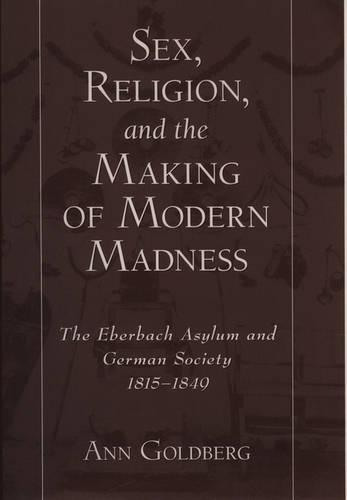
Full Product Details
Author: Ann Goldberg (Assistant Professor of History, Assistant Professor of History, University of California, Riverside)
Publisher: Oxford University Press Inc
Imprint: Oxford University Press Inc
Dimensions:
Width: 16.00cm
, Height: 3.10cm
, Length: 23.40cm
Weight: 0.590kg
ISBN: 9780195125818
ISBN 10: 0195125819
Pages: 256
Publication Date: 29 July 1999
Audience:
Professional and scholarly
,
Professional & Vocational
Format: Hardback
Publisher's Status: Active
Availability: To order

Stock availability from the supplier is unknown. We will order it for you and ship this item to you once it is received by us.
Reviews
Goldberg is...never satisfied with simple monocausal explanations, but moves sensitively and surefootedly through dense matrices of cultural factors, social pressures, political endeavors, and medical theorizing. --Central European History<br> This is a taut, concise and well-written analysis. It is also a richly nuanced and multilayered study, at once theoretically sophisticate and concretely historical. -- Journal of Modern History <br> Goldberg's remarkable study of mental illness in early nineteenth-century Germany places the phenomenon of insanity squarely within the context of a late absolutist regime and a crisis-ridden, impoverished social and economic order. Her account of the gendered structuring of madness, its bureaucratic politics, and its connections to religious enthusiasm and religious prejudice offers an unexpected but extraordinarily illuminating insight into state and society in Germany before the revolution of 1848. --Jonathan Sperber, University of Missouri<br> Goldberg's enterprise is an original and long-missed contribution to the social and cultural history of madness in the first half of the nineteenth century. Her work provides at the same time valuable insights into the broader field of the history of peasant culture and social experience, especially in the rural world of Nassau. The strength of Goldberg's work is an outstanding and sensitive interpretation of the individual's experience of madness as a language of distress and dissent in rural lower-class culture that was shaped by gender and ethnicity. --Doris Kaufmann, Max Planck Institute for the History of Science, Berlin<br> Ann Goldberg's new book opens a challenging new dimension ofnineteenth-century German social history. We've had histories of asylums and medicalization in other national fields for some years, likewise a profusion of works on the formation of Germany's bourgeois culture. There is even the kernel of a literature on early nineteenth-century German rural society. Now Goldberg has beautifully brought together these concerns. This fascinating exploration of sexualities, religion, and the modern pedagogies of order takes us to the frontier of bourgeois culture and rural society, where ordinary people learned how to be ill. This is a 'micro' history that compels the 'macro' to listen. --Geoff Eley, The University of Michigan<br> In giving a prominent voice to patient and village life, she [Goldberg] reveals not only the medical but the social construction of 'madness, ' made vivid through her detailed rendering of the immense strains of impoverished rural life for Germans of the early nineteenth century. --Susan Lanzoni, Journal of Asian History<br>
Goldberg is...never satisfied with simple monocausal explanations, but moves sensitively and surefootedly through dense matrices of cultural factors, social pressures, political endeavors, and medical theorizing. --Central European History This is a taut, concise and well-written analysis. It is also a richly nuanced and multilayered study, at once theoretically sophisticate and concretely historical. -- Journal of Modern History Goldberg's remarkable study of mental illness in early nineteenth-century Germany places the phenomenon of insanity squarely within the context of a late absolutist regime and a crisis-ridden, impoverished social and economic order. Her account of the gendered structuring of madness, its bureaucratic politics, and its connections to religious enthusiasm and religious prejudice offers an unexpected but extraordinarily illuminating insight into state and society in Germany before the revolution of 1848. --Jonathan Sperber, University of Missouri Goldberg's enterprise is an original and long-missed contribution to the social and cultural history of madness in the first half of the nineteenth century. Her work provides at the same time valuable insights into the broader field of the history of peasant culture and social experience, especially in the rural world of Nassau. The strength of Goldberg's work is an outstanding and sensitive interpretation of the individual's experience of madness as a language of distress and dissent in rural lower-class culture that was shaped by gender and ethnicity. --Doris Kaufmann, Max Planck Institute for the History of Science, Berlin Ann Goldberg's new book opens a challenging new dimension of nineteenth-century German social history. We've had histories of asylums and medicalization in other national fields for some years, likewise a profusion of works on the formation of Germany's bourgeois culture. There is even the kernel of a literature on early nineteenth-century German rural society. Now Goldberg has beautifully brought together these concerns. This fascinating exploration of sexualities, religion, and the modern pedagogies of order takes us to the frontier of bourgeois culture and rural society, where ordinary people learned how to be ill. This is a 'micro' history that compels the 'macro' to listen. --Geoff Eley, The University of Michigan In giving a prominent voice to patient and village life, she [Goldberg] reveals not only the medical but the social construction of 'madness,' made vivid through her detailed rendering of the immense strains of impoverished rural life for Germans of the early nineteenth century. --Susan Lanzoni, Journal of Asian History Goldberg is...never satisfied with simple monocausal explanations, but moves sensitively and surefootedly through dense matrices of cultural factors, social pressures, political endeavors, and medical theorizing. --Central European History This is a taut, concise and well-written analysis. It is also a richly nuanced and multilayered study, at once theoretically sophisticate and concretely historical. -- Journal Of Modern History Goldberg's remarkable study of mental illness in early nineteenth-century Germany places the phenomenon of insanity squarely within the context of a late absolutist regime and a crisis-ridden, impoverished social and economic order. Her account of the gendered structuring of madness, its bureaucratic politics, and its connections to religious enthusiasm and religious prejudice offers an unexpected but extraordinarily illuminating insight into state and society in Germany before the revolution of 1848. --Jonathan Sperber, University of Missouri Goldberg's enterprise is an original and long-missed contribution to the social and cultural history of madness in the first half of the nineteenth century. Her work provides at the same time valuable insights into the broader field of the history of peasant culture and social experience, especially in the rural world of Nassau. The strength of Goldberg's work is an outstanding and sensitive interpretation of the individual's experience of madness as a language of distress and dissent in rural lower-class culture that was shaped by gender and ethnicity. --Doris Kaufmann, Max Planck Institute for the History of Science, Berlin Ann Goldberg's new book opens a challenging new dimension of nineteenth-century German social history. We've had histories of asylums and medicalization in other national fields for some years, likewise a profusion of works on the formation of Germany's bourgeois culture. There is even the kernel of a literature on early nineteenth-century German rural society. Now Goldberg has beautifully brought together these concerns. This fascinating exploration of sexualities, religion, and the modern pedagogies of order takes us to the frontier of bourgeois culture and rural society, where ordinary people learned how to be ill. This is a 'micro' history that compels the 'macro' to listen. --Geoff Eley, The University of Michigan In giving a prominent voice to patient and village life, she [Goldberg] reveals not only the medical but the social construction of 'madness,' made vivid through her detailed rendering of the immense strains of impoverished rural life for Germans of the early nineteenth century. --Susan Lanzoni, Journal of Asian History
Author Information
Ann Goldberg is an assistant professor of history at the University of California, Riverside.