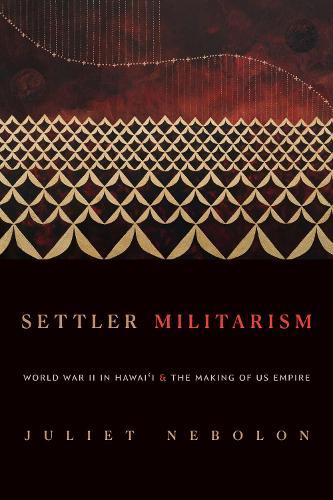
Full Product Details
Author: Juliet Nebolon
Publisher: Duke University Press
Imprint: Duke University Press
Weight: 0.363kg
ISBN: 9781478031017
ISBN 10: 1478031018
Pages: 256
Publication Date: 01 November 2024
Audience:
Professional and scholarly
,
Professional & Vocational
Format: Paperback
Publisher's Status: Active
Availability: In Print

This item will be ordered in for you from one of our suppliers. Upon receipt, we will promptly dispatch it out to you. For in store availability, please contact us.
Reviews
“Settler Militarism is a timely and urgently needed analysis of settler colonial governance and US militarism. Juliet Nebolon adeptly theorizes ‘settler militarism’ as a confluence of biopolitical regimes, racialized social reproduction, wartime pedagogies, and colonial-military spatial practices deployed in the name of national security to justify Native Hawaiian land dispossession. This book is a vital and invaluable contribution to key discussions and debates within settler colonial studies, Native American and Indigenous studies, American studies, and histories of US imperial militarism.” -- Alyosha Goldstein, author of * Poverty in Common: The Politics of Community Action during the American Century * “Juliet Nebolon draws from a deep archival well to theorize a regime of biopolitical governance in Hawai‘i that flexibly utilizes a varied repertoire of ‘life-giving’ that camouflages the economy of death at its core. Ultimately, Nebolon demonstrates that the settler militarist project is driven by occupation and control over land and territory and the beings that inhabit it. Illuminating wartime Hawai‘i with analytical sophistication and care, Settler Militarism will enrich the fields of Asian American and American studies.” -- Vernadette Vicuña Gonzalez, author of * Securing Paradise: Tourism and Militarism in Hawai‘i and the Philippines *
“Settler Militarism is a timely and urgently needed analysis of settler colonial governance and US militarism. Juliet Nebolon adeptly theorizes ‘settler militarism’ as a confluence of biopolitical regimes, racialized social reproduction, wartime pedagogies, and colonial-military spatial practices deployed in the name of national security to justify Native Hawaiian land dispossession. This book is a vital and invaluable contribution to key discussions and debates within settler colonial studies, Native American and Indigenous studies, American studies, and histories of US imperial militarism.” - Alyosha Goldstein, author of (Poverty in Common: The Politics of Community Action during the American Century) “Juliet Nebolon draws from a deep archival well to theorize a regime of biopolitical governance in Hawai‘i that flexibly utilizes a varied repertoire of ‘life-giving’ that camouflages the economy of death at its core. Ultimately, Nebolon demonstrates that the settler militarist project is driven by occupation and control over land and territory and the beings that inhabit it. Illuminating wartime Hawai‘i with analytical sophistication and care, Settler Militarism will enrich the fields of Asian American and American studies.” - Vernadette Vicuña Gonzalez, author of (Securing Paradise: Tourism and Militarism in Hawai'i and the Philippines)
“Settler Militarism is a timely and urgently needed analysis of settler-colonial governance and US militarism. Juliet Nebolon adeptly theorizes ‘settler militarism’ as a confluence of biopolitical regimes, racialized social reproduction, wartime pedagogies, and colonial-military spatial practices deployed in the name of national security to justify Native Hawaiian land dispossession. This book is a vital and invaluable contribution to key discussions and debates within settler colonial studies, Native American and Indigenous studies, American studies, and histories of US imperial militarism.” -- Alyosha Goldstein, author of * Poverty in Common: The Politics of Community Action during the American Century * “Juliet Nebolon draws from a deep archival well to theorize a regime of biopolitical governance in Hawai‘i that flexibly utilizes a varied repertoire of ‘life-giving’ that camouflages the economy of death at its core. Ultimately, Nebolon demonstrates that the settler militarist project is driven by occupation and control over land and territory and the beings that inhabit it. Illuminating wartime Hawai‘i with analytical sophistication and care, Settler Militarism will enrich the fields of Asian American and American studies.” -- Vernadette Vicuña Gonzalez, author of * Securing Paradise: Tourism and Militarism in Hawai‘i and the Philippines *
“Settler Militarism is a timely and urgently needed analysis of settler-colonial governance and US militarism. Juliet Nebolon adeptly theorizes ‘settler militarism’ as a confluence of biopolitical regimes, racialized social reproduction, wartime pedagogies, and colonial-military spatial practices deployed in the name of national security to justify Native Hawaiian land dispossession. This book is a vital and invaluable contribution to key discussions and debates within settler colonial studies, Native American and Indigenous studies, American studies, and histories of US imperial militarism.” -- Alyosha Goldstein, author of * Poverty in Common: The Politics of Community Action During the American Century *
Author Information
Juliet Nebolon is Assistant Professor of American Studies at Trinity College.