|
|
|||
|
||||
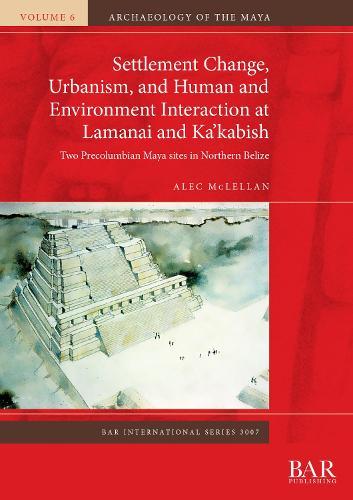
OverviewFull Product DetailsAuthor: Alec McLellanPublisher: BAR Publishing Imprint: BAR Publishing Weight: 0.925kg ISBN: 9781407357560ISBN 10: 1407357565 Pages: 232 Publication Date: 29 October 2020 Audience: Professional and scholarly , Professional & Vocational Format: Paperback Publisher's Status: Active Availability: Available To Order We have confirmation that this item is in stock with the supplier. It will be ordered in for you and dispatched immediately. Table of Contents"List of Figures List of Tables Glossary of Terms Abstract Introduction Research Questions Review of Chapters 1. Maya History and the sites of Lamanai and Ka'kabish 1.1 Overview of Maya History 1.1.1 Paleoindian Period (12,000 BC to 7000 BC) 1.1.2 Archaic Period (7000 BC to 2000 BC) 1.1.3 Preclassic Period (2000 BC to AD 250) 1.1.4 Classic Period (AD 250 to 900) 1.1.5 Postclassic Period (AD 900 to 1521) 1.1.6 Spanish Colonial Period (AD 1521 to 1708) 1.2 The Precolumbian Maya at Lamanai 1.2.1 Archaeological History 1.2.2 Location and Composition 1.3 The Precolumbian Maya at Ka'kabish 1.3.1 Archaeological History 1.3.2 Location and Composition 1.4 Summary 2. Settlement Patterns and Maya Urbanism 2.1 Settlement Patterns 2.1.1 A Definition of Settlement Patterns 2.1.2 Settlement Patterns and the Colonial Past 2.1.3 The Advent of Archaeology in the New World 2.1.4 Towards a Systematic Approach 2.1.5 Post-1960s and Settlement Systems 2.1.6 Settlement Patterns and Contemporary Studies 2.2 Maya Urbanism 2.2.1 Definitions of Urbanism 2.2.2 Population, Density, and Urbanism 2.2.3 Low-Density and Peri-urban Settlements in the Past 2.2.4 The Sustainable and Resilient City 2.2.5 Current Theories and the Archaeological Record 2.3 Summary 3. Human and Environment Interaction, Landscape Modification, and Spatial Organisation of the Precolumbian Maya 3.1 The Built Environment 3.1.1 A Comparison of the Size and Scale of Two Ancient Cities 3.1.2 Spatial Organization and the ""Mayacene"" 3.1.3 Urban Heat Islands, Lime Production, and Green Cities 3.2 Landscape Modifications and the Precolumbian Maya 3.2.1 Water Retention Systems and Landscape Transformation 3.2.2 Terraces and Agricultural Intensification 3.2.3 Land Clearance, Deforestation, and Soil Erosion 3.3 The Precolumbian Maya and the Contemporary World 3.3.1 Deforestation and Soil Erosion in the Current Era 3.3.2 Human Niche Construction 3.4 Summary 4. Methods: Analysing and Recording Precolumbian Maya Settlement 4.1 Lamanai and Ka'kabish: Re-analysis of Existing Data 4.1.1 Interpreting Temporal Dynamics at Lamanai 4.1.2 Interpreting Temporal Dynamics at Ka'Kabish 4.2 The Inter-site Settlement Zone: Surface Survey 4.2.1 Archaeological History of the Settlement Zone 4.2.1.1 The Maya Research Project Survey 4.2.1.2 The Spring Mapping Project Survey 4.2.2 Survey and Mapping Techniques 4.2.3 Field Conditions 4.2.4 Ceramic Assemblages 4.2.5 Lithic Assemblages 4.3 Geomorphology and Landscape Ecology 4.4 Presentation and Arrangement of Data 4.4.1 Designation of the Settlement Zone 4.4.2 A Heuristic Device 4.4.3 Sherd Density 4.4.4 Relative-Risk Surfaces 4.5 Methodological Justification and Limitations 4.5.1 Methodological Justification 4.5.2 Methodological Limitations 4.6 Summary 5. The Civic-Ceremonial Centres of Lamanai and Ka'kabish 5.1 The Chronology at Lamanai 5.1.1 Evidence from the Middle Preclassic to Early Classic periods 5.1.2 Evidence from the Late Classic to Late Postclassic periods 5.2 The Temporal Dynamics at Lamanai 5.3 The Chronology at Ka'kabish 5.3.1 Evidence from the Middle Preclassic to Late Postclassic Periods 5.4 The Temporal Dynamics at Ka'kabish 5.5 Summary 6. The Inter-site Settlement Zone and its Artefacts 6.1 Spacial Distribution of the Structures 6.1.1 Settlement Zone A 6.1.2 Settlement Zone B 6.1.3 Settlement Zone C 6.1.4 Settlement Zone D 6.1.5 Settlement Zone E 6.1.6 Settlement Zone F 6.2 Ceramic Assemblage 6.2.1 Type:Variety 6.2.2 Density and Distribution of Sherds 6.2.2.1 Settlement Zone A 6.2.2.2 Settlement Zone B 6.2.2.3 Settlement Zone C 6.2.2.4 Settlement Zone D 6.2.2.5 Settlement Zone E 6.2.2.6 Settlement Zone F 6.3 Lithic Assembalge 6.4 Temporal Dynamics of the Settlement Zone 6.4.1 Settlement Zone A 6.4.2 Settlement Zone B 6.4.3 Settlement Zone C 6.4.4 Settlement Zone D 6.4.5 Settlement Zone E 6.4.6 Settlement Zone F 6.5 Summary 7. Human and Environmental Dynamics in the Region 7.1 Environmental Setting of the Study 7.2 Evidence of Environmental Change 7.2.1 Environmental Change and the New River Lagoon 7.2.2 History of Vegetation Change 7.2.3 Agroforestry and the Exploitation of Pine 7.3 Settlement Dynamics and the Changing Environment 7.3.1 Settlement Dynamics in the Study Zone 7.3.2 Human/Environment Interaction at Ka'kabish, Lamanai, and the Inter-Site Settlement Zone 7.3.3 The Environment and the Maya 7.4 Summary 8. Lamanai, Ka'kabish, the Inter-site Settlement Zone, and the Greater Region of Northern Belize 8.1 Major Sites within 25 km of Lamanai 8.1.1 Greater Lamanai Region 8.1.1.1 Chau Hiix 8.1.1.2 El Pozito 8.1.2 Dynamics of Sites within 25 km 8.2 Major Sites Between 25-50 km from Lamanai 8.2.1 Three Rivers Region 8.2.1.1 La Milpa 8.2.1.2 Blue Creek 8.2.1.3 Dos Hombres 8.2.2 Northern Belize Region 8.2.2.1 Nohmul"Reviews{\rtf1\ansi\ansicpg1252\deff0\deflang2057{\fonttbl{\f0\fswiss\fprq2\fcharset0 Calibri;}{\f1\fnil\fcharset0 Verdana;}} \viewkind4\uc1\pard\sa160\sl252\slmult1\f0\fs22\lquote Ever since the discovery of Early Postclassic public architecture at Lamanai, the site was regarded as an anomaly that survived the precipitous population decline of the 9\super th\nosupersub century. Now we know that this time was Lamanai\rquote s population peak and have new ways of going forward to understand how it thrived while other cities were abandoned.\rquote Professor Thomas Guderjan, The University of Texas at Tyler\par \par \lquote Alec McLellan\rquote s monograph is well written, well researched, and well thought out. It is fresh, timely, and exciting research and it fills a big gap in our understanding of Lamanai and of northern Belize during the Preclassic, Classic, and Postclassic periods.\rquote Dr Terry Powis, Kennesaw State University \par \par \lquote\lang1033 I looked at each chapter and found something useful at every turn. This book will be incredibly useful for anyone involved in Maya (or Mesoamerican) archaeology.\rquote Professor Fred Valdez, Jr., The University of Texas at Austin\lang2057\par \pard\f1\fs17\par } Author InformationAlec McLellan is a Research Fellow at Trent University, Peterborough, Canada. He has excavated archaeological sites in Belize, Canada, and the United Kingdom. He specialises in settlement patterns, spatial analysis, geographic information systems, and early complex societies. Alec received his PhD from University College London. Tab Content 6Author Website:Countries AvailableAll regions |
||||