Overview
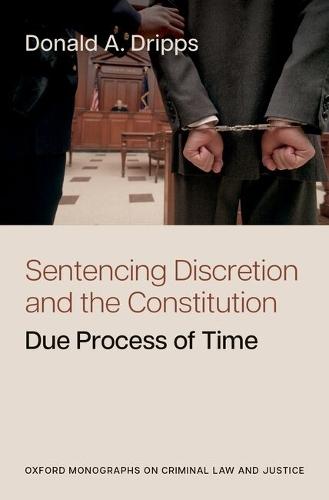
The U.S. Supreme Court maintains that prosecutorial discretion to charge different offenses authorized by the penal code is practically limited only by the penal code itself. Because typical offense conduct violates multiple statutes carrying different maximum – and minimum – sentences, by choosing the charge, the prosecution commonly also chooses the sentence. The Court, however, holds that when judges exercise sentencing discretion, due process requires impeccable neutrality and adversary hearings. Sentencing Discretion and the Constitution: Due Process of Time addresses the fundamental incompatibility of the U.S. Supreme Court's approach to the sentencing power of judges as compared to prosecutors. The Court says that when prosecutors induce a guilty plea by filing lesser charges than the code allows, the defendant is getting a break rather than being strong-armed. This doctrinal fiction persists because neither dissenting justices nor academic critics have yet justified a baseline by which the infliction of years – or even decades – in prison for refusing to plead guilty or to provide information, should be treated as a coercive threat rather than an offer permitted in the ""give and take"" of plea bargaining. In theory, the charges filed should be proportional to culpability, not the most severe the code permits. This raises another hard problem: theorists have not to date advanced a persuasive account of proportionate punishment. Unlike prior works, Sentencing Discretion and the Constitution exposes the connections between these problems and proposes a unified solution. The right against excessive punishment, like the right against erroneous conviction, is best understood as a right to procedural justice. More broadly, curtailing prosecutorial sentencing is an essential step toward curtailing mass incarceration – a problem that otherwise is more likely to get worse than better. This book will be of interest to readers concerned with plea bargaining, sentencing, constitutional law, legal history, and criminal law theory.
Full Product Details
Author: Donald A. Dripps (Class of 1975 Endowed Professor, Class of 1975 Endowed Professor, University of San Diego School of Law)
Publisher: Oxford University Press Inc
Imprint: Oxford University Press Inc
Dimensions:
Width: 16.50cm
, Height: 2.30cm
, Length: 24.20cm
Weight: 0.508kg
ISBN: 9780197830369
ISBN 10: 0197830366
Pages: 240
Publication Date: 20 April 2026
Audience:
College/higher education
,
Postgraduate, Research & Scholarly
Format: Hardback
Publisher's Status: Active
Availability: To order

Stock availability from the supplier is unknown. We will order it for you and ship this item to you once it is received by us.
Author Information
Donald A. Dripps is a graduate of Northwestern University and the University of Michigan Law School, where he was Editor-in-Chief of the Michigan Law Review. After law school, he clerked for second-circuit Judge Amalya Lyle Kearse, and then taught at Illinois and Minnesota before joining the faculty of the University of San Diego School of Law. His publications include About Guilt and Innocence: The Origins, Development, and Future of Constitutional Criminal Procedure (Greenwood Press, 2003) and dozens of articles, including contributions to the Yale Law Journal and the California, Columbia, NYU, USC and Vanderbilt law reviews.