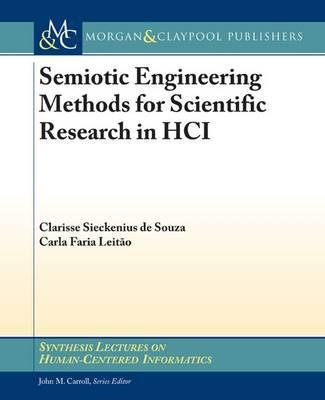
Semiotic Engineering Methods for Scientific Research in HCI

Author:   Sickenius de Souza ,  Carla Faria Leitao ,  John Millar Carroll
Publisher:   Morgan & Claypool Publishers
ISBN:  

9781598299441


Pages:   122
Publication Date:   15 April 2009
Format:   Paperback
Availability:   In Print   Availability explained
Limited stock is available. It will be ordered for you and shipped pending supplier's limited stock.

Our Price $92.40 Quantity:  
Add to Cart

Share |

Semiotic Engineering Methods for Scientific Research in HCI


Overview

Semiotic engineering was originally proposed as a semiotic approach to designing user interface languages. Over the years, with research done at the Department of Informatics of the Pontifical Catholic University of Rio de Janeiro, it evolved into a semiotic theory of human-computer interaction (HCI). It views HCI as computer-mediated communication between designers and users at interaction time. The system speaks for its designers in various types of conversations specified at design time. These conversations communicate the designers' understanding of who the users are, what they know the users want or need to do, in which preferred ways, and why. The designers' message to users includes even the interactive language in which users will have to communicate back with the system in order to achieve their specific goals. Hence, the process is, in fact, one of communication about communication, or metacommunication. Semiotic engineering has two methods to evaluate the quality of metacommunication in HCI: the semiotic inspection method (SIM) and the communicability evaluation method (CEM). Up to now, they have been mainly used and discussed in technical contexts, focusing on how to detect problems and how to improve the metacommunication of specific systems. In this book, Clarisse de Souza and Carla Leitão discuss how SIM and CEM, which are both qualitative methods, can also be used in scientific contexts to generate new knowledge about HCI. The discussion goes into deep considerations about scientific methodology, calling the reader's attention to the essence of qualitative methods in research and the kinds of results they can produce. To illustrate their points, the authors present an extensive case study with a free open-source digital audio editor called Audacity. They show how the results obtained with a triangulation of SIM and CEM point at new research avenues not only for semiotic engineering and HCI but also for other areas of computer science such as software engineering and programming.

Full Product Details

Author:   Sickenius de Souza ,  Carla Faria Leitao ,  John Millar Carroll
Publisher:   Morgan & Claypool Publishers
Imprint:   Morgan & Claypool Publishers
Dimensions:   Width: 18.70cm , Height: 0.70cm , Length: 23.50cm
Weight:   0.248kg
ISBN:  

9781598299441


ISBN 10:   1598299441
Pages:   122
Publication Date:   15 April 2009
Audience:   Professional and scholarly ,  Professional & Vocational
Format:   Paperback
Publisher's Status:   Unknown
Availability:   In Print   Availability explained
Limited stock is available. It will be ordered for you and shipped pending supplier's limited stock.

Table of Contents

Reviews

Author Information

Tab Content 6

Author Website:  

Countries Available

All regions
Latest Reading Guide

NOV RG 20252


Shopping Cart
Your cart is empty
Shopping cart
Mailing List