|
|
|||
|
||||
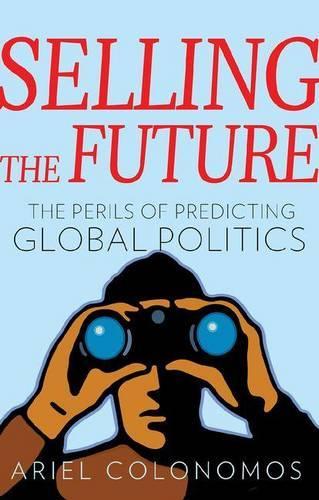
OverviewIn an age of uncertainty, those who can anticipate revolution, the outbreak of wars, or which states might default are much in demand. The marketplace of ideas about the future is huge, and includes 'wonks"", scholars and pundits who produce scenarios, predictions and ratings. The more opaque the future seems to be, so the relation between knowledge and power intensifies, above all the nexus between those who sell their expertise and those who consume it. In his investigation of the paradoxes of forecasting, Ariel Colonomos interrogates today's knowledge factories to reveal how our futures are shaped by social scientists, think tanks and rating agencies. He explains why conservative and linear predictions prevail, and why the future, especially when linked to national interest, reflects a systematic search for stability. The notion of a globalized world whose main characteristic is speed, and where predictions have accelerating, self-fulfilling effects, is obsolete. Those who are supposed to know, reassure those who are supposed to act. Their preferences converge, and thus the industry of the future has a decelerating effect on world politics. These 'lords of knowledge' reinforce pre-existing beliefs, create expectations about the future, while obstructing its vision when -- inevitably -- it diverges from its orderly path. Full Product DetailsAuthor: Ariel Colonomos (CERI/CNRS) , Gregory ElliottPublisher: OUP India Imprint: OUP India Dimensions: Width: 14.50cm , Height: 2.30cm , Length: 21.80cm Weight: 0.408kg ISBN: 9780190603649ISBN 10: 019060364 Publication Date: 15 August 2016 Audience: General/trade , General Format: Hardback Publisher's Status: Active Availability: Available To Order We have confirmation that this item is in stock with the supplier. It will be ordered in for you and dispatched immediately. Table of ContentsReviewsColonomos ends by pondering the ambivalence humans have toward knowing the future. Readers are induced to contemplate an age-old issue: the perfectibility of the human condition. Is the model ever upward evolution or civilizational rise, decline, and fall? Summing up: Recommended. -- <em>CHOICE</em> Author InformationAriel Colonomos is Senior Research Fellow, CERI/CNRS, Paris. Tab Content 6Author Website:Countries AvailableAll regions |
||||