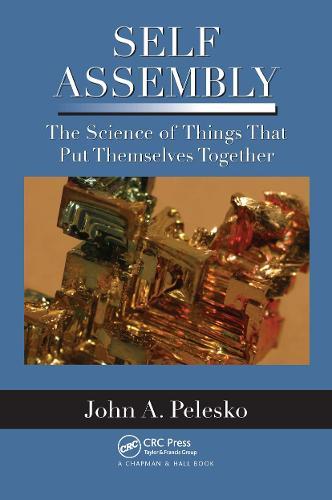
Full Product Details
Author: John A. Pelesko
Publisher: Taylor & Francis Inc
Imprint: Chapman & Hall/CRC
Dimensions:
Width: 15.20cm
, Height: 1.70cm
, Length: 22.90cm
Weight: 0.476kg
ISBN: 9781584886877
ISBN 10: 1584886870
Pages: 336
Publication Date: 21 May 2007
Audience:
Professional and scholarly
,
Professional & Vocational
Format: Paperback
Publisher's Status: Active
Availability: In Print

This item will be ordered in for you from one of our suppliers. Upon receipt, we will promptly dispatch it out to you. For in store availability, please contact us.
Reviews
[The book] is really very beautiful. It is a fantastic list of disparate topics that are all elegantly organized around the theme of self assembly. [The author has] managed to put together a coherent story starting with simple physical effects, such as surface tension and bubble rafts, to organic systems like the tobacco mosaic virus and the ribosome to the Cheerios effect (for those of us who like breakfast cereal!). This is then elegantly connected to George Whiteside's engineered Cheerios effect, to magnetic self assembly and finally ending with very recent work on DNA self assembly-including even the latest work out of Winfree's lab! It is really terrific. I had not considered how powerful a course about self assembly would be before I saw how [the author] put everything together in [this] book. -Dr. Michael P. Brenner, Glover Professor of Applied Mathematics and Applied Physics, Harvard University, Cambridge, Massachusetts, USA Self-assembly is an exploding field, the basis of both biological systems and the most advanced nanotechnologies. Self Assembly offers the reader a unique guide: it spans scales ranging from molecular to macroscopic, levels of complexity ranging from simple crystals to systems that compute, and modes of understanding ranging from equations to experiments with floating soda straws. It's the best introduction I've seen. -Dr. K. Eric Drexler, author of Nanosystems: Molecular Machinery, Manufacturing, and Computation This text of John Pelesko's is a wonderful introduction to the emerging field of self assembly. Self assembly is an important field to be informed about at this time, in part because it is critical to the science and engineering of nanostructures and nanodevices constructed on scales below the limits of conventional top-down methodologies such as lithography. He manages superbly to impart to the reader the excitement of the ongoing research in this quickly evolving and highly interdisciplinary field. The text ranges over a wide variety of topics, including the impact of self assembly to nanoscience, chemistry, biochemistry, physics, material science, and robotics. It covers a number of recent revolutionary breakthroughs in self assembly, demonstrating the self assembly of complex and richly patterned nanostructures. The text would be essential reading to anyone in these fields, as well as to anyone with a curiosity about the basic processes that are used by nature to assemble the most complex things we know about in the universe-ourselves. -John H. Reif, A. Hollis Edens Distinguished Professor of Computer Science, Duke University, Durham, North Carolina, USA
""[The book] is really very beautiful. It is a fantastic list of disparate topics that are all elegantly organized around the theme of self assembly. [The author has] managed to put together a coherent story starting with simple physical effects, such as surface tension and bubble rafts, to organic systems like the tobacco mosaic virus and the ribosome to the Cheerios effect (for those of us who like breakfast cereal!). This is then elegantly connected to George Whiteside's engineered Cheerios effect, to magnetic self assembly and finally ending with very recent work on DNA self assembly-including even the latest work out of Winfree's lab! It is really terrific. I had not considered how powerful a course about self assembly would be before I saw how [the author] put everything together in [this] book."" -Dr. Michael P. Brenner, Glover Professor of Applied Mathematics and Applied Physics, Harvard University, Cambridge, Massachusetts, USA ""Self-assembly is an exploding field, the basis of both biological systems and the most advanced nanotechnologies. Self Assembly offers the reader a unique guide: it spans scales ranging from molecular to macroscopic, levels of complexity ranging from simple crystals to systems that compute, and modes of understanding ranging from equations to experiments with floating soda straws. It's the best introduction I've seen."" -Dr. K. Eric Drexler, author of Nanosystems: Molecular Machinery, Manufacturing, and Computation ""This text of John Pelesko's is a wonderful introduction to the emerging field of self assembly. Self assembly is an important field to be informed about at this time, in part because it is critical to the science and engineering of nanostructures and nanodevices constructed on scales below the limits of conventional top-down methodologies such as lithography. He manages superbly to impart to the reader the excitement of the ongoing research in this quickly evolving and highly interdisciplinary field. The text ranges over a wide variety of topics, including the impact of self assembly to nanoscience, chemistry, biochemistry, physics, material science, and robotics. It covers a number of recent revolutionary breakthroughs in self assembly, demonstrating the self assembly of complex and richly patterned nanostructures. The text would be essential reading to anyone in these fields, as well as to anyone with a curiosity about the basic processes that are used by nature to assemble the most complex things we know about in the universe-ourselves."" -John H. Reif, A. Hollis Edens Distinguished Professor of Computer Science, Duke University, Durham, North Carolina, USA
"""[The book] is really very beautiful. It is a fantastic list of disparate topics that are all elegantly organized around the theme of self assembly. [The author has] managed to put together a coherent story starting with simple physical effects, such as surface tension and bubble rafts, to organic systems like the tobacco mosaic virus and the ribosome to the Cheerios effect (for those of us who like breakfast cereal!). This is then elegantly connected to George Whiteside's engineered Cheerios effect, to magnetic self assembly and finally ending with very recent work on DNA self assembly-including even the latest work out of Winfree's lab! It is really terrific. I had not considered how powerful a course about self assembly would be before I saw how [the author] put everything together in [this] book."" -Dr. Michael P. Brenner, Glover Professor of Applied Mathematics and Applied Physics, Harvard University, Cambridge, Massachusetts, USA ""Self-assembly is an exploding field, the basis of both biological systems and the most advanced nanotechnologies. Self Assembly offers the reader a unique guide: it spans scales ranging from molecular to macroscopic, levels of complexity ranging from simple crystals to systems that compute, and modes of understanding ranging from equations to experiments with floating soda straws. It's the best introduction I've seen."" -Dr. K. Eric Drexler, author of Nanosystems: Molecular Machinery, Manufacturing, and Computation ""This text of John Pelesko's is a wonderful introduction to the emerging field of self assembly. Self assembly is an important field to be informed about at this time, in part because it is critical to the science and engineering of nanostructures and nanodevices constructed on scales below the limits of conventional top-down methodologies such as lithography. He manages superbly to impart to the reader the excitement of the ongoing research in this quickly evolving and highly interdisciplinary field. The text ranges over a wide variety of topics, including the impact of self assembly to nanoscience, chemistry, biochemistry, physics, material science, and robotics. It covers a number of recent revolutionary breakthroughs in self assembly, demonstrating the self assembly of complex and richly patterned nanostructures. The text would be essential reading to anyone in these fields, as well as to anyone with a curiosity about the basic processes that are used by nature to assemble the most complex things we know about in the universe-ourselves."" -John H. Reif, A. Hollis Edens Distinguished Professor of Computer Science, Duke University, Durham, North Carolina, USA"
Author Information
University of Delaware, Newark, USA