Overview
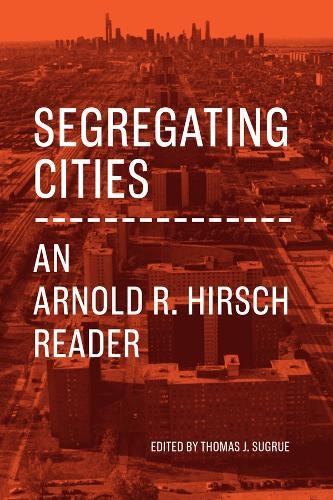
Collects critical essays by the author of Making the Second Ghetto. Arnold R. Hirsch (1949–2018) was one of the preeminent urban historians of his generation, a reputation cemented by his landmark book, Making the Second Ghetto. With compelling clarity, Hirsch demonstrated that segregation is not the inevitable result of individual choices, natural tendencies, or cultural traits—it is a structural phenomenon, reinforced on every level by state power. Segregating Cities collects the author’s key essays, some previously unpublished, to reveal a more complete picture of a remarkable scholar and his exploration of race, place, politics, and policy in the twentieth-century American city. Together, these essays can help us see segregation for what it is, so that we can then begin to truly work to overcome it.
Full Product Details
Author: Arnold R. Hirsch ,
Thomas J. Sugrue
Publisher: The University of Chicago Press
Imprint: University of Chicago Press
Weight: 0.454kg
ISBN: 9780226744407
ISBN 10: 022674440
Pages: 552
Publication Date: 07 May 2026
Audience:
Professional and scholarly
,
College/higher education
,
Professional & Vocational
,
Postgraduate, Research & Scholarly
Format: Hardback
Publisher's Status: Active
Availability: In Print

This item will be ordered in for you from one of our suppliers. Upon receipt, we will promptly dispatch it out to you. For in store availability, please contact us.
Reviews
“Hirsch’s prose is at once careful and cutting, laying bare the structural and social forces that shaped our urban environment. Segregating Cities is authoritative, urgent, and humane scholarship. It’s a model and inspiration for anyone who values the truth about America and race.” -- Josh Levin, author of “The Queen: The Forgotten Life Behind an American Myth” “As he did over four decades ago, Hirsch continues to enlighten us on the key actors, guiding principles, and policy choices that shaped US cities and their racial composition in the post-World War era. Lest we think that segregation, particularly in northern cities, happened naturally or by accident, Hirsch dives deep into local and federal policymakers’ and elected officials’ deliberations, their private comments, public pronouncements, and the frequent contradictions between the two. He shows us the consequences of their actions. He also highlights those who had the courage to defend racial liberalism, integration, and equitable policies for African Americans and other minorities. Hirsch has left an extraordinary legacy for urban historians.” -- Lilia Fernández, author of “Brown in the Windy City: Mexicans and Puerto Ricans in Postwar Chicago”
“As he did over four decades ago, Hirsch continues to enlighten us on the key actors, guiding principles, and policy choices that shaped US cities and their racial composition in the post-World War era. Lest we think that segregation, particularly in northern cities, happened naturally or by accident, Hirsch dives deep into local and federal policymakers’ and elected officials’ deliberations, their private comments, public pronouncements, and the frequent contradictions between the two. He shows us the consequences of their actions. He also highlights those who had the courage to defend racial liberalism, integration, and equitable policies for African Americans and other minorities. Hirsch has left an extraordinary legacy for urban historians.” -- Lilia Fernández, author of “Brown in the Windy City: Mexicans and Puerto Ricans in Postwar Chicago”
“Hirsch’s prose is at once careful and cutting, laying bare the structural and social forces that shaped our urban environment. Segregating Cities is authoritative, urgent, and humane scholarship. It’s a model and inspiration for anyone who values the truth about America and race.” -- Josh Levin, author of “The Queen: The Forgotten Life Behind an American Myth” “Every scholar today who writes about racism, segregation, class, immigration, liberalism, housing, cities, mob violence, municipal, state or federal politics, or the construction of whiteness owes a debt to Arnold R. Hirsch. This fine collection of Hirch’s brilliant and bracing articles, including several that were never-before published, demonstrates why.” -- Beryl Satter, author of “Cash on the Block: The Broken Promise of Reinvestment in Black Urban Neighborhoods” “The influence of Hirsch’s scholarship on how historians today conceive and write about race, power, and politics in twentieth-century American cities cannot be overstated. This compilation of Hirsch’s most important essays, including previously unpublished work, will be essential reading for anyone seeking to understand how the structures and institutions that fuel racial segregation and inequality were built and maintained, as well as for those who are working to dismantle them.” -- Andrew W. Kahrl, author of “The Black Tax: 150 Years of Theft, Exploitation, and Dispossession in America” “Segregating Cities is an important collection of the work of Arnold R. Hirsch, a historian who reframed the discussion of race, ethnicity, and social class in the American city. This compilation demonstrates the vast scope of Hirsch’s work and adds to the continuing discussion of his concept of the Second Ghetto and its impact on American urban life. It is a worthy partner to his classic study, Making the Second Ghetto, and a vital book for anyone interested in the ongoing discussion of race in the United States.” -- Dominic A. Pacyga, author of “Clout City: The Rise and Fall of the Chicago Political Machine” “As he did over four decades ago, Hirsch continues to enlighten us on the key actors, guiding principles, and policy choices that shaped US cities and their racial composition in the post-World War era. Lest we think that segregation, particularly in northern cities, happened naturally or by accident, Hirsch dives deep into local and federal policymakers’ and elected officials’ deliberations, their private comments, public pronouncements, and the frequent contradictions between the two. He shows us the consequences of their actions. He also highlights those who had the courage to defend racial liberalism, integration, and equitable policies for African Americans and other minorities. Hirsch has left an extraordinary legacy for urban historians.” -- Lilia Fernández, author of “Brown in the Windy City: Mexicans and Puerto Ricans in Postwar Chicago”
Author Information
Arnold R. Hirsch (1949–2018) was the Ethel and Herman L. Midlo Endowed Chair for New Orleans Studies at the University of New Orleans. The author of the influential Making the Second Ghetto: Race and Housing in Chicago, 1940–1960, Hirsch’s research showed how racism pervaded every stratum of American society. Thomas J. Sugrue is the Julius Silver Professor of Social and Cultural Analysis and History at New York University. He is the author of Not Even Past: Barack Obama and the Burden of Race, Sweet Land of Liberty: The Forgotten Struggle for Civil Rights in the North, and The Origins of the Urban Crisis: Race and Inequality in Postwar Detroit, as well as coauthor of These United States: A Nation in the Making, 1890 to the Present.