Overview
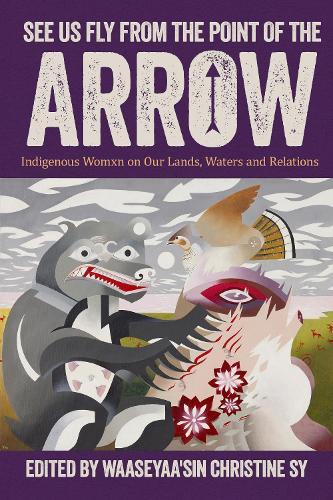
This textured collection of essays by Indigenous contributors from across Turtle Island and beyond illuminates stories, dialogues and curations invoked through the idea of home-lands, waters and relations. From Mushkego poetics and Ktunaxa exhortation to Palestinian, Dharug and nêhiyaw movement, these offerings wrap us in a diversity of womxns’ thoughts and voices.
Full Product Details
Author: waaseyaa'sin Christine Sy ,
Doctor Tasha Beeds ,
Shirina Evans ,
Mariam Georgis
Publisher: Wolsak & Wynn Publishers
Imprint: Wolsak & Wynn Publishers
Dimensions:
Width: 15.20cm
, Height: 1.30cm
, Length: 22.90cm
ISBN: 9781998408214
ISBN 10: 1998408213
Pages: 250
Publication Date: 02 June 2026
Audience:
General/trade
,
General
Format: Paperback
Publisher's Status: Forthcoming
Availability: Not yet available

This item is yet to be released. You can pre-order this item and we will dispatch it to you upon its release.
Author Information
waaseyaa’sin Christine Sy is Ojibwe from Bawating Sault Ste. Marie and Lac Seul First Nation in Northwestern Ontario. Her mother is Mary Chisel-ban, and her father is Jim Hammond from Bell Island, Newfoundland. The mother of a young adult bear and human to a beloved cat with many sweet nicknames, she enjoys photography, following social media content creators, visiting with friends and getting to know family members. Living now in lək̓ʷəŋən territory, she is thrilled to be able throw herself into the winter Salish Sea during the occasional perimenopausal moment. Presently writing a monograph about Anishinaabeg “at the boiling place” – the sugar bush – she has also been published in various literary journals with her most recent poem, “persons on the side of the road,” being published in a special issue of the Great Lakes Review (2023). The fact is the pandemic snatched her literary verve and it’s taking its time returning. Dr. Tasha Beeds is a Black-Indigenous scholar of nêhiyaw, Scottish-Metis and mixed Bajan ancestry from the Treaty 6 Territories of Saskatchewan. She moves through the world in the layered fullness of these lineages, living her work through many intertwined roles: mother, kôhkom, Aunty, creative artist, poet, Water Walker and Midewiwin woman from Minweyweywigaan Lodge, grounded in Roseau River First Nation and Wiikwemkoong Unceded Territory. Internationally recognized for her research and Water protection work, she has been supported by the Bibliographic Society of America, NdN Collective, and Na’ah Illahee, and has held roles with the University of Saskatchewan, University of Windsor, Carleton University, Queen’s University and Kenjgewin Teg. Carrying Water Walk teachings from the late Josephine Mandamin-Ba, the late Shirley Ida Eliza Williams-Ba, and Liz Osawamick, she has Walked for the Water in for sixteen years. Her work honours Indigenous brilliance and sovereignty, carrying Ancestral teachings forward for future generations. Shirina Evans is a nêhiyaw iskwêw (Cree womxn), mother, scholar and legal researcher. She is a member of the Lac La Ronge Indian Band and a JD/JID candidate at the University of Victoria, where her research focuses on Indigenous land governance, treaty interpretation and the legal infrastructures of settler colonialism. Her work examines how surveying, property law and administrative regimes have operated together to dispossess Indigenous nations while constraining Indigenous access to courts and legal remedies. Shirina has over eight years of experience working within the Canadian criminal justice system and currently collaborates with First Nations on governance, land and legal research initiatives. Beyond academia, she is deeply committed to Indigenous language revitalization and creative practice, using writing and visual work to explore law, memory and land. Her scholarship is grounded in relational responsibility, Cree legal principles and lived experience. Mariam Georgis is Assyrian from now called Iraq. Displaced from her homeland as a child, she arrived in now called Canada and grew up on the land covered by the Dish With One Spoon Wampum Belt Covenant, present-day Hamilton, ON. She currently resides on the traditional territories of the səl̓ilw̓ətaʔɬ (Tsleil-Waututh), kʷikʷəƛ̓əm (Kwikwetlem), Sḵwx̱wú7mesh Úxwumixw (Squamish) and xʷməθkʷəy̓əm (Musqueam) West Coast Salish nations. Mariam is an assistant professor of Global Indigeneity in the Department of Gender, Sexuality and Women’s Studies at Simon Fraser University where she teaches Global Approaches to Indigenous Feminisms and Indigeneities Around the World. Grounded in embodied decolonial feminist epistemologies, her scholarship is located at the nexus of global politics, critical Indigenous studies and Middle East studies. Her research interests include issues of global colonialism(s), Indigeneities and decolonization; global security and violence; and politics of southwest Asia. Joyce Green is a citizen of the Ktunaxa Nation and a member of Yaq̓it ʔa·knuqⱡiʔit (Tobacco Plains Indian Band). She lives in ʔa·kiskaqⱡi?it – “where two trails meet on the prairie” (Cranbrook, BC), in ʔamakʔis Ktunaxa – the unceded and stolen territory of the Ktunaxa Nation. Her ancestry includes English, Ktunaxa and Cree-Scots Metis people and she honours them all. Her research interests focus on Indigenous-settler relations and the possibility of decolonization in Canada; and a transformative ecology of relationship with place, epitomized by many traditional Indigenous conceptions of land and place. She is the editor of three books (Making Space for Indigenous Feminism [editions 1 and 2]) and Indivisible: Indigenous Human Rights (all Fernwood Publishing). She is Professor Emerita of Political Science (retired) at the University of Regina, and is a student of the Ktunaxa language now. Salam Hamdan is a Palestinian living in ramallah in the West Bank. Her first language is Arabic, her dialect is Palestinian. Salam is a mother to a daughter named luna, and a grandmother mother to Maya and Sophie. She is an artist, who uses art as a form of resistance against colonization and oppression. She’s also a writer who has published a number of articles and essays. She's a founder of Insan Center for Gender Studies at Al-Quds university in Jerusalem. She is a social and political activist. Loreisa Lepine is the first officially recognized and “ongoing” Indigenous Land Steward at the University of Victoria and is also the first lək̓ʷəŋən woman to teach as a sessional professor in the school of Environmental Studies and the Restoration of Natural Systems Program. Loreisa’s role was built around advocating for the integral responsibility of Indigenous women and Two-Spirit people in the transmission of knowledge outside and within restrictive colonial systems. Loreisa’s work involves the creation and prioritization of reconnection to land for Indigenous students in their homelands. Outside of their work as Indigenous Land Steward, they are an avid reader, and practising artist of many mediums including weaving, cowichan knitting, clothing design, jewelry making and poetry. They are also a thaunty (they/aunty) that you will rarely catch without a flashy pair of earrings on to match their very colourful wardrobe. Mary Jane Metatawabin is a Mushkego Elder from Fort Albany First Nation. She is a proud grandmother, mother, sister, auntie and daughter. Raised in her language, she translates and interprets the world through the primacy of her Mushkego regional view. She has created Cree language resources (Turtle’s Back Publishing), aired on Wawatay News, often serves as translator or interpreter between Cree and English, and is the voiceover for the Cree version of “Conservation on the Coast” (2018). As a survivor of St. Anne’s Residential School, Mary Jane appeared in In Jesus’ Name: Shattering the Silence of St. Anne’s Residential School (2017). In 2025, she was blanketed with a quilt from Quilt for Survivors and remains active in attending gatherings amongst survivors throughout Ontario. She is often called upon to support community efforts be they within her First Nation, municipalities or regions throughout Ontario, or various institutions. A poet, orator and storyteller, Mary Jane is committed to Indigenous advocacy, cultural preservation and healing, guided by Cree Matriarchal Teachings and her lived experiences. Dr. Jo Anne Rey is a Dharug community member, caring for Dharug Ngurra/Country (most of the Sydney basin). Her doctoral academic work is centred in Country and Dharug community, particularly women, their ancestors and their connections to Ngurra/Country. Australian Aboriginal knowledges and practices are the longest continuing cultural system on the planet, more than 65,000 years. With the constant threat of climate changing catastrophes, Jo’s post-doctoral work has continued restoring Dharug community’s relationality with Ngurra through cultural fire practices as a caring for Country and mega-fire mitigation initiative. In 2024 this was activated through an historic Dharug women’s-led cultural burn at a place called Brown’s Waterhole. Jo’s connection to that waterhole is through a Brown ancestor on her mother’s line. As this was funded by a NSW State Government initiative, this was the first time Dharug women have been invited to engage in their cultural practice in the city. Yanaldyi budyari gumadawa, Walking with Good Spirit together. Dorothy Taylor is Mississauga Ojibwe Anishinaabe and is recognized as a traditional knowledge holder and Elder. She resides in the Curve Lake community with her husband, Mark. Dorothy is a storyteller and hand drummer. She is known locally and beyond as an environmental activist. Dorothy is the Founder of the Sacred Water Circle, a multi-faith collective of community volunteers with the vision of restoring humanity’s sacred relationship with water. She is a founding member of Inwendaamin Oki – How We Are Related to the Land – which brings together students, alumni and community members promoting land and water at Trent University. Elder Dorothy frequently conducts ceremonies and shares the culture in the schools. The children and the Youth are her inspiration. She lives in the light and with gratitude and most importantly love. Mavis Underwood is one of sixteen children of George and Geraldine Underwood of STAUTW, Tsawout community in WSANEC Nation. Pride grows with two daughters, Josephine and Geraldine Henry, and Grandma duties to Geraldine's daughter, Grace. Career paths for Mavis have been rich and varied. She serves the STAUTW community in health, housing, social development and education. As part of the Tsawout Bighouse Committee, Mavis shares recognition for completing the community Bighouse which serves as an anchor for WSANEC cultural continuity and life enrichment. Her achievements have been recognized with a Deryck Thomson Award for contributions to social policy change; a Woman of Distinction Award for Community Leadership; a Canada 125 Medal; and, a 2025 King Charles III Coronation Medal. Mavis’s work and community involvement is rooted in the influences of her First Nations grandparents, parents and many First Nations women and men who have role modelled the traditional values of compassion, hard work and helpfulness.