|
|
|||
|
||||
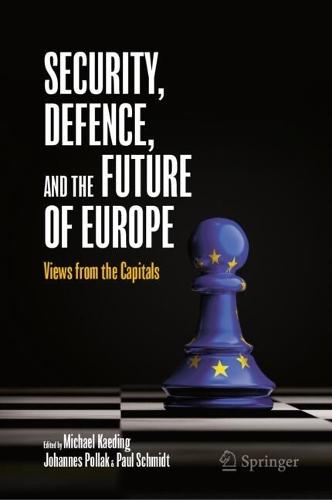
OverviewFull Product DetailsAuthor: Michael Kaeding , Johannes Pollak , Paul SchmidtPublisher: Springer Nature Switzerland AG Imprint: Springer Nature Switzerland AG ISBN: 9783032182784ISBN 10: 3032182786 Pages: 197 Publication Date: 02 May 2026 Audience: General/trade , General Format: Hardback Publisher's Status: Active Availability: Not yet available This item is yet to be released. You can pre-order this item and we will dispatch it to you upon its release. Table of ContentsChapter 1: Austria: The end of the neutrality bubble?.- Chapter 2: No fairy tale: Belgium’s struggle with defence investment.- Chapter 3: Security and defence of the EU: What is Bulgaria’s contribution?.- Chapter 4: Between NATO and the EU: Croatia’s security and defence choices.- Chapter 5: European security challenges and the case of Cyprus.- Chapter 6: Czech Security in the face of the Russian-Ukrainian War: Growing defence capabilities and their sociopolitical costs.- Chapter 7: A super-Atlanticist no more: Copenhagen turns to Europe for security and defence.- Chapter 8: Estonia: Small state, big resolve.- Chapter 9: Finland: Without security, everything is nothing.- Chapter 10: “When Paris sneezes, Europe catches a cold”: Why the French crisis is bad news for European defence.- Chapter 11: Germany’s Zeitenwende: All that glitters is not gold.- Chapter 12: European security in the danger zone: Greece’s strategic role.- Chapter 13: Hungary: The Allied outlier.- Chapter 14: Militarily neutral, but not politically neutral – a view from Ireland.- Chapter 15: Italy in security and defence: A reluctant actor.- Chapter 16: Former weakest link of European defence: The case of Latvia.- Chapter 17: Lithuania’s security and defence policy: From overreliance on collective defence to leading by example.- Chapter 18: Luxembourg: Security on the cheap.- Chapter 19: Maltese neutrality and the challenge of EU defence and security cooperation.- Chapter 20: Poland: All (not so) quiet on the Eastern front.- Chapter 21: Atlantic anchor, European pulse: Portugal’s take on security and defence.- Chapter 22: Romania’s security is inextricably linked with the transatlantic relationship.- Chapter 23: Estranged in mind, entwined in reality: Security and threat perception in Slovakia.- Chapter 24: A free-for-all: Slovenia and EU defence commitments.- Chapter 25: A reluctant spender with a focus on the South: Spain and European defence.- Chapter 26: Sweden: Supporting Europe by supporting Ukraine.- Chapter 27: The Netherlands and EU security and defence: A reluctant partnership.- Chapter 28: NEIGHBOURS.- Chapter 29: EU military and defence readiness 2030: The view from Albania.- Chapter 30: Between wars and worries: Why Bosnia and Herzegovina needs a new security compass.- Chapter 31: Georgia’s wartime shift: Isolated from the West, left alone with Russia.- Chapter 32: Iceland’s security: A new European dimension.- Chapter 33: Kosovo’s security challenges: Between progress, fragility and uncertainty.- Chapter 34: Liechtenstein: Without protection, but also without worries.- Chapter 35: Moldova’s secured European future: Defence, resilience and the enlargement imperative.- Chapter 36 : Montenegro’s perspective: Between the Atlantic and the Urals.- Chapter 37: North Macedonia: Cooperation and partnerships as fundamentals to security.- Chapter 38: Why staying outside the EU weakens Norwegian security.- Chapter 39: Security on the sidelines: Serbia’s public perceptions of European defence and strategic autonomy.- Chapter 40: Switzerland: Variations on the theme of neutrality.- Chapter 41: Between necessity and norms: Turkey’s integration into Europe’s emerging security architecture.- Chapter 42: The UK: Between the ‘Special Relationship’ with the U.S. and stronger defence cooperation with Europe.- Chapter 43: Ukraine’s lessons for Europe.ReviewsAuthor InformationDr. Michael Kaeding is a Professor for European Integration and European Union Politics at the Institute of Political Science, University of Duisburg-Essen (Germany). He is also Director of Studies at the Department of European Political and Governance Studies, part of the College of Europe in Bruges (Belgium), a Visiting Fellow of the European Institute of Public Administration in Maastricht (the Netherlands), and a Senior Research Fellow at the University of Ljubljana (Slovenia). Dr. Johannes Pollak is a Professor of International Relations and Rector of Sigmund Freud Private University in Vienna (Austria). He has previously served as Rector of Webster Vienna Private University. In summer 2019, he was elected Chair of the Board at the Institute of European Politics in Berlin (Germany). Paul Schmidt is Secretary General of the Austrian Society for European Politics in Vienna (Austria), which promotes and supports the analysis of and communications on European affairs. He has previously worked at the Oesterreichische Nationalbank, both in Vienna and at their Representative Office in Brussels at the Permanent Representation of Austria to the European Union. Tab Content 6Author Website:Countries AvailableAll regions |
||||