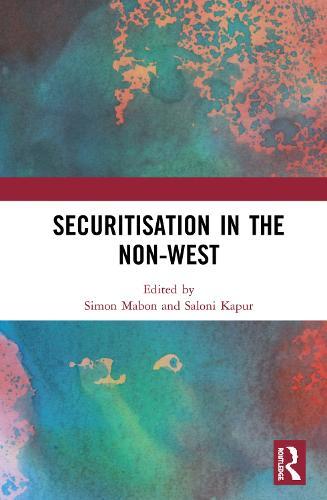
Securitisation in the Non-West

Author:   Simon Mabon (University of Lancaster, UK) ,  Saloni Kapur
Publisher:   Taylor & Francis Ltd
ISBN:  

9780367586508


Pages:   160
Publication Date:   30 June 2020
Format:   Paperback
Availability:   In Print   Availability explained
This item will be ordered in for you from one of our suppliers. Upon receipt, we will promptly dispatch it out to you. For in store availability, please contact us.

Our Price $88.99 Quantity:  
Add to Cart

Share |

Securitisation in the Non-West


Overview

The concept of securitisation has gained increasing prominence in the past decade. Initially developed in Copenhagen, the term has been used to describe the broadening of the security agenda and the framing of particular issues as existential threats across the world. In spite of this prominence, very little work has been undertaken that questions the extent to which the concept can be applied beyond the Western world. This volume engages with these questions, providing a theoretical overview of issues with using the concept beyond the West, along with empirical papers looking at its use in a number of different contexts. The chapters in this book were originally published as a special issue of Global Discourse.

Full Product Details

Author:   Simon Mabon (University of Lancaster, UK) ,  Saloni Kapur
Publisher:   Taylor & Francis Ltd
Imprint:   Routledge
Weight:   0.453kg
ISBN:  

9780367586508


ISBN 10:   0367586509
Pages:   160
Publication Date:   30 June 2020
Audience:   College/higher education ,  Tertiary & Higher Education
Format:   Paperback
Publisher's Status:   Active
Availability:   In Print   Availability explained
This item will be ordered in for you from one of our suppliers. Upon receipt, we will promptly dispatch it out to you. For in store availability, please contact us.

Table of Contents

Introduction – The Copenhagen School goes global: securitisation in the Non-West 1. ‘It’s not a Muslim ban!’ Indirect speech acts and the securitisation of Islam in the United States post-9/11 2. Recursion or rejection? Securitization theory faces Islamist violence and foreign religions 3. Review of ‘Recursion or rejection? Securitization theory faces Islamist violence and foreign religions’, by Mona Kanwal Sheikh 4. Existential threats and regulating life: securitization in the contemporary Middle East 5. Review of ‘Existential threats and regulating life: securitization in the contemporary Middle East’, by Simon Mabon 6. From Copenhagen to Uri and across the Line of Control: India’s ‘surgical strikes’ as a case of securitisation in two acts 7. Securitization analysis beyond its power-critique 8 Securitization outside of the West: conceptualizing the securitization–neo-patrimonialism nexus in Africa 9. Securitization and the global politics of cybersecurity 10. The politics of securitized technology 11. Let’s just say we’d like to avoid any great power entanglements: desecuritization in post-Mao Chinese foreign policy towards major powers 12. China and discourses of desecuritization: a reply to Vuori 13. Securitization, mafias and violence in Brazil and Mexico 14. Sovereign implications of securitization work

Reviews

Author Information

Simon Mabon is a Senior Lecturer in International Relations at Lancaster University, UK, Director of the Richardson Institute, UK, and a Research Associate at the Foreign Policy Centre, UK. He is the author of Saudi Arabia and Iran: Soft Power Rivalry in the Middle East (2013), co-author of Hezbollah: From Islamic Resistance to Government (2015), The Origins of ISIS (2016), and co-editor of Terrorism and Political Violence (2015), amongst a number of other publications pertaining to Middle Eastern politics and International Relations. Saloni Kapur is currently a PhD candidate at Lancaster University, UK. Her work interrogates international society’s responsibility towards instability in Pakistan. She employs the English school’s concepts of great-power responsibility and regional society to conduct normative research on international counterterrorism cooperation, drawing on aesthetic sources and treating terrorists as social actors.

Tab Content 6

Author Website:  

Countries Available

All regions
Latest Reading Guide

NOV RG 20252


Shopping Cart
Your cart is empty
Shopping cart
Mailing List