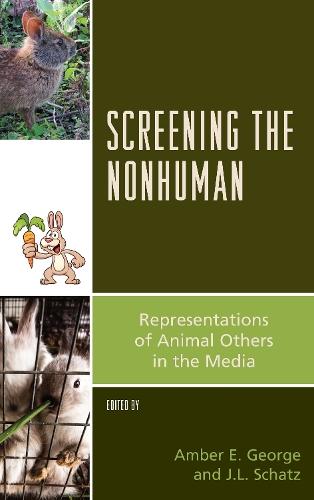
Full Product Details
Author: Amber E. George ,
J.L. Schatz ,
Joseph Anderton ,
Michael Atkinson
Publisher: Bloomsbury Publishing Plc
Imprint: Lexington Books
Dimensions:
Width: 15.10cm
, Height: 1.80cm
, Length: 21.90cm
Weight: 0.358kg
ISBN: 9781498513760
ISBN 10: 149851376
Pages: 240
Publication Date: 06 November 2018
Audience:
Professional and scholarly
,
Professional & Vocational
Format: Paperback
Publisher's Status: Active
Availability: Manufactured on demand

We will order this item for you from a manufactured on demand supplier.
Reviews
Our fellow animals have had rough treatment on film-like many of our fellow humans. But they cannot organize and protest like we can. The book you have before you gives us tools and evidence to make the case on their behalf. Freedom from harm is a basic animal right, and that applies to issues of representation as well as physical treatment. Their cause must be our cause. -- Toby Miller, author of Television Studies: The Basics Finally, analyses of animal representations in popular culture from an explicitly Critical Animal Studies point of view. I enthusiastically recommend Screening the Nonhuman: Representations of Animal Others to those who want to enhance visual literacy while opening their minds to the revolutionary perspective of total liberation. -- Ian Purdy, Executive Director, Institute for Critical Animal Studies A wonderfully insightful, provocative, and much needed book that combines critical theory, media analysis, and cultural studies with the ethics and urgency of animal liberation politics. This crossover work builds bridges between activism, academia, and the general public, and will surely inspire discussion and debate about the role of nonhuman animals in both film and society. -- Jason Del Gandio, author of Rhetoric for Radicals: A Handbook for 21st Century Activists
"Our fellow animals have had rough treatment on film—like many of our fellow humans. But they cannot organize and protest like we can. The book you have before you gives us tools and evidence to make the case on their behalf. Freedom from harm is a basic animal right, and that applies to issues of representation as well as physical treatment. Their cause must be our cause. -- Toby Miller, author of Television Studies: The Basics Finally, analyses of animal representations in popular culture from an explicitly Critical Animal Studies point of view. I enthusiastically recommend Screening the Nonhuman: Representations of Animal Others to those who want to enhance visual literacy while opening their minds to the revolutionary perspective of total liberation. -- Ian Purdy, Executive Director, Institute for Critical Animal Studies A wonderfully insightful, provocative, and much needed book that combines critical theory, media analysis, and cultural studies with the ethics and urgency of animal liberation politics. This crossover work builds bridges between activism, academia, and the general public, and will surely inspire discussion and debate about the role of nonhuman animals in both film and society. -- Jason Del Gandio, author of ""Rhetoric for Radicals: A Handbook for 21st Century Activists"""
Author Information
Amber E. George is program coordinator for the Intergroup Dialogue Project at Cornell University. J.L. Schatz is instructor at Binghamton University.