Overview
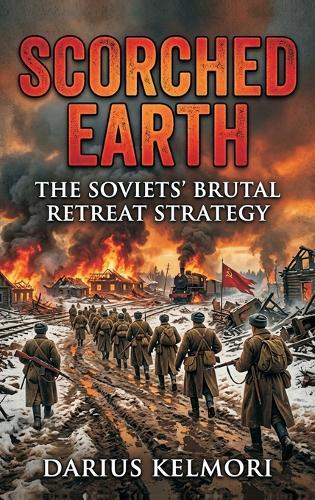
When the German invasion tore open the Soviet front in 1941, retreat was not only a military movement but a nationwide act of subtraction. Railways were stripped, factories dismantled, granaries emptied, bridges prepared for demolition, and whole populations pushed east or left to endure occupation. In that crisis, the Soviet leadership embraced scorched earth strategy as a wager that destruction could manufacture time - time to mobilise, to reconstitute armies, and to rebuild production beyond the enemy's reach. Scorched Earth: The Soviets' Brutal Retreat Strategy explains how denial worked as a system rather than a slogan. It traces soviet evacuation policy alongside industrial relocation, showing how transport bottlenecks and priority lists decided what could be saved. It follows the parallel growth of state coercion: movement controls, labour demands, and security policing meant to enforce compliance and suppress panic, often at direct cost to civilians. Across concrete cases such as rail hubs, river crossings, industrial basins, and winter withdrawals, the book asks what actually slowed an invader, what merely punished the home population, and how incomplete destruction could hand usable assets to the enemy. Written for students, general readers of modern history, and analysts of strategy and governance, this is a framework for judging denial strategies by more than dramatic images of burning towns. Readers will come away understanding how operational tempo depends on infrastructure and labour; why mobilisation is as much administrative as it is martial; and how the burdens of retreat are distributed, remembered, and rebuilt. The central lesson is not that scorched earth ""works"" or ""fails"", but that it reshapes the state and society that survive it.
Full Product Details
Author: Darius Kelmori
Publisher: Vij Books
Imprint: Vij Books
Dimensions:
Width: 15.20cm
, Height: 2.10cm
, Length: 22.90cm
Weight: 0.572kg
ISBN: 9789377944193
ISBN 10: 9377944198
Pages: 302
Publication Date: 15 April 2026
Audience:
General/trade
,
General
Format: Hardback
Publisher's Status: Active
Availability: In Print

This item will be ordered in for you from one of our suppliers. Upon receipt, we will promptly dispatch it out to you. For in store availability, please contact us.
Author Information
Darius Kelmori writes about war as an institutional stress test: the moment when plans meet scarcity, fear, and the stubborn materiality of roads, rails, and bread. His work is driven by a simple conviction that strategy cannot be understood solely through battlefield movement. It has to include the state's administrative choices, the machinery of mobilisation, and the human beings who are moved, compelled, or left behind by policy.Kelmori's approach is grounded in close reading of orders, organisational routines, and the practical language of logistics, alongside the moral vocabulary that states use to justify harm in the name of survival. He is especially interested in the boundary between necessity and excess: how governments define ""military value"", how they rank lives and assets in emergencies, and how those rankings echo into postwar recovery and political memory. That interest keeps his writing attentive to trade-offs rather than retrospective certainty.A recurring thread in his perspective is Eastern Europe's layered geography of invasion and retreat, where archives, rail junctions, and industrial towns sit atop older fault lines of empire and ideology. Instead of treating civilians as background to operations, he places everyday endurance and administrative coercion at the centre of the story. The result is nonfiction that aims to be rigorous, readable, and ethically serious: a guide to understanding not only what was destroyed, but why destruction was chosen, how it was enforced, and what it changed.