Overview
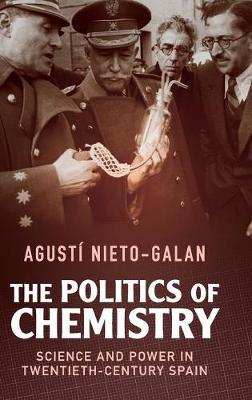
Agustí Nieto-Galan argues that chemistry in the twentieth century was deeply and profoundly political. Far from existing in a distinct public sphere, chemical knowledge was applied in ways that created strong links with industrial and military projects, and national rivalries and international endeavours, that materially shaped the living conditions of millions of citizens. It is within this framework that Nieto-Galan analyses how Spanish chemists became powerful ideological agents in different political contexts, from liberal to dictatorial regimes, throughout the century. He unveils chemists' position of power in Spain, their place in international scientific networks, and their engagement in fierce ideological battles in an age of extremes. Shared discourses between chemistry and liberalism, war, totalitarianism, religion, and diplomacy, he argues, led to advancements in both fields.
Full Product Details
Author: Agustí Nieto-Galan (Universitat Autònoma de Barcelona)
Publisher: Cambridge University Press
Imprint: Cambridge University Press
Dimensions:
Width: 15.80cm
, Height: 1.80cm
, Length: 23.50cm
Weight: 0.630kg
ISBN: 9781108482431
ISBN 10: 1108482430
Pages: 308
Publication Date: 22 August 2019
Audience:
General/trade
,
General
Format: Hardback
Publisher's Status: Active
Availability: Available To Order

We have confirmation that this item is in stock with the supplier. It will be ordered in for you and dispatched immediately.
Reviews
'Scientists were prominent in building Spain's democratic Republic - two, the chemist Jose Giral and the physiologist Juan Negrin, became prime ministers. Science under the Franco dictatorship was dominated by one chemist, Jose Maria Albareda while another, Manuel Lora-Tamayo, was Minister of Education and Science in the 1960s. This fascinating and totally original work examines the links between chemistry and politics in a way that casts its light far beyond the specifics of Spain.' Paul Preston, London School of Economics and Political Science 'After taking sides during the Spanish Civil War, chemists either emigrated, endured persecution in Spain, or supported the Franco regime - the latter often selling out their colleagues in the process. Today the Fascist chemists are honored in Spain, but not their victims, an injustice this path-breaking and important book will correct.' Mark Walker, Union College, New York `Scientists were prominent in building Spain's democratic Republic - two, the chemist Jose Giral and the physiologist Juan Negrin, became prime ministers. Science under the Franco dictatorship was dominated by one chemist, Jose Maria Albareda while another, Manuel Lora-Tamayo, was Minister of Education and Science in the 1960s. This fascinating and totally original work examines the links between chemistry and politics in a way that casts its light far beyond the specifics of Spain.' Paul Preston, London School of Economics and Political Science 'After taking sides during the Spanish Civil War, chemists either emigrated, endured persecution in Spain, or supported the Franco regime - the latter often selling out their colleagues in the process. Today the Fascist chemists are honored in Spain, but not their victims, an injustice this path-breaking and important book will correct.' Mark Walker, Union College, New York
'Scientists were prominent in building Spain's democratic Republic - two, the chemist José Giral and the physiologist Juan Negrín, became prime ministers. Science under the Franco dictatorship was dominated by one chemist, José María Albareda while another, Manuel Lora-Tamayo, was Minister of Education and Science in the 1960s. This fascinating and totally original work examines the links between chemistry and politics in a way that casts its light far beyond the specifics of Spain.' Paul Preston, London School of Economics and Political Science 'After taking sides during the Spanish Civil War, chemists either emigrated, endured persecution in Spain, or supported the Franco regime - the latter often selling out their colleagues in the process. Today the Fascist chemists are honored in Spain, but not their victims, an injustice this path-breaking and important book will correct.' Mark Walker, Union College, New York 'Anyone interested in the history of chemistry, the relationship between power and science, and the formations of scientific communities and identities would find this carefully researched book an open invitation to follow further research and explore the unresolved topics that the book elucidates.' Santiago Guzmán Gámez 'The book provides a rich account of the political dimension of chemistry … the book provides an extraordinary understanding of the role of chemistry and its practitioners in the shaping of science and society in the twentieth century.' Ignacio Suay-Matallana '… Nieto-Galan's account is very convincing … has not only written an inspiring book on the 'moral ambiguity of chemistry,' but has also contributed significantly to the intersection of science, power, and politics in the twentieth century.' Anna Catharina Hofmann, Technology and Culture 'The Politics of Chemistry is a much needed addition to the history of Spanish chemistry, the history of science in the Francoist era, and more generally how scientists behave in authoritarian or totalitarian regimes.' Peter J. T. Morris, Journal of Modern History
Author Information
Agustí Nieto-Galan is Professor of History of Science at the Universitat Autònoma de Barcelona (UAB), He has written widely on the history of chemistry and natural dyestuffs, the history of science popularization and the urban history of science (eighteenth to twentieth centuries). In 2009 and 2018, he was awarded the 'ICREA-Acadèmia' Research Prize by the Catalan Government.