Full Product Details
Author: Paul Diesing ,
Richard E. Hartwig
Publisher: Taylor & Francis Inc
Imprint: AldineTransaction
Edition: New edition
Dimensions:
Width: 15.20cm
, Height: 2.40cm
, Length: 22.90cm
Weight: 0.703kg
ISBN: 9780202308159
ISBN 10: 0202308154
Pages: 484
Publication Date: 30 June 2005
Audience:
College/higher education
,
Professional and scholarly
,
Undergraduate
,
Postgraduate, Research & Scholarly
Format: Paperback
Publisher's Status: Active
Availability: In Print

This item will be ordered in for you from one of our suppliers. Upon receipt, we will promptly dispatch it out to you. For in store availability, please contact us.
Reviews
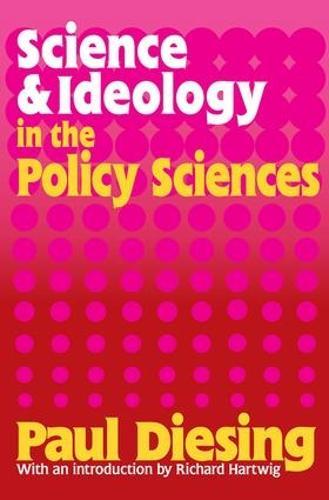
"""In 1982, Diesing published a remarkable book entitled Science and Ideology in the Policy Sciences. When I interviewed Diesing in Buffalo in the summer of 1984, he told me that to date, the publication had been reviewed in only two professional journals. I was astounded. Science & Ideology...was the best book I had read in a decade, and it related directly to all the policy sciences. The lack of professional response may partially reflect Diesing's disinterest in self-promotion, but beyond this is the 'community' problem. Scholars are recognized within disciplines, but there is only a tiny 'community of social science'. I consider this to be the most brilliant of Diesing's books. Like all of Diesing's works, it remains highly relevant today."" - from the introduction by Richard Hartwig."""
In 1982, Diesing published a remarkable book entitled Science and Ideology in the Policy Sciences. When I interviewed Diesing in Buffalo in the summer of 1984, he told me that to date, the publication had been reviewed in only two professional journals. I was astounded. Science & Ideology...was the best book I had read in a decade, and it related directly to all the policy sciences. The lack of professional response may partially reflect Diesing's disinterest in self-promotion, but beyond this is the 'community' problem. Scholars are recognized within disciplines, but there is only a tiny 'community of social science'. I consider this to be the most brilliant of Diesing's books. Like all of Diesing's works, it remains highly relevant today. - from the introduction by Richard Hartwig.
Author Information
Paul Diesing is professor emeritus of political science at the State University of New York at Buffalo. He did his graduate studies in philosophy from the University of Chicago and has taught at that university, the University of Illinois, and the University of Colorado. Diesing has also been a faculty associate at the Buffalo Center for International Conflict Studies, where he participated in the Center's program of researching in bargaining theory and international crises. He is the author of Reason in Society: Five Types of Decisions and Their Social Conditions and Science and Ideology in the Policy Sciences.