Overview
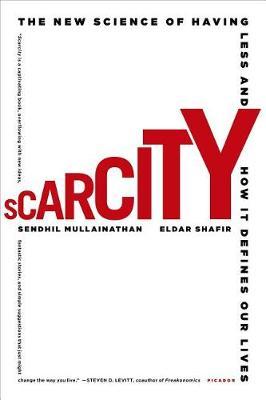
In this provocative book based on cutting-edge research, Sendhil Mullainathan and Eldar Shafir show that scarcity creates a distinct psychology for everyone struggling to manage with less than they need. Busy people fail to manage their time efficiently for the same reasons the poor and those maxed out on credit cards fail to manage their money. The dynamics of scarcity reveal why dieters find it hard to resist temptation, why students and busy executives mismanage their time, and why the same sugarcane farmers are smarter after harvest than before. Once we start thinking in terms of scarcity, the problems of modern life come into sharper focus, and Scarcity reveals not only how it leads us astray but also how individuals and organizations can better manage scarcity for greater satisfaction and success.
Full Product Details
Author: Sendhil Mullainathan ,
Eldar Shafir
Publisher: St Martin's Press
Imprint: St Martin's Press
Dimensions:
Width: 12.70cm
, Height: 2.10cm
, Length: 22.00cm
Weight: 0.259kg
ISBN: 9781250056115
ISBN 10: 125005611
Pages: 304
Publication Date: 04 November 2014
Audience:
General/trade
,
General
Format: Paperback
Publisher's Status: Active
Availability: Available To Order

We have confirmation that this item is in stock with the supplier. It will be ordered in for you and dispatched immediately.
Reviews
Extraordinarily illuminating...Mullainathan and Shafir have made an important, novel, and immensely creative contribution. <i>Cass R. Sunstein, The New York Review of Books</i></p> Compelling, important...A handy guide for those of us looking to better understand our inability to ever climb out of the holes we dig ourselves, whether related to money, relationships, or time. <i>The Boston Globe</i></p> [<i>Scarcity</i> offers] groundbreaking insights into...the effects of poverty on cognition and our ability to make choices about our lives. <i>Samantha Power, The Wall Street Journal</i></p> This is a book to read--but not while you are watching something else at the same time. <i>Eric Schmidt, executive chairman of Google and coauthor of The New Digital Age</i></p> <i>Scarcity</i> is a captivating book, overflowing with new ideas, fantastic stories, and simple suggestions that just might change the way you live. <i>Steven D. Levitt, coauthor</i></p> Sendhil Mullainathan and Eldar Shafir are stars in their respective disciplines, and the combination is greater than the sum of its parts. Together they manage to merge scientific rigor and a wry view of the human predicament. Their project has a unique feel to it: it is the finest combination of heart and head that I have seen in our field. <i>Daniel Kahneman, author of Thinking, Fast and Slow</i></p> Sendhil Mullainathan and Eldar Shafir show how the logic of scarcity applies to rich and poor, educated and illiterate, Asian, Western, Hispanic, and African cultures alike. They offer insights that can help us change our individual behavior and that open up an entire new landscape of public policy solutions. A breathtaking achievement! <i>Anne-Marie Slaughter, professor emerita, Princeton University, and president and CEO of the New America Foundation</i></p> Here is a winning recipe. Take a behavioral economist and a cognitive psychologist, each a prominent leader in his field, and let their creative minds commingle. What you get is a highly original and easily readable book that is full of intriguing insights. What does a single mom trying to make partner at a major law firm have in common with a peasant who spends half her income on interest payments? The answer is scarcity. Read this book to learn the surprising ways in which scarcity affects us all. <i>Richard H. Thaler, University of Chicago, coauthor of Nudge</i></p> With a smooth blend of stories and studies, <i>Scarcity</i> reveals how the feeling of having less than we need can narrow our vision and distort our judgment. This is a book with huge implications for both personal development and public policy. <i>Daniel H. Pink, author of Drive and To Sell Is Human</i></p> Insightful, eloquent, and utterly original, <i>Scarcity </i>is the book you can't get enough of. It is essential reading for those who don't have the time for essential reading. <i>Daniel Gilbert, Edgar Pierce Professor of Psychology, Harvard University, and author of Stumbling on Happiness</i></p> The book's unified theory of the scarcity mentality is novel in its scope and ambition. <i>The Economist</i></p> A pacey dissection of a potentially life-changing subject. <i>Time Out London</i></p> A succinct, digestible and often delightfully witty introduction to an important new branch of economics. <i>New Statesman</i></p> One of the most significant economics books of the year. <i>Tyler Cowen, Marginal Revolution</i></p> The struggle for insufficient resources--time, money, food, companionship--concentrates the mind for better and, mostly, worse, according to this revelatory treatise on the psychology of scarcity...The authors support their lucid, accessible argument with a raft of intriguing research...and apply it to surprising nudges that remedy everything from hospital overcrowding to financial ignorance...Insightful. <i>Publishers Weekly (starred review)</i></p>
One of Publishers Weekly 's Best Books of 2013 Extraordinarily illuminating. . . . Mullainathan and Shafir have made an important, novel, and immensely creative contribution. --Cass R. Sunstein, The New York Review of Books Sendhil Mullainathan and Eldar Shafir offer groundbreaking insights into, among other themes, the effects of poverty on cognition and our ability to make choices about our lives. --Samantha Power, The Wall Street Journal Scarcity is a captivating book, overflowing with new ideas, fantastic stories, and simple suggestions that just might change the way you live. --Steven D. Levitt, coauthor of Freakonomics Compelling, important ... Scarcity is likely to change how you view both entrenched poverty and your own ability -- or inability --to get as much done as you'd like... It's a handy guide for those of us looking to better understand our inability to ever climb out of the holes we dig ourselves, whether related to money, relationships, or time. -- The Boston Globe Sendhil Mullainathan and Eldar Shafir are stars in their respective disciplines, and the combination is greater than the sum of its parts. Together they manage to merge scientific rigor and a wry view of the human predicament. Their project has a unique feel to it: it is the finest combination of heart and head that I have seen in our field. --Daniel Kahneman, author of Thinking, Fast and Slow The scarcity phenomenon is good news because to a certain extent, we can design our way around it...What's particularly useful about the idea of scarcity is that it is overarching; ease that burden, and people will be better able to deal with all the rest. -- The New York Times Sendhil Mullainathan and Eldar Shafir show how the logic of scarcity applies to rich and poor, educated and illiterate, Asian, Western, Hispanic, and African cultures alike. They offer insights that can help us change our individual behavior and that open up an entire new landscape of pub
Author Information
Sendhil Mullainathan, a professor of economics at Harvard University, is a recipient of a MacArthur Foundation ""genius grant"" and conducts research on development economics, behavioral economics, and corporate finance. He lives in Cambridge, Massachusetts. Eldar Shafir is the William Stewart Tod Professor of Psychology and Public Affairs at Princeton University. He conducts research in cognitive science, judgment and decision-making, and behavioral economics. He lives in Princeton, New Jersey.