Overview
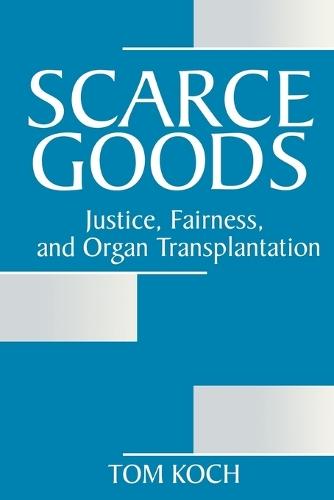
In 1841 the American sailing ship William Brown struck an iceberg. About half of the passengers and all of the crew were saved in two small, open boats. The next night, half of the passengers in the larger long-boat were thrown overboard because the boat was overfull. This was the first case of lifeboat ethics, of hard choices in the face of scarcity. Since then the question has been who should die so that others, equally needy, might live? Both the case of the William Brown and the ethics it spawned have been used in recent years to describe the problem of health care rationing generally, and organ transplantation specifically. Koch reexamines and reinterpretes the paradigm case of lifeboat ethics, the story of the William Brown, not as an unavoidable tragedy, but as an avoidable series of errors. Its relation to more general issues of distributive justice are then considered. The lessons learned from both the historical review and its application to distributive principles are then applied to the problem of graft organ distribution in the United States. Through the use of maps, the problem of organ distribution is considered at a range of scales, from the international to the urban. The contextual issues become more evident as one moves from international to hemispheric, fron national to regional, and then local systems. Finally, Koch reviews the lessons in light of other problems of distribution in the face of scarcity. The central lesson-that scarcity is exacerbated where it is not in fact created by our distributive programs-is explored thoroughly. The result is no good choices for anyone and the continuation of the scarcity that for most seems inevitable, but, from the evidence provided, is itself an outcome of inequalities of distribution at different scales of society. Of particular interest to students, scholars, and policymakers involved with issues of planning and health care economics, medical geography, and concepts of justice.
Full Product Details
Author: Tom Koch
Publisher: Bloomsbury Publishing Plc
Imprint: Praeger Publishers Inc
Dimensions:
Width: 15.60cm
, Height: 1.50cm
, Length: 23.50cm
Weight: 0.425kg
ISBN: 9780275974336
ISBN 10: 0275974332
Pages: 272
Publication Date: 30 November 2001
Recommended Age: From 7 to 17 years
Audience:
College/higher education
,
Professional and scholarly
,
Tertiary & Higher Education
,
Professional & Vocational
Format: Paperback
Publisher's Status: Active
Availability: Manufactured on demand

We will order this item for you from a manufactured on demand supplier.
Reviews
Dr. Koch's Scarce Goods rethinks the debate about the distribution of organs for transplantation. His use of maps to analyze what is happening today and to examine alternative strategies reshapes and advances our thinking. -Denis Wood Author The Power of Maps, Home Rules, Seeing Through Maps Tom Koch has written and impressive book. Important reading for anyone interested in issues of justice in healthcare, and especially organ transplantation. -Mark G. Kuczewski Associate Professor and Director Neiswanger Institute for Bioethics and Health Policy Loyola University, Chicago
Dr. Koch's Scarce Goods rethinks the debate about the distribution of organs for transplantation. His use of maps to analyze what is happening today and to examine alternative strategies reshapes and advances our thinking. -Denis Wood Author The Power of Maps, Home Rules, Seeing Through Maps
""Dr. Koch's Scarce Goods rethinks the debate about the distribution of organs for transplantation. His use of maps to analyze what is happening today and to examine alternative strategies reshapes and advances our thinking.""-Denis Wood Author The Power of Maps, Home Rules, Seeing Through Maps ""Tom Koch has written and impressive book. Important reading for anyone interested in issues of justice in healthcare, and especially organ transplantation.""-Mark G. Kuczewski Associate Professor and Director Neiswanger Institute for Bioethics and Health Policy Loyola University, Chicago
"""Dr. Koch's Scarce Goods rethinks the debate about the distribution of organs for transplantation. His use of maps to analyze what is happening today and to examine alternative strategies reshapes and advances our thinking.""-Denis Wood Author The Power of Maps, Home Rules, Seeing Through Maps ""Tom Koch has written and impressive book. Important reading for anyone interested in issues of justice in healthcare, and especially organ transplantation.""-Mark G. Kuczewski Associate Professor and Director Neiswanger Institute for Bioethics and Health Policy Loyola University, Chicago"
Author Information
TOM KOCH is a writer and bioethicist specializing in medical ethics. A frequent contributor to newspapers, magazines, and the CBC Radio, he is the author of 11 books./e Dr. Koch also is a forum associate at the David Lam Center, Simon Fraser University and an associate of the Center on Aging at The University of Hawaii.