Overview
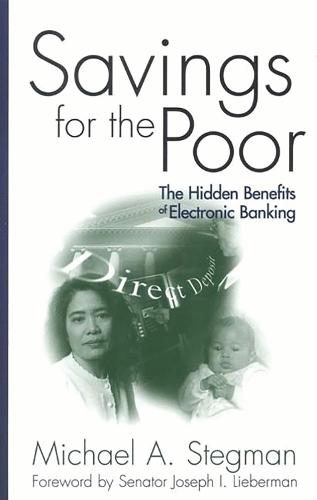
Beginning this year, federal payment recipients will receive their government benefits through electronic funds transfer (EFT)-- what most of us call direct deposit. Although cost-cutting is the driving force behind the move to a virtually all-electronic federal payment system, Michael Stegman believes the initiative has a far broader potential: to bring poor Americans into the banking mainstream. In this book Stegman outlines how many families will enter the mainstream banking system through EFT '99, as the program is called. He explains in careful detail the thinking behind the shift to EFT and the implementation of the program this year. He also argues that, for maximum success, EFT '99 should be combined with a program of national Individual Development Accounts (IDAs), dedicated savings accounts for low-income people that can be used for purchasing a first home, acquiring more education or job training, or starting a small-business. Essentially, EFT '99 will bring people into the banking system, and IDAs will give them an incentive to use the system to its fullest in order to make their money work for them and their children. There are other steps that the government can take to boost EFT's ability to help public aid recipients achieve self-sufficiency. It can: add a direct deposit option to state benefits payments programs; give banks significant additional Community Reinvestment Act Credit for establishing accounts for EFT recipients; and regulate fees for cashing government benefits and voluntary accounts so that people are not charged excessively for accessing their money. This book demonstrates that with careful planning and a relatively small investment the government's EFT initiative can have a major payoff in real assets and improved prospects for those who have been, for far too long, on the fringes of the country's mainstream banking system. Brookings Metro Series
Full Product Details
Author: Michael A. Stegman ,
Joseph I. Lieberman
Publisher: Bloomsbury Publishing Plc
Imprint: Brookings Institution
Dimensions:
Width: 15.20cm
, Height: 1.50cm
, Length: 22.90cm
Weight: 0.330kg
ISBN: 9780815780939
ISBN 10: 0815780931
Pages: 232
Publication Date: 01 September 1999
Audience:
College/higher education
,
Professional and scholarly
,
Undergraduate
,
Postgraduate, Research & Scholarly
Format: Paperback
Publisher's Status: Active
Availability: Manufactured on demand

We will order this item for you from a manufactured on demand supplier.
Reviews
Michael Stegman has written an important book. It is a must read for anyone interested in ways to alleviate poverty and to achieve a greater degree of economic well-being in our country. --Eugene A. Ludwig, Vice Chairman Bankers Trust/Deutsche Bank Professor Stegman makes a powerful argument that the advantages of a bank account, and especially of savings, should not be reserved for the rich and middle-class, but rather should be easily available for anyone trying to move from welfare to work, to save her money, increase her assets, and improve her life or her children's chances. --Senator Joseph I. Lieberman, Democratic Senator from Conneticut
Michael Stegman has written an important book. It is a must read for anyone interested in ways to alleviate poverty and to achieve a greater degree of economic well-being in our country. -Eugene A. Ludwig, Vice Chairman Bankers Trust/Deutsche Bank | Professor Stegman makes a powerful argument that the advantages of a bank account, and especially of savings, should not be reserved for the rich and middle-class, but rather should be easily available for anyone trying to move from welfare to work, to save her money, increase her assets, and improve her life or her children's chances. -Senator Joseph I. Lieberman, Democratic Senator from Conneticut
"""Michael Stegman has written an important book. It is a must read for anyone interested in ways to alleviate poverty and to achieve a greater degree of economic well-being in our country."" —Eugene A. Ludwig, Vice Chairman Bankers Trust/Deutsche Bank |""Professor Stegman makes a powerful argument that the advantages of a bank account, and especially of savings, should not be reserved for the rich and middle-class, but rather should be easily available for anyone trying to move from welfare to work, to save her money, increase her assets, and improve her life or her children's chances."" —Senator Joseph I. Lieberman, Democratic Senator from Conneticut"
Author Information
Michael A. Stegman is professor of public policy and director of the Center for Community Capitalism in the Kenan Institute of Private Enterprise, University of North Carolina at Chapel Hill. He was previously Assistant Secretary for Policy Development and Research at the U.S. Department of Housing and Urban Development. Joseph I. Lieberman is a former United States Senator from Connecticut.