Overview
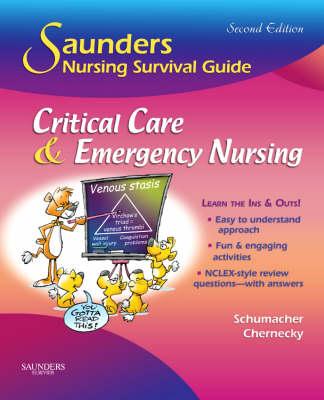
Part of the popular Saunders Nursing Survival Guide series, this book prepares you to manage the most common health care problems you'll see in critical care, trauma, or emergency settings. Each chapter is organized from the most immediate and life-threatening conditions to less emergent critical care conditions. Its lighthearted, cartoon-filled approach simplifies difficult concepts, covering each body system in terms of current practice standards. Consistent headings break content into four succinct areas of review: What (subject) IS, What You NEED TO KNOW, What You DO, and Do You UNDERSTAND? Clinical terms and shorthand expressions are highlighted, exposing you to terminology used in the hospital setting. A color insert illustrates concepts and principles of critical care and emergency nursing, including various complications Mnemonic devices aid your memory and interactive activities help you learn, with exercises including fill in the blank, matching, word jumbles, true/false, and crossword puzzles. Special icons help you focus on vital information: Take Home Points help you prepare for clinical rotations. Caution notes alert you to dangerous conditions and how to avoid them. Lifespan notes point out age-related variations in signs and symptoms, nursing interventions, and patient teaching. Culture notes cite possible variations related to a patient's cultural background. Web links direct you to Internet resources for additional research and study. What You WILL LEARN learning objectives help you identify quickly the content covered and goals for each chapter. NCLEX""¥ examination-style review questions at the end of each chapter allow you to test your understanding of content and practice for the Boards. Cartoon characters with brief captions help to better explain difficult concepts. Margin notes are streamlined for ease of use and effectiveness. Content updates reflect current practice and emergent situations, including increased focus on disaster preparedness, code management, updated ACLS guidelines, and hypertension.
Full Product Details
Author: Lori Schumacher (Associate Professor, Georgia Health Sciences University, School of Nursing, Augusta, GA) ,
Cynthia C. Chernecky (Professor, Department of Physiological and Technological Nursing, School of Nursing, Georgia Health Sciences University, Augusta, GA)
Publisher: Elsevier Health Sciences
Imprint: W B Saunders Co Ltd
Edition: 2nd edition
Dimensions:
Width: 19.10cm
, Height: 1.50cm
, Length: 23.50cm
Weight: 0.610kg
ISBN: 9781416061694
ISBN 10: 141606169
Pages: 400
Publication Date: 31 July 2009
Audience:
College/higher education
,
Professional and scholarly
,
Undergraduate
,
Professional & Vocational
Replaced By: 9780721603742
Format: Paperback
Publisher's Status: Active
Availability: Awaiting stock

The supplier is currently out of stock of this item. It will be ordered for you and placed on backorder. Once it does come back in stock, we will ship it out for you.