Overview
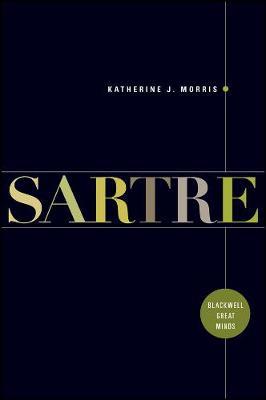
A novel introduction to Jean-Paul Sartre?s existentialist phenomenology. Draws parallels between Sartre?s work and the work of Wittgenstein Stresses continuities rather than conflict between Sartre and Merleau-Ponty, and between Sartre and post-structuralist/post-modernist thinkers, thus corroborating ?new Sartre? readings Exhibits the influence of Gestalt psychology in Sartre?s descriptions of the life-world Forms part of the Blackwell Great Minds series, which outlines the views of the great western thinkers and captures the relevance of these figures to the way we think and live today
Full Product Details
Author: Katherine Morris (University of Oxford, UK)
Publisher: John Wiley and Sons Ltd
Imprint: Wiley-Blackwell (an imprint of John Wiley & Sons Ltd)
Dimensions:
Width: 15.40cm
, Height: 1.50cm
, Length: 22.70cm
Weight: 0.260kg
ISBN: 9780631232797
ISBN 10: 0631232796
Pages: 200
Publication Date: 27 December 2007
Audience:
Professional and scholarly
,
Professional & Vocational
Format: Paperback
Publisher's Status: Out of Print
Availability: Awaiting stock

Reviews
New works on Sartre call for a justification. For Katherine J. Morris's book there are several, from its limpid and lively style to its sympathetic elaboration of insights that Sartre often left undeveloped. Especially rewarding is her emphasis on Sartre's conception of his philosophical project which, Morris skilfully argues, bears comparison with Wittgenstein's picture of philosophy as 'therapy'. David Cooper, Northern Michigan University<!--end--> Well-written ... and skillful ... .Its probing and bridging of the analytic- Continental gap ... [is] perhaps its greatest single contribution to ongoing philosophical discussion. Notre Dame Philosophical Reviews
New works on Sartre call for a justification. For Katherine J. Morris's book there are several, from its limpid and lively style to its sympathetic elaboration of insights that Sartre often left undeveloped. Especially rewarding is her emphasis on Sartre's conception of his philosophical project which, Morris skilfully argues, bears comparison with Wittgenstein's picture of philosophy as 'therapy'. David Cooper, Northern Michigan University<!--end--> Well-written ... and skillful ... .Its probing and bridging of the analytic- Continental gap ... [is] perhaps its greatest single contribution to ongoing philosophical discussion. Notre Dame Philosophical Reviews
New works on Sartre call for a justification. For Katherine J. Morris's book there are several, from its limpid and lively style to its sympathetic elaboration of insights that Sartre often left undeveloped. Especially rewarding is her emphasis on Sartre's conception of his philosophical project which, Morris skilfully argues, bears comparison with Wittgenstein's picture of philosophy as 'therapy'. David Cooper, Northern Michigan University<!--end--> Well-written ... and skillful ... .Its probing and bridging of the analytic- Continental gap ... [is] perhaps its greatest single contribution to ongoing philosophical discussion. Notre Dame Philosophical Reviews
Author Information
Katherine Morris has been a Lecturer in philosophy at Mansfield College, Oxford University since 1986 and a fellow since 1998; she holds an MPhil in medical anthropology as well as a DPhil in philosophy. The author of numerous articles on Sartre, Merleau-Ponty, Descartes and Wittgenstein, she is also the co-author of Descartes? Dualism (1996) with G.P. Baker.