Overview
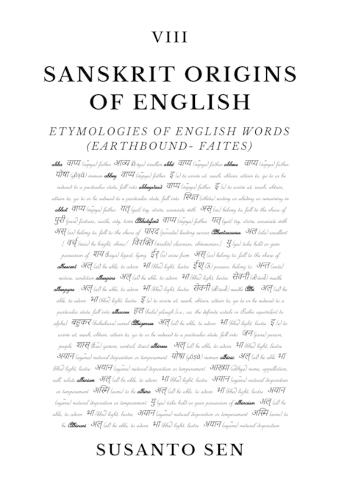
This book delves into the Sanskrit origins of over 7400 English words from earthbound to faites in alphabetical order. Examples of the Sanskrit origins of English words from this book: earthfast fixed in the ground, like a stone. (S) इरा (irā) earth + (S) यत् (yat) associate with + (S) पष् (paṣ) bind, fasten + (S) ध (dha) possessing, having, holding, placing, bestowing, causing eastbound to head towards the east. (S) व्युष्ट (vyuṣṭa) dawned + (S) बुन्ध् (bundh) bind Easter a festival that celebrates the resurrection of Jesus Christ on the first Sunday after the first full moon following the northern spring equinox. The name is cognate with Middle English Ester, Old English ēastre. (S) इष्ट (iṣṭa) sacrifice, sacrificing, worshipped with sacrifices, sacrament, sacred rite, wished for + (S) एर् (ēr) raise, procure, obtain, bring near, cause to obtain electric 1. relating to electricity or electric current. 2. exciting. 3. something that runs on electricity. 4. very bright. (S) आलग् (ālag) cling to, adhere + (S) तॄ (tṝ) carry through or over, cross over, get through + (S) आख्या (ākhyā) name, appellation, call, relate elephant the largest terrestrial mammal that is herbivorous, grey in colour, has curved tusks, large ears and a large trunk. The name is cognate with Middle English elefant, elefaunt, Old French elefant, elefan, olifant, Latin elephantus, comprising of Ancient Greek ἐλέφᾱς (eléphās), meaning ""ivory."" (S) हालु (hālu) tooth + (S) वान्त (vānta) ejected from the mouth eligible to have the strength or qualities meeting certain conditions. (S) इ (e) to arrive at, reach, obtain, attain to, go to or be reduced to a particular state, fall into + (S) ली (lī) adhering, clinging to + (S) ज (ja) produced or caused by + (S) बल (bala) strength elixir a potion with medical properties. (S) इ (e) to arrive at, reach, obtain, attain to, go to or be reduced to a particular state, fall into + (S) लेह्य (lehya) nectar, electuary, syrup + (S) क्षीर (kṣīra) milky juice or sap of plants emir a prince, ruler or commander in an Islamic nation. The word is cognate with Middle French emir, from Ottoman Turkish امیر (emir), Arabic أَمِير (ʔamīr), meaning ""commander, prince."" (S) यम् (yam) govern, control + (S) एर् (ēr) raise, procure, obtain, bring near, cause to obtain faint 1. to lose consciousness for a short time. 2. lacking courage or strength. 3. dim or vague. ■ The word is cognate with Middle English faynt, feynt, meaning ""weak, feeble,"" Old French faint, feint, meaning ""feigned, negligent, sluggish,"" past participle of feindre, faindre, meaning ""to feign, sham, work negligently."" (S) पन्न (panna) fallen, fallen down, perished, sunken + (S) ध (dha) possessing, having, holding, placing, bestowing, causing fairy 1. a human-like mythical being with magical powers. 2. a derogatory term for a gay person. (S) वि-हृ (vi-hṛ) pass one's time, play, wander about for pleasure + (S) इ (e) to arrive at, reach, obtain, attain to, go to or be reduced to a particular state, fall into
Full Product Details
Author: Susanto Sen
Publisher: Susanto Sen
Imprint: Susanto Sen
Volume: 13
Dimensions:
Width: 17.80cm
, Height: 2.80cm
, Length: 25.40cm
Weight: 0.943kg
ISBN: 9789334302875
ISBN 10: 9334302879
Pages: 552
Publication Date: 20 May 2025
Audience:
General/trade
,
General
Format: Paperback
Publisher's Status: Active
Availability: Available To Order

We have confirmation that this item is in stock with the supplier. It will be ordered in for you and dispatched immediately.