Overview
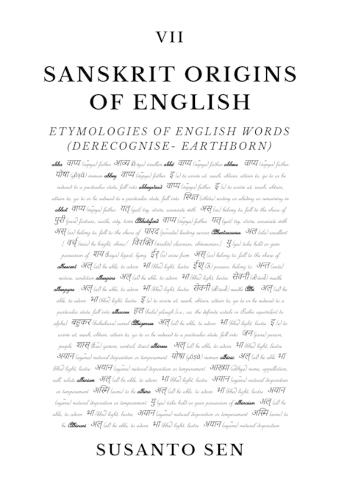
This book traces the Sanskrit origins of over 7400 English words, from derecognise to earthborn, in alphabetical order. Examples of the Sanskrit origins of English words from this book: derogatory disparaging, reducing the power or value of. The word is cognate with Late Latin dērogātōrius, Latin dērogāre. (S) दारक (dāraka) breaking, splitting, tearing + (S) यत् (yat) try, strive, associate with + (S) अरि (ari) attached to destine to preordain, or to assign for a particular purpose, or to have a specific destination. The word is cognate with Middle English destinen, Old French destiner. (S) दिष्ट (diṣṭa) destiny, shown, pointed out, fixed, fate, directed, allotment, decree, aim, goal + (S) अयान (ayāna) natural disposition or temperament detergent a synthetic water-soluble, non-soap cleansing agent. The word is cognate with French détergent, Latin dētergēns, the present participle of dētergeō, comprising of dē, meaning ""off"" and tergeō, meaning ""wipe, polish."" (S) ध (dha) possessing, having, holding, placing, bestowing, causing + (S) दॄ (dṝ) be dispersed or scattered + (S) ज (ja) produced or caused by + (S) अन्त (anta) nature, condition dragee a sweet or confection. The word is cognate with French dragée. (S) द्राक्षा (drākṣā) grape, grapes dragon 1. a mythical or legendary serpentine creature. 2. some animals which resemble a dragon in appearance, such as a Komodo dragon. 3. the Draco constellation. 4. the erstwhile Chinese empire or the People's Republic of China. (S) दृक्कर्ण (dṛkkarṇa) snake, eye-eared 5. a harridan, i.e., a vicious and scolding woman (who is especially old). (S) दुर्गुण (durguṇa) having bad qualities 6. a type of carrier pigeon. (S) तारक (tāraka) causing or enabling to pass or go over, carrying over + (S) इन (ina) able 7. (slang) a transvestite man. The word is a combination of ""drag queen."" (S) द्राघ् (drāgh) tarry, delay, exert one's self, tire, be long or slow, stretch + {(S) कनी (kanī) girl, maiden/ (S) क (ka) king + (S) यूनी (yūnī) young woman} 8. (historical) a short musket hooked to a cavalry soldier's belt. (S) तुरगिन् (turagin) horseman dragoon 1. a cavalryman who rides horseback but fights dismounted. 2. a soldier armed with a dragon musket. (S) तुरगिन् (turagin) horseman 3. a type of carrier pigeon. (S) तारक (tāraka) causing or enabling to pass or go over, carrying over + (S) ऊन (ūna) inferior, smaller each distinct ones of a group of objects or beings. (S) एकज (ekaja) born or produced alone or single eadem (Latin) same. The word is also spelled as Idem. (S) इदम् (idam) this here eager very willing or ready to take or do something. (S) आग्रह (āgraha) insisting on, persistence, strong inclination for earache pain in the ear. (S) ऊह् (ūh) listen for + (S) एर् (ēr) obtain, bring near, procure for one's self + (S) अघ (agha) pain, suffering
Full Product Details
Author: Susanto Sen
Publisher: Susanto Sen
Imprint: Susanto Sen
Volume: 12
Dimensions:
Width: 17.80cm
, Height: 2.80cm
, Length: 25.40cm
Weight: 0.943kg
ISBN: 9789334301953
ISBN 10: 9334301953
Pages: 552
Publication Date: 20 June 2025
Audience:
General/trade
,
General
Format: Paperback
Publisher's Status: Active
Availability: Available To Order

We have confirmation that this item is in stock with the supplier. It will be ordered in for you and dispatched immediately.