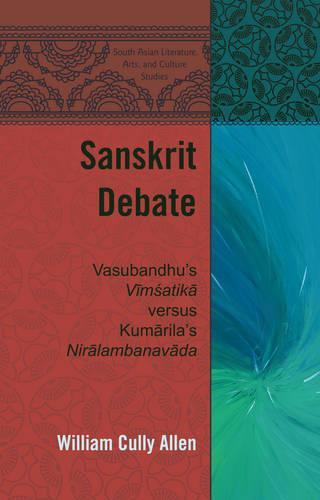
Sanskrit Debate: Vasubandhu’s ""Vīmśatikā"" versus Kumārila’s ""Nirālambanavāda""

Author:   Moumin Quazi ,  William Cully Allen
Publisher:   Peter Lang Publishing Inc
Edition:   New edition
Volume:   2
ISBN:  

9781433117589


Pages:   138
Publication Date:   30 December 2014
Format:   Hardback
Availability:   Manufactured on demand   Availability explained
We will order this item for you from a manufactured on demand supplier.

Our Price $269.68 Quantity:  
Add to Cart

Share |

Sanskrit Debate: Vasubandhu’s ""Vīmśatikā"" versus Kumārila’s ""Nirālambanavāda""


Overview

Sanskrit Debate: Vasubandhu’s ‘Vīmśatikā’ versus Kumārila’s ‘Nirālambanavāda’ illustrates the rules and regulations of classical Indian debate literature (pramānaśāstra) by introducing new translations of two Sanskrit texts composed in antithesis to each other’s tradition of thought and practice. In the third century CE, Vasubandhu, a Buddhist philosopher-monk, proposed that the entire world of lived experience is a matter of mind only through his Vīmśatikā (Twenty Verses). In the seventh century CE, Kumārila, a Hindu philosopher-priest, composed Nirālambanavāda (Non-Sensory Limit Debate) to establish the objective reality of objects by refuting Vasubandhu’s claim that objects experienced in waking life are not different from objects experienced in dreams. Kumārila rigorously employs formal rules and regulations of Indian logic and debate to demonstrate that Vasubandhu’s assertion is totally irrational and incoherent. Vīmśatikā ranks among the world’s most misunderstood texts but Kumārila’s historic refutation allows Vīmśatikā to be read in its own text-historical context. This compelling, radically revolutionary re-reading of Vīmśatikā delineates a hermeneutic of humor indispensable to discerning its medicinal message. In Vīmśatikā, Vasubandhu employs the form of professional Sanskrit logic and debate as a guise and a ruse to ridicule the entire enterprise of Indian philosophy. Vasubandhu critiques all Indian theories of epistemology and ontology and claims that both how we know and what we know are acts of the imagination.

Full Product Details

Author:   Moumin Quazi ,  William Cully Allen
Publisher:   Peter Lang Publishing Inc
Imprint:   Peter Lang Publishing Inc
Edition:   New edition
Volume:   2
Dimensions:   Width: 15.00cm , Height: 1.50cm , Length: 22.50cm
Weight:   0.340kg
ISBN:  

9781433117589


ISBN 10:   1433117584
Pages:   138
Publication Date:   30 December 2014
Audience:   Professional and scholarly ,  Professional & Vocational
Format:   Hardback
Publisher's Status:   Active
Availability:   Manufactured on demand   Availability explained
We will order this item for you from a manufactured on demand supplier.

Table of Contents

Contents: Classical Indian Philosophy - Vimsatika and Auto-Commentary in Text-Historical Context - Translation of Vimsatika and Auto-Commentary - Niralambanavada in Text-Historical Context - Translation of Niralambanavada - The Verdict.

Reviews

Author Information

William Cully Allen studied Sanskrit at Harvard University, The University of Pennsylvania, and Banaras Hindu University before earning his PhD in South Asian religion at Temple University. Allen has taught for twenty-five years at Temple University, Austin College, Bucknell University, Muhlenberg College, and the University of the Arts.

Tab Content 6

Author Website:  

Countries Available

All regions
Latest Reading Guide

NOV RG 20252


Shopping Cart
Your cart is empty
Shopping cart
Mailing List