Overview
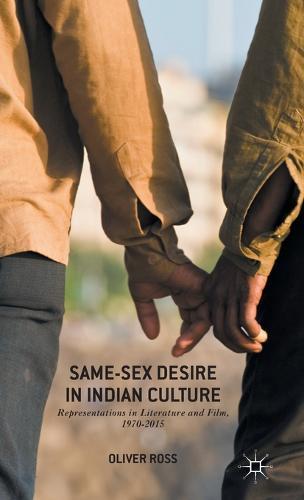
This book explores representations of same-sex desire in Indian literature and film from the 1970s to the present. Through a detailed analysis of poetry and prose by authors like Vikram Seth, Kamala Das, and Neel Mukherjee, and films from Bollywood and beyond, including Onir's My Brother Nikhil and Deepa Mehta's Fire, Oliver Ross argues that an initially Euro-American ""homosexuality"" with its connotations of an essential psychosexual orientation, is reinvented as it overlaps with different elements of Indian culture. Dismantling the popular belief that vocal gay and lesbian politics exist in contradistinction to a sexually ""conservative"" India, this book locates numerous alternative practices and identities of same-sex desire in Indian history and modernity. Indeed, many of these survived British colonialism, with its importation of ideas of sexual pathology and perversity, in changed or codified forms, and they are often inflected by gay and lesbian identities in thepresent. In this account, Oliver Ross challenges the preconception that, in the contemporary world, a grand narrative of sexuality circulates globally and erases all pre-existing narratives and embodiments of sexual desire.
Full Product Details
Author: Oliver Ross
Publisher: Palgrave Macmillan
Imprint: Palgrave Macmillan
Edition: 1st ed. 2016
Dimensions:
Width: 14.00cm
, Height: 1.40cm
, Length: 21.60cm
Weight: 3.796kg
ISBN: 9781137570758
ISBN 10: 113757075
Pages: 205
Publication Date: 05 January 2016
Audience:
Professional and scholarly
,
Professional & Vocational
Format: Hardback
Publisher's Status: Active
Availability: Manufactured on demand

We will order this item for you from a manufactured on demand supplier.
Reviews
Oliver Ross brings fresh insight to the debates and texts he examines and undertakes some excellent exegeses of much-analyzed, as well as under-analysed texts. He bravely takes on the current received wisdom that gay identity is 'irremediably Eurocentric'; as he points out, practitioners of queer theory who propound this view exempt queer theory itself from Eurocentricity in a largely unexamined way. - Ruth Vanita, Professor of Liberal Studies, University of Montana, USA and co-editor of Same-Sex Love in India: Readings from Literature and History
Oliver Ross brings fresh insight to the debates and texts he examines and undertakes some excellent exegeses of much-analyzed, as well as under-analysed texts. He bravely takes on the current received wisdom that gay identity is 'irremediably Eurocentric'; as he points out, practitioners of queer theory who propound this view exempt queer theory itself from Eurocentricity in a largely unexamined way. - Ruth Vanita, Professor of Liberal Studies, University of Montana, USA and co-editor of Same-Sex Love in India: Readings from Literature and History Reviewer: Ruth Vanita, Professor of English, University of Montana, USA Report on 'Same-Sex Desire and Syncretism: Same-Sex Desire in Indian Literature and Film Outline This book situates itself as an intervention in the debate around whether identity terms like 'gay' are inappropriate or even neo-colonial imports from the West into India, and whether indigenous terms should be discovered or coined in their place. Ross proposes the model of what he calls syncretism, arguing that Indian activists and writers eclectically use English-language terms like 'gay' along with newly coined terms like 'kothi' and that thereby the English-language terms themselves morph and indicate identities that are distinct in some ways from their Western counterparts. Ross then proceeds to examine a number of texts and films about same-sex desire, with a view to uncovering syncretic representations of same-sex desire in them. He employs strategies of close reading as well as historical and biographical criticism in his exegeses, raising questions regarding the intersection of various identities based on religion, caste and sexuality, and enquiring whether or not the representation of same-sex desire is imbricated with anxiety about the author's own identity or the reception of the work. Strengths Ross examines English-language texts on which many young scholars round the world have written and continue to write, and he thus covers well-trodden ground, such as Fire and the writings of Vikram Seth, Raj Rao and Kamala Das,. However, he does bring fresh insight to the debates and texts he examines. This is primarily because he is more skilled at close reading than most queer theorists. The book contains some good analyses of much-analysed texts such as Fire as well as of recent and less-analysed texts such as Neel Mukherjee's A Life Apart. Thus, Ross manages to balance appreciation for the intervention accomplished by Fire with a judicious assessment of its simplistic portrayal of Hindu thought, texts and practices. Likewise, he performs a good close reading I have seen of the Feroze-Maan relationship in Vikram Seth's A Suitable Boy (though somewhat marred by inaccurate comments on Lucknow's culture and the ghazal) and a thoughtful exegesis of The Sandal Trees. Ross's main innovation is his challenge to the current received wisdom among queer theorists that gay identity is 'irremediably Eurocentric' (8); as he points out with understated irony, practitioners of queer theory who propound this view exempt queer theory itself from Eurocentricity in a largely unexamined way (p. 8). He also challenges the assertions of non-academic commentators like Jeremy Seabrook and Shivananda Khan that the deployment of terms like 'gay' by Indians is neo-colonial and retrograde. His model of syncretism is sensible and well articulated. The book is clearly organized. Ross writes with an awareness of multiple contexts and hybridities. I list factual errors and over-readings in the Appendix. Ross is capable of elegant writing; unfortunately, he muddies it with jargon of this kind: 'There emerges a diachronic approach to irruptive moments in Indian history and their syncretic overlapping with contemporary homosexual subjectivity and existence, but ambivalence predominates' (164). Weaknesses It is very important that the title of this book be changed. It performs the same hubristic move as Rushdie's infamous anthology, when it equates twentieth-century English language and film with all of 'Indian Literature and Film.' India has the world's largest film industry, and most Indian films, including many on same-sex desire, are made in Indian languages. Likewise, there is a huge body of work, centuries old, in many Indian languages. This book deals only with twentieth-century literature and film in English, and the title should make that clear. Ross's grasp of the history of LGBT movements in India is somewhat tenuous. For instance, he claims that homosexuality has been extensively represented in the Indian media since the controversy around Deepa Mehta's film Fire in 1998 (p. 41). In fact, homosexuality began to be covered in the media at least since 1992, when the protest led by ABVA (AIDS Bhedbhav Virodhi Andolan or AIDS Anti-Discrimination Movement) outside the Delhi police headquarters made front-page news. Ross discusses the recent Naz case against the anti-sodomy law (Section 377) and the participation of celebrities in it; however, he does not even mention ABVA which filed the first petition against Section 377 and also in 1991 published the path-breaking Less than Gay: A Citizens' Report. This little book contained important testimonies by LGBT people, and also summarized the literature available up to that time. Similarly, Ross appears unaware of Indian NGOs' dependence on foreign funding and the way this influences their politics. ABVA on principle took no institutional funding and died for lack of funds. Most Indian non-governmental organizations working on HIV prevention and LGBT rights today receive substantial funding from Western agencies. Western funding agencies are much more inclined to fund activists with indigenous-sounding identities than those who use terms like 'gay' and 'homosexual.' Lawrence Cohen, in an important essay that Ross fails to cite, has traced the way terms like kothi were constructed in the shadow of the HIV crisis. The Naz empire built by the late Shivananda Khan, which was based in London, was a primary player in this construction. Hence too the fact that Seabrook and Khan are unperturbed by the use of the English-language term 'MSM' as an identity category, even though this term was first used by American health care workers in the context of HIV prevention. To reinforce his model of syncretism, Ross notes that activists like Ashok Row Kavi and Vivek Anand, founders of Humsafar Trust, who started out by claiming a 'gay' identity and critiquing terms like kothi and MSM, have now embraced the latter (227-28). What he fails to examine, though, is the way foreign funding and its imperatives influenced this change. The failure to explore the nexus between money on the one hand and terminology used by activists on the other is a serious one, since Ross's project is centrally concerned with the debate around the choice and use of identity categories. Second, the basis on which Ross selects texts is unclear. He needs to clarify why, for example, he writes about Neel Mukherjee at length but merely mentions Suniti Namjoshi, the pioneering lesbian writer from India who has a substantial following there, or why he writes about texts by some non-gay writers, such as Manju Kapoor and Amol Palekar but excludes other much higher-quality texts, such as Vikram Chandra's story 'Artha,' which engages with many of the themes Ross is interested in, such as same-sex relationships across the Hindu-Muslim divide. The criterion cannot be quality because Ross seems to make no distinction between poor-quality texts like Rangayan's or Rao's and high-quality ones like Seth's or Onir's. Likewise, since Ross mentions Hindi films such as Sholay, the astonishing film Dedh Ishqiya should at least be mentioned, especially as it relates to the world of Lucknow rekhti, which Ross dismisses as unexpressive of female-female desire. Some of these inclusions and exclusions seem to be tailored to fit Ross's undeclared schema. This is the case with Vikram Seth. Although he makes no distinction between works on the basis of quality, Ross assumes an overly judgmental tone with regard to certain authors, for example, Seth, who he describes as suffering from 'anxieties' (119) and 'trepidation' and writing in a 'truncated' way. Inexplicably, though, when writing about the far more closeted Agha Shahid Ali who never came out in India or to his family, and led a double life (gay in the West, closeted in India) he nowhere uses such judgmental terms but simply praises the poetry for its 'liminality and ambiguity' (231). To demonstrate Seth's anxieties, Ross examines poems only from his first collection, Mappings, but ignores his next two collections, The Humble Administrator's Garden (1985) and All You Who Sleep Tonight (1990), both of which contain poems explicitly about male-male relationships ('Baburnama,' 'Soon'), and both of which fall in the period of Seth's work (1980s to late 1990s) that Ross claims to examine. No reasons are vouchsafed for these odd omissions. Acknowledging that Seth has, in the 2000s, been militantly out in India, Ross states that he will examine only Seth's work only up to the 1990s. But why? Why not analyze one of Seth's most widely circulated poems, 'Love's Great Power,' written in the aftermath of the Supreme Court judgment that reinstated the anti-sodomy law. The poem would seem to be directly relevant to Ross's project. Third, it is important that Ross update his secondary sources. For example, he includes Shohini Ghosh's book, Fire, in the bibliography but nowhere engages with it in his chapter on that film. He refers far more often to Gopinath who avowedly writes only on the diaspora, than to Ghosh, an Indian film-maker and critic, who has produced an important body of work on same-sex desire in Indian cinema and television. Similarly, Ross constantly refers to Urdu poetry about male-male desire but dismisses the very important body of Urdu poetry on female-female desire and the terminology developed in it, without taking into account the most recent and only book-length exegesis of this poetry. He claims, 'Innumerable self-identified lesbian writers from India and the diaspora, including Suniti Namjoshi and Ashwini Sukhtankar, have averred that there is no word in the Indian languages outside English to describe a female-female desiring identity' (228) and then proceeds to dismiss rekhti as indicating the erasure of female-female desire by male writers. First two writers do not add up to 'innumerable' and second, neither of the two writers cited reads Indian languages. Ross claims that courtesans were 'secluded' in the kotha (35); he could not be more wrong. The word tawaif (courtesan) refers to mobility (circling around). Courtesans traveled widely and performed in many public venues up to the mid twentieth century. Vanita's recent book argues that rekhti and its terminology circulated widely in the nineteenth century (Havelock Ellis cited it) and that courtesans in the early nineteenth century functioned as the intellectual peers of male poets. If Ross disagrees he needs to spell out the grounds of his disagreement. Petievich, who initially took a view opposed to Vanita's, has modified her position recently. Recommendation The book should be published with significant revisions, as outlined above (see also the list of specific inaccuracies below). The subtitle should be changed to reflect the contents of the book. Appendix: Specific Inaccuracies 1. p. 38 amrad parast (literally, boy worshiper, not 'boy lover') is an Urdu literary term, derived directly from Persian. It is not 'widely used' and it appears only in Urdu poetry up to the nineteenth century. Ugra is certainly not alluding to this highly 'civilized' term when he refers to words that 'cannot be written in civilized language.' Rather, he is referring to street terms like gandu (still widely in use). 2. p. 31 This is a simplistic and homogenizing view of Hindu nationalists. Their views range from those of BJP Finance Minister Arun Jaitley who has recommended decriminalizing homosexuality to those of Baba Ramdev who considers homosexuality a disease anywhere in the world. Some Hindu nationalists have also changed their views over time, such as the prominent intellectual Swapan Dasgupta, who some years ago argued that homosexuality was known in ancient India but so was robbery and both were disapproved of; he has since changed his view and now recommends decriminalization. The same is true of Ross's remarks on p. 64, based on Bachhetta's 1999 essay. Not all Hindu nationalists characterize Muslims as queer; in fact, Ashok Row Kavi, who is arguably the most prominent pioneering gay activist in India is himself a Hindu nationalist. 3. pp. 53-54. This account of the protests against the attacks on Fire is inaccurate and misleading. The protests were significant because a number of women's organizations and civil liberties organizations for the first time came out on the streets to defend the representation of lesbian desire. Even the CPI(M) issued a statement in its favor. This account makes it sound as if CALERI was the primary leader of the protests, which is not true. CALERI was a Delhi-based group, founded by a diasporic lesbian who was visiting India for a few months (and who has since married a man and had a child with him) and her lover, who shortly after migrated to the US. Many Indian lesbians who attended CALERI meetings were deeply dissatisfied with the way CALERI's leaders framed the issues. 4. Ross's placement of Indian literary and cultural tropes is often seriously inaccurate. Thus he claims that the lotus in Sanskrit writings is feminine and androgynous 132). In fact, the lotus is ubiquitous across time in Indian literature, including in non-Sanskritic languages, as a trope for any beautiful person, and also for beautiful eyes, lips, breasts, face, feet and heart. Of its many names in Sanskrit and Sanskritic languages, all of which are male and female names today, some are male and some are female. Its 'traditional gender associations' are not female (133); quoting one verse from hundreds of thousands proves nothing. The lotus is as strongly associated with Krishna as with Radha. Likewise, Ross misreads Kidwai's remark to mean that the epithet 'moon faced' refers primarily to boys (99-100). In Urdu poetry, any beautiful person may be referred to as moon faced. Both in Hindi and Urdu, the moon frequently appears as an epithet, a trope and name for women, e.g. Mah Laqa. Chand, Chandra, a trend which continues in Bombay cinema. Similarly, Bangles in themselves are not 'a symbol of male-female marriage' (65) since they are widely worn by unmarried women. Specific types of bangles are signs of marriage in some regions and communities. Bangles also have an older history of symbolizing love between women, as seen in rekhti. 8. p. 184, last paragraph, and footnote 4. The 'T' in 'T. Muraleedharan' stands for 'Tharayil.' If it appears as 'Thomas' in the Pillai book, this is probably a misprint. The author is not a Christian. Check with him (mtharayil@ gmail.com) and correct this. 9. p.68. 'While the sari is a symbol of femininity befitting sat?, at least in light of the construction of widow self-sacrifice within patriarchal discourse as the apotheosis of female duty. Kiran is attired in a kurta and salwar. In the context of the hyper-feminine, her clothing bespeaks her androgyny and reinvention of tradition.' This is a ridiculous formulation First, the sari is worn by millions of women, including politicians, educationists, writers, scientists, factory workers and warrior queens like Rani Lakshmibai who wore it when ridfing a horse to fight the British in 1857. To call it a 'symbol of femininity befitting sati' is like calling the Western full-length skirt a 'symbol of femininity befitting witch-burning.' Second, Kiran's kurta-salwar does not 'bespeak her androgyny and reinvention of tradition.' Kurta-salwar is a perfectly 'traditional' dress in north India and has now spread to other regions. Many women throughout the country routinely wear both kurta-salwar and sari as well as trousers. So are they supporting sati when they wear a sari one day and reinventing tradition when they wear a kurta-salwar the next day? Likewise, p. 205, wearing a salwar-kameez or a sari does not necessarily mean the wearer is 'visibly traditional' (either in cinema or in life). This is the normal working attire of most Indian women. Many women maintain wardrobes ranging from saris and salwar kameez to skirts and jeans. And in any case, is modernity to be signaled just by wearing Western dress? Isn't the skirt or dress or pantsuit 'traditional' Western attire? Or is Western 'tradition' more 'modern' and inherently less 'conservative' than Indian 'tradition'? 14. p. 106 It is not a 'revelation' that they are 'in fact' half sisters. Whether or not they are half-sisters remains ambiguous. It is strongly implied that Kalyanikutty may be lying. 1. 17. p. 130. This account of the 'sybaritism' of Nawabi Lucknow is based on colonial and social reformist/nationalist judgments, which have been challenged over the last fifty years by a number of historians, such as C.A. Bayly, Rulers, Townsmen and Bazaars: North Indian Society in the Age of British Expansion 1770-1870 (Cambridge: Cambridge UP, 1983), M. H. Fisher, A Clash of Cultures: Awadh, the British, and the Mughals (Riverdale, MD: Riverdale, 1987), Rosie Llewellyn-Jones, A Fatal Friendship: The Nawabs, the British and the City of Lucknow (1985). For the way colonial administrators such as R. W. Sleeman, the last British Resident in Awadh, constructed the Nawabs as decadent and licentious, see Vanita, 'India,' in The Fin-de-Siecle World ed. Michael Saler (Routledge, 2014), 283-99. p. 80 With regard to Das's conversion from Hinduism to Islam, it is worth mentioning that she converted because of a younger male lover who was Muslim, and later seemed to regret the conversion. p. 82. Ross critiques Rosemary George for her critique of earlier Indian feminists' silencing of lesbianism in Das's oeuvre; this shows him to be out of touch with Indian feminism, because most Indian women's organizations themselves now critique their earlier silencing of lesbianism within the women's movement pp. 136-37 This definition of yaar as referring only to male-male friendship is incorrect. The word derives from Sanskrit jaaraj, meaning a woman's adulterous male lover. In 18th-19th century Urdu poetry, a man's female beloved could also be termed yar as also a woman's male beloved). In modern India, the term is ubiquitous; both men and women use it to refer to both cross-sex and same-sex friends. pp. 41 and 183 ff Television is a very important factor in the velocity with which attitudes to homosexuality are changing. The representation of homosexuality is not restricted to English-language audio-visual media. Numerous sympathetic television talk-shows in both Hindi and English from the 1990s onwards have been followed by television soap-operas, for example, a television drama set in the Hindi heartland of Haryana, entitled Maryada Lekin Kab Tak (Honor, but how long?) had a story-line involving a married young man coming out to his family as in love with his best friend, a politician's son. pp. 193 ff. The discussion of My Brother Nikhil exaggerates the closeting effect of the foregrounding of the protagonist's sister. Ross compares the film's focus on biological family with the American Queer as Folk's focus on chosen family (194). While the foregrounding of Nikhil's sister in My Brother Nikhil, may function to reassure the heterosexual viewer, nevertheless it also reflects the importance of natal family (both parents and siblings) in the lives of most Indians, which can hardly be over-stated. Almost all the single people I know in India, whether straight or gay, have spent most of or all of their adult lives living with their parents or have returned home to live with their siblings after retirement. This includes prominent 'out' gay scholars and activists. The brother-sister relationship in particular, is endowed with intense romantic feeling in north Indian culture, as exemplified in the widely celebrated raksha bandhan (rakhi) festival, when sisters tie sacred threads on the wrists of both biological and self-chosen brothers. Several heterosexual sisters have been radicalized by gay brothers, for example, Anuja Gupta, the sister of pioneering gay activist Siddharth Gautam, went on to found organizations working on HIV and other sexuality issues, and Vismita Gupta-Smith made a film on gay issues, inspired by her gay brother. To suggest that a supportive sister of this kind is 'immolated on the altar of male-male desire'(197) is absurd. In the service of his analysis, Ross ignores scenes that foreground the protagonist's relationship with his boyfriend, for example, the scene of their first meeting in a bar. p. 116 Seth on India Today cover, consciously mimics the posture of an arrested person who poses holding a placard in front of him. Unshaven and shabby looking 118 too judgmental - seems disinguenous? Why should all homosexuality be primarily about sex? Is all heterosexuality primarily about sex?Is Dante' s love for Beatrice not real? Misreading of coil tosnap or spring 123 terrifying miles is hardly mock heroic. It represents the very real fears of a gay person making a physical advance to someone of whose sexuality s/he is unsure. Generation gap perhaps Circumscription is no more so than the hetero relations
Author Information
Oliver Ross is a Teaching Fellow of English at the University of Cambridge, UK.