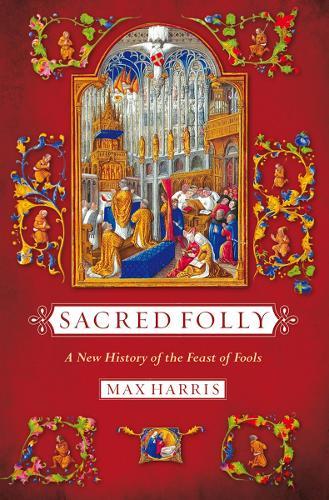
Full Product Details
Author: Max R. Harris
Publisher: Cornell University Press
Imprint: Cornell University Press
Dimensions:
Width: 15.50cm
, Height: 2.10cm
, Length: 23.50cm
Weight: 0.907kg
ISBN: 9780801479496
ISBN 10: 0801479495
Pages: 336
Publication Date: 17 March 2014
Recommended Age: From 18 years
Audience:
General/trade
,
General
Format: Paperback
Publisher's Status: Active
Availability: To order

Stock availability from the supplier is unknown. We will order it for you and ship this item to you once it is received by us.
Language: English
Reviews
Max Harris has responded to the challenge laid down by Aime Cherest morethan 150 years ago, to produce fresh ideas on the Feast of Fools....Sacred Folly is a splendid response to Cherest's challenge, clear headed, well structured, based on very wide reading and sensitively handled material. It deserves to be widely read. Jean Dunbabin, Medium Aevum
"""The Feast of Fools has provided modern imaginations with a suggestive picture of medieval clerical dissolution. Popular fiction has found the picture irresistible... What Max Harris's stunning new book, Sacred Folly, reveals is that the phenomenon has been grossly misrepresented in scholarly literature, too. Harris dismantles prevailing accounts of the Feast of Fools piece by piece, disentangling the historical evidence from the imaginative projections of generations of scholars... Sacred Folly puts the historical discussion of the Feast of Fools on an entirely new footing.""-William Robins, The Journal of Medieval Latin (2012) ""Max Harris has responded to the challenge laid down by Aime Cherest morethan 150 years ago, to produce fresh ideas on the Feast of Fools...Sacred Folly is a splendid response to Cherest's challenge, clear headed, well structured, based on very wide reading and sensitively handled material. It deserves to be widely read.""-Jean Dunbabin,Medium Aevum ""Sacred Folly is a major achievement; it is a book that we have needed, and Max Harris is preeminently the person to have written it. It reads gracefully, and the author is an attractive presence throughout.""-David Bevington, Phyllis Fay Horton Distinguished Service Professor in the Humanities, University of Chicago ""In this bracingly revisionist book, Max Harris overturns long-held assumptions about the nature and functions of the Feast of Fools. Denounced by fifteenth-century French theologians as a wanton and ungodly rite, the Feast of Fools was in reality, as Harris shows, a reverential, not a rowdy, holiday. With incisive analysis and meticulous scholarship, Sacred Folly sets the record straight. In doing so, it unearths the fascinating history of one of the most misunderstood liturgical festivities.""-Claire Sponsler, University of Iowa ""Max Harris has written an important and necessary book, offering for the first time an accurate history of a subject that has been persistently and consistently misrepresented in scholarship. No other book has even remotely approached the thorough revision of the history of the Feast of Fools successfully undertaken here. Harris takes on the daunting tasks of sorting accurate from biased interpretation, tracing the passing down of error from scholar to scholar, and identifying the deliberate introduction and transmission of misinformation. Harris not only demolishes an inaccurate history but also constructs a new and durable one to replace it.""-Pamela Sheingorn, Bernard M. Baruch College and Graduate Center, CUNY ""The modern history of medieval ritual has long been a history of misinformation and misunderstanding. This engaging book is a crucial intervention that should recalibrate the methods for studying early liturgy, drama, and popular culture; it also suggests the need for a reevaluation of larger historical narratives. By gathering, disentangling, and contextualizing primary and secondary sources produced over two millennia, Max Harris proves that the Feast of Fools was a legitimate liturgical celebration shaped by specific historical developments in the twelfth century and in certain areas of northern France. In so doing, he not only reconstructs the circumstances in which clergy conceptualized, crafted, performed, and defended a particular festive liturgy; he also exposes the ways that changing notions of propriety distorted secondhand accounts of it, leading to its suppression in the fifteenth century and the metastasizing of these erroneous reports down to the present day. This is an exemplary work of scholarship: careful but wide-ranging, lucid, and humane.""-Carol Symes, University of Illinois at Urbana-Champaign"
""The Feast of Fools has provided modern imaginations with a suggestive picture of medieval clerical dissolution. Popular fiction has found the picture irresistible... What Max Harris's stunning new book, Sacred Folly, reveals is that the phenomenon has been grossly misrepresented in scholarly literature, too. Harris dismantles prevailing accounts of the Feast of Fools piece by piece, disentangling the historical evidence from the imaginative projections of generations of scholars... Sacred Folly puts the historical discussion of the Feast of Fools on an entirely new footing.""-William Robins, The Journal of Medieval Latin (2012) ""Max Harris has responded to the challenge laid down by Aime Cherest morethan 150 years ago, to produce fresh ideas on the Feast of Fools...Sacred Folly is a splendid response to Cherest's challenge, clear headed, well structured, based on very wide reading and sensitively handled material. It deserves to be widely read.""-Jean Dunbabin,Medium Aevum ""Sacred Folly is a major achievement; it is a book that we have needed, and Max Harris is preeminently the person to have written it. It reads gracefully, and the author is an attractive presence throughout.""-David Bevington, Phyllis Fay Horton Distinguished Service Professor in the Humanities, University of Chicago ""In this bracingly revisionist book, Max Harris overturns long-held assumptions about the nature and functions of the Feast of Fools. Denounced by fifteenth-century French theologians as a wanton and ungodly rite, the Feast of Fools was in reality, as Harris shows, a reverential, not a rowdy, holiday. With incisive analysis and meticulous scholarship, Sacred Folly sets the record straight. In doing so, it unearths the fascinating history of one of the most misunderstood liturgical festivities.""-Claire Sponsler, University of Iowa ""Max Harris has written an important and necessary book, offering for the first time an accurate history of a subject that has been persistently and consistently misrepresented in scholarship. No other book has even remotely approached the thorough revision of the history of the Feast of Fools successfully undertaken here. Harris takes on the daunting tasks of sorting accurate from biased interpretation, tracing the passing down of error from scholar to scholar, and identifying the deliberate introduction and transmission of misinformation. Harris not only demolishes an inaccurate history but also constructs a new and durable one to replace it.""-Pamela Sheingorn, Bernard M. Baruch College and Graduate Center, CUNY ""The modern history of medieval ritual has long been a history of misinformation and misunderstanding. This engaging book is a crucial intervention that should recalibrate the methods for studying early liturgy, drama, and popular culture; it also suggests the need for a reevaluation of larger historical narratives. By gathering, disentangling, and contextualizing primary and secondary sources produced over two millennia, Max Harris proves that the Feast of Fools was a legitimate liturgical celebration shaped by specific historical developments in the twelfth century and in certain areas of northern France. In so doing, he not only reconstructs the circumstances in which clergy conceptualized, crafted, performed, and defended a particular festive liturgy; he also exposes the ways that changing notions of propriety distorted secondhand accounts of it, leading to its suppression in the fifteenth century and the metastasizing of these erroneous reports down to the present day. This is an exemplary work of scholarship: careful but wide-ranging, lucid, and humane.""-Carol Symes, University of Illinois at Urbana-Champaign
Author Information
Max Harris is Executive Director Emeritus of the Wisconsin Humanities Council, University of Wisconsin-Madison. He has also taught at Yale University and the University of Virginia. He is the author of four previous books, including Carnival and Other Christian Festivals: Folk Theology and Folk Performance and Aztecs, Moors, and Christians: Festivals of Reconquest in Mexico and Spain.