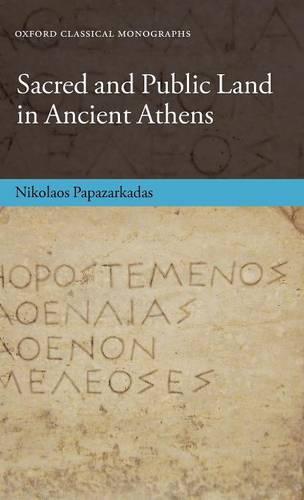
Sacred and Public Land in Ancient Athens

Author:   Nikolaos Papazarkadas (Assistant Professor of Classics, University of California, Berkeley.)
Publisher:   Oxford University Press
ISBN:  

9780199694006


Pages:   416
Publication Date:   13 October 2011
Format:   Hardback
Availability:   To order   Availability explained
Stock availability from the supplier is unknown. We will order it for you and ship this item to you once it is received by us.

Our Price $296.00 Quantity:  
Add to Cart

Share |

Sacred and Public Land in Ancient Athens


Overview

Full Product Details

Author:   Nikolaos Papazarkadas (Assistant Professor of Classics, University of California, Berkeley.)
Publisher:   Oxford University Press
Imprint:   Oxford University Press
Dimensions:   Width: 14.80cm , Height: 2.70cm , Length: 22.40cm
Weight:   0.636kg
ISBN:  

9780199694006


ISBN 10:   0199694001
Pages:   416
Publication Date:   13 October 2011
Audience:   College/higher education ,  Postgraduate, Research & Scholarly
Format:   Hardback
Publisher's Status:   Active
Availability:   To order   Availability explained
Stock availability from the supplier is unknown. We will order it for you and ship this item to you once it is received by us.

Table of Contents

1. INTRODUCTION: MODERN SCHOLARLY RESPONSES ; 2. THE ATHENIAN POLIS AS ADMINISTRATOR OF SACRED REALTY ; 2.1. A preliminary note ; 2.2. The landed wealth of Athena Polias and the Other Gods ; 2.3. The sacred property of the Eleusinian Goddesses: administrative aspects ; 2.4. The new polis-gods as proprietors of realty ; 2.5. Athenaion Politeia 47.4-5 and the leasing of sacred lands in Classical Athens ; 2.6. Investing sacred rentals ; 2.7. The economic significance of sacred rentals ; 3. THE CONSTITUTIONAL SUBUNITS OF ATHENS AS ADMINISTRATORS OF REALTY ; 3.1. The landed assets of the Attic tribes ; 3.1.i. The early phase ; 3.1.ii. The Athenian reacquisition of Oropos and the tribal land allotment ; 3.1.iii. Administration of phyle-properties and tribal economics ; 3.2. The real property of the Attic demes ; 3.2.i. Prolegomenon ; 3.2. ii. The mechanism of leasing ; 3.2.iii. Other forms of deme property administration ; 3.2.iv. Sales of lands controlled by demes ; 3.2.v. Rentals, deme economics, and religion ; 3.2.vi. Non-sacral deme property ; 3.2.vii. Lessees and purchasers of deme properties ; 3.2.viii. The territorial aspect of the Attic demes ; 3.2.ix. Epilogue ; 4. THE NON-CONSTITUTIONAL ASSOCIATIONS OF ATHENS AS ADMINISTRATORS OF REALTY ; 4.1. The real property of the Attic phratries ; 4.1.i. Types of phratric realty ; 4.1.ii. Exploitation of phratric realty ; 4.2. The Attic gene and their landed property ; 4.2.i. Introductory remark ; 4.2.ii. The landed wealth of the Salaminioi: a case-study ; 4.2.iii. Gentilician property: beyond the Salaminioi ; 4.2.iv. An overview ; 4.3. The real property of the Attic orgeones ; 4.3.i. Leasing out orgeonic property ; 4.3.ii. Sales of orgeonic property and the problem of alienation ; 4.3.iii. Lessees and purchasers of orgeonic property: some considerations ; 4.4. Other types of associations as property administrators ; 5. PUBLIC, NON-SACRED, REALTY IN ANCIENT ATHENS ; 5.1. The evidence ; 5.2. An interpretative analysis ; 6. CONSPECTUS ; APPENDICES ; Appendix I: The Sacred Orgas ; Appendix II: Moriai: Sacred arboriculture in Classical Athens ; Appendix III: IG II2 1593 revisited ; Appendix IV: The Theodoreion of the Prasieis ; Appendix V: The genos of the Pyrrhakidai ; Appendix VI: The split of the Salaminioi and the eponymous archon Phanomachos ; Appendix VII: Catalogue of lessees and guarantors of polis-controlled temene ; BIBLIOGRAPHY

Reviews

In this ambitious and often erudite book, Papazarkadas takes up the challenge of elucidating the origins and nature of land (as well as built structures) that fell under the control or ownership of various corporate entities, ranging from phratries and demes to the polis itself as a manager of land ascribed to one deity or another William S. Bubelis, Bryn Mawr Classical Review


In this ambitious and often erudite book, Papazarkadas takes up the challenge of elucidating the origins and nature of land (as well as built structures) that fell under the control or ownership of various corporate entities, ranging from phratries and demes to the polis itself as a manager of land ascribed to one deity or another William S. Bubelis, Bryn Mawr Classical Review [an] admirable book ... [Papazarkadas] showcases the relevant literary and lexicographic evidence ... he is scrupulous in not pushing this evidence, often fragmentary and/or problematic in other ways, further than it can properly go; unfailingly polite in assessing the work of his predecessors in the fi eld; and disarmingly modest when making his own (many and various) contributions to the topic. David Whitehead, Classical Review


Author Information

Nikolaos Papazarkadas has taught at Oxford and Trinity College Dublin, and is currently an Assistant Professor of Classics at the University of California at Berkeley. He specializes in Greek Epigraphy and has published extensively on inscriptions from Athens and the Cyclades.

Tab Content 6

Author Website:  

Countries Available

All regions
Latest Reading Guide

NOV RG 20252


Shopping Cart
Your cart is empty
Shopping cart
Mailing List