Overview
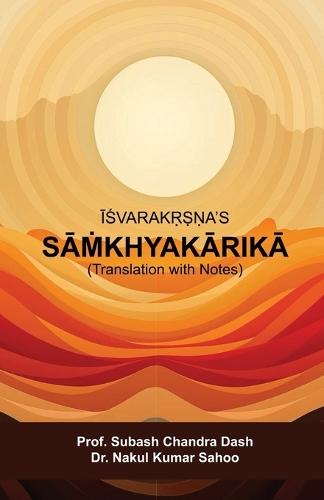
The Sāṁkhyakārikā of Īśvarakṛṣṇa stands as one of the most influential and enduring texts in the long tradition of Indian philosophical thought. Composed around the 4th to 5th A.D., it systematizes and codifies the doctrines of the classical Sāṁkhya School, presenting them in seventy ślokas yet profound aphorisms (kārikās). The text occupies a pivotal place in the intellectual history of India, bridging the speculative cosmologies of early Sāṁkhya with the later analytical developments of Yoga and Vedānta. The Kārikā begins with the most fundamental fact human life-the (duḥkhatraya). universality of suffering From this recognition arises the philosophical inquiry into its cessation, which the text regards as the ultimate human goal (niḥśreyasa). It argues that empirical and ritual remedies, though temporarily effective, fail to provide lasting relief because they lack ekānta (certainty) and atyanta (permanence). The inadequacy of worldly and Vedic means leads to the discovery of a higher path: discriminative knowledge, the insight that distinguishes between the eternal Puruṣa (pure consciousness) and the transient Prakṛti (material nature). Liberation (mokṣa) is achieved when this distinction is fully realized, resulting in the absolute cessation of suffering and the attainment of spiritual freedom. The philosophical method of the Sāṁkhyakārikā combines rigorous logical reasoning with psychological and metaphysical analysis. Its dualistic ontology, based on the twenty-five principles (tattvas), provides a comprehensive framework for explaining both the material and the conscious dimensions of existence. The text's precision and systematic structure established a model for subsequent Indian philosophical treatises and inspired a rich commentarial tradition, including Gauḍapāda's Bhāṣya, Vācaspati Miśra's Tattvakaumudī Vijñānabhikṣu's Sāṁkhyapravacanabhāṣya. This present book seeks to present the Sāṁkhyakārikā not merely as a historical artifact but as a living philosophical text that continues to address enduring questions about consciousness, causality and the human condition. By exploring its epistemological rigor, metaphysical depth, and soteriological vision, the work aims to demonstrate that the Sāṁkhyakārikā remains a vital contribution to the universal quest for knowledge and liberation. Hope this will be helpful for students and researchers towards better understanding.
Full Product Details
Author: Īśvarakṛṣṇa ,
Subash Chandra Dash ,
Nakul Kumar Sahoo
Publisher: Black Eagle Books
Imprint: Black Eagle Books
Dimensions:
Width: 14.00cm
, Height: 0.90cm
, Length: 21.60cm
Weight: 0.186kg
ISBN: 9781645608745
ISBN 10: 1645608743
Pages: 154
Publication Date: 18 May 2026
Audience:
General/trade
,
General
Format: Paperback
Publisher's Status: Active
Availability: Available To Order

We have confirmation that this item is in stock with the supplier. It will be ordered in for you and dispatched immediately.
Author Information
Īśvarakṛṣṇa was an Indian philosopher and sage. He was the author of Samkhyakarika (""Verses on Samkhya""), an account of the universe and its components (tattvas) according to the Samkhya school, one of the six schools of Hindu philosophy. Samkhyakarika is the earliest surviving authoritative text on classical Samkhya philosophy.Isvara Krishna in Kārikā describes himself as laying down the essential teachings of Kapila as taught to Āsuri and by Āsuri to Pañcaśikha to himself. Samkhyakarika includes distilled statements on epistemology, metaphysics and soteriology of the Samkhya school. The text also refers to an earlier work of Samkhya philosophy called Ṣaṣṭitantra (science of sixty topics) which is now lost. The text was imported and translated into Chinese about the middle of the 6th century CE. The records of Al Biruni, the Persian visitor to India in the early 11th century, suggests Samkhyakarika was an established and definitive text in India in his times. Prof. Subash Chandra Dash, formerly Head of the Department of Sanskrit, Hindi and Yoga, Utkal University, a double gold medalist from the Savitri Bai Phule University of Poona is an academician, Researcher and Creative author in Sanskrit, Odia, Hindi and English languages. He was an ICCR Chair Professor in Sanskrit at Mahendradatta University, Bali, Indonesia for two years. He taught Sanskrit and Indian Philosophy, Buddhism and Indian Culture to the students of Bali, Indonesia. He has worked in the subjects like Nyaya -Vaisesika Philosophy, Indian Theory of knowledge transmission, Yoga tradition & Philosophy, Pali and Buddhist literature Manuscriptology, Religious studies and Indian Culture. During his Academic tenure, he has served in the world-famous institutes like Vaidic Samsodhana Mandala, Pune, Centre of Advanced study in Sanskrit, Poona University and Deccan College and Research Institute Pune. He has authored 24 books and presented more than two hundred research papers in National and International Seminars and Conferences. Dr. Nakul Kumar Sahoo is a distinguished scholar of Indian philosophy. He completed his M.A., M.Phil. and Ph.D. degrees in Sanskrit from Utkal University, Bhubaneswar. A UGC-NET qualifier, his research interests include Nyaya-Vaisesika, Vedanta, Mimamsa, Sa?khya, Yoga and Vedic Studies. He has published twelve research articles and four book chapters in reputed national and international journals and is the author of three books. Dr. Sahoo has presented papers at more than twenty-five national and international seminars and conferences. He received the RUSA Fellowship during his doctoral research and has been honored with the Pratibha Kavi Sammana and Guru Gaurava Sammana for his outstanding contributions to Odia poetry, short stories and creative writing.