|
|
|||
|
||||
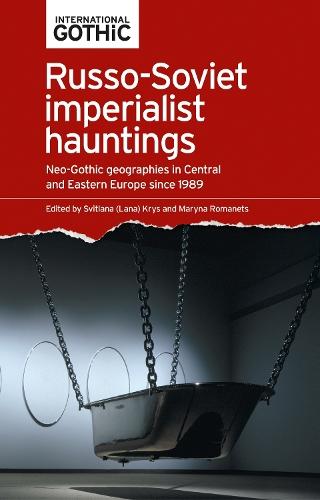
OverviewRusso-Soviet imperialist hauntings attempts to capture some of the ghosts of the colonial and totalitarian past that have been proliferating in international political and cultural landscapes after the collapse of the USSR. By conflating postcolonial, post-totalitarian, postcommunist, and Gothic discourses, it maps virtually untouched aspects of cultural decolonisation, focusing on unsettling 'hauntings' of unresolved memory traces of Russo-Soviet domination in the former Eastern Bloc countries and Soviet republics. Operating within a vast intertextual field of social, cultural, and ideological discourses, the volume enables a productive exchange across distinct (inter)disciplinary boundaries and represents a range of voices from Europe and North America. The contributors' diverse interests draw on transmedia (literature, visual arts, and film), transnational, and translingual (diasporic literature) approaches, providing insights into a variety of forms that the Gothic has taken in the (late) twentieth and twenty-first centuries, and demonstrating its consistent engagement with history, ideology, and politics. Full Product DetailsAuthor: Svitlana Krys , Maryna RomanetsPublisher: Manchester University Press Imprint: Manchester University Press Dimensions: Width: 21.60cm , Height: 2.40cm , Length: 13.80cm Weight: 0.644kg ISBN: 9781526191038ISBN 10: 1526191032 Pages: 428 Publication Date: 26 May 2026 Audience: College/higher education , Postgraduate, Research & Scholarly Format: Hardback Publisher's Status: Active Availability: Not yet available, will be POD This item is yet to be released. You can pre-order this item and we will dispatch it to you upon it's release. This is a print on demand item which is still yet to be released. Table of ContentsIntroduction to Russo-Soviet imperialist hauntings— Maryna Romanets I Art, performance, and film 1 The ghosts of the Soviet past in Natalia Vorozhbyt’s Take the Rubbish Out, Sasha— Oleksandra Wallo 2 Refusing to die: Neo-Gothic political fiction and post-Yugoslav cultural production— Mirjana Stošic3 Post-Soviet apocalypse in Gothic fiction and Gothic politics— Dina Khapaeva II Gender, identity, and sexuality 4 Haunted in desolation: Queering the post-Soviet Latvian Gothic— Karlis Verdinš 5 Sophia Andrukhovych’s Felix Austria:The postcolonial neo-Gothic and Ukraine’s search for itself— Vitaly Chernetsky 6 Feminism as a Gothic “thoughtcrime”: Contextualizing Alma by Izabela Filipiak— Dorota Filipczak III Spectral geographies, borderland, diaspora 7 The Eastern European monster reclaimed: Finding a voice in a postsocialist, postcolonial world— Eva R. Hudecova 8 Andriy Lyubka’s Carbide: Ukrainian democratic reforms through a dark glass— Svitlana (Lana) Krys 9 The madwoman on the farm: Witches in Ukrainian Canadian literature— Lindy Ledohowski IV (Post)communism, totalitarianism, historical trauma 10 Spectrality, necropolitics, and Gothic topography of the city in Nikolai Grozni’s Wunderkind— Roberto Adinolfi and Maryna Romanets 11 Institutional Gothic in the novels of Vladimir Sharov and Evgenii Vodolazkin— Muireann Maguire 12 The tomb of the reluctant tyrant: Uncanny imaginings of totalitarianism in Ismail Kadare’s The Pyramid — Adriana Raducanu Editors’ postscript: Cradle — Svitlana (Lana) Krysand Maryna Romanets Bibliography Index -- .ReviewsAuthor InformationSvitlana (Lana) Krys is Associate Professor of English and Comparative Literature at MacEwan University, Canada Maryna Romanets is Professor of English at the University of Northern British Columbia, Canada Tab Content 6Author Website:Countries AvailableAll regions |
||||